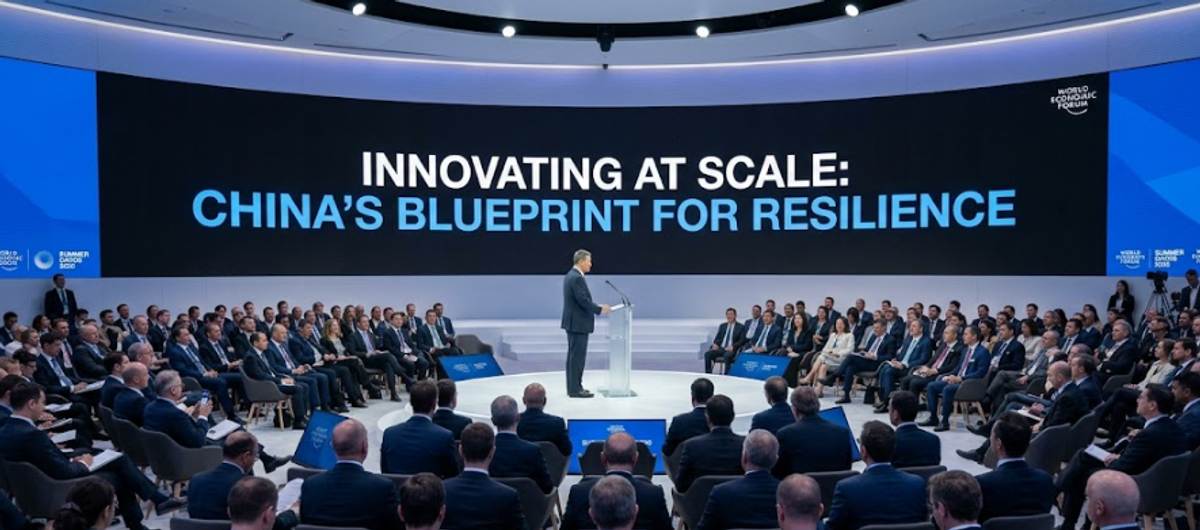
China made a significant public case this week. The 17th Annual Meeting of the New Champions - Summer Davos 2026 in Dalian - gave Premier Li Qiang a global platform, and the China Innovation-Led Economic Resilience Blueprint 2026 became the defining thread running through three days of sessions, speeches, and meetings between over 1,700 participants from more than 90 countries.
If you're trying to understand where China's economy is heading, and what it means for global business, the Dalian forum was a useful snapshot.
What the WEF's "Innovating at Scale" Theme Actually Signals
The WEF's chief economist survey set a sobering baseline: nearly nine in ten expect global growth to weaken over the next 12 months. Geopolitical risk, energy disruptions, fractured supply chains. None of that is going away soon.
And while more than 90% of those same economists expect AI adoption to accelerate, most believe the productivity gains will take longer to arrive than originally hoped.
That's the gap "Innovating at Scale" was designed to address. Mirek Dusek, WEF's managing director, put it plainly: we need to deploy tech advances "to benefit as many people, economies and societies as possible." Saying that is easy. Building the bridge between breakthrough and economic output is where most strategies fall apart.
China's pitch at Dalian was that it's already on the other side. That's a bold claim. But the data behind it is harder to dismiss than it used to be.
The China Innovation-Led Resilience 2026 Case Premier Li Qiang Made
Premier Li's opening plenary wasn't a feel-good address. It was an argument.
The core claim: China has built a self-reinforcing cycle where technological innovation drives industrial upgrading, which then drives the next wave of technological iteration. Not a one-time push - a loop. And the bottleneck Li identified isn't the laboratory. "The biggest hurdle to innovation," he said, "is not invention in the laboratory, but crossing the 'Darwinian Sea' between the laboratory and the marketplace."
That phrase lands because it's accurate. Most innovation dies in that crossing.
China answers that its scale of application scenarios shortens the distance dramatically. The new energy vehicle sector is the clearest proof. Breakthroughs in power batteries, new materials, and communications tech didn't come from government subsidies, Li argued. They came from having an ecosystem large enough to deploy, stress-test, and iterate at mass scale. That's the competitive edge. "Not government subsidies as some have speculated," he said directly.
Worth sitting with: this China innovation-led resilience 2026 argument is backed by data. High-tech manufacturing contributed up to 26% of China's overall industrial growth last year.
How China Integrates Innovation Into the Real Economy
Here's where it gets concrete.
Just before Summer Davos, the WEF announced 16 new additions to its Global Lighthouse Network - the benchmark recognition for manufacturers deploying advanced technology at the frontier. More than half are in China. Sectors include shipbuilding, smart logistics, and precision manufacturing. The Global Lighthouse Network advanced manufacturing China 2026 picture is no longer emerging. It's a fact.
On AI, the numbers are striking. Chinese large language models were consuming over 100 trillion tokens daily by the end of May 2026 - ranking among the highest in the world. Chinese LLM 100 trillion token consumption scale isn't a vanity metric. It reflects real deployment into enterprise workflows and consumer applications, not just lab experimentation.
Jonas Prising, CEO of ManpowerGroup, noticed this firsthand. "Attitudes to AI are much more positive in China," he said, pointing to how platforms like WeChat and Alipay have already normalized tech adoption into daily life - and how that baseline is now translating into professional AI use. Andrew Maynard of Arizona State University was blunter: "Innovation in China is advancing at a much faster pace than in Europe and North America."
The 15th Five-Year Plan's Pillar Industry Targets
The 15th Five-Year Plan (2026-2030), adopted earlier this year, does something a lot of national plans don't: it focuses as much on building application ecosystems as it does on frontier research. That's the China emerging pillar industries 15th Five-Year Plan logic - don't just invent, deploy.
Six sectors are getting priority: integrated circuits, the low-altitude economy, intelligent robots, and three others. Combined, they were approaching 6 trillion yuan (roughly $880 billion) in 2025. Target: surpass 10 trillion yuan by 2030.
China’s intelligent robots and low-altitude economy market size 2030 projections back that trajectory. The low-altitude economy in particular - commercial drones, urban air mobility, airborne logistics - is growing fast enough that regulatory frameworks are already struggling to keep pace. That's usually a sign the market is genuinely moving.
Yu Feng, president of Honeywell China, called the plan's specificity part of what makes China readable for foreign capital. He pointed to semiconductors, data centers, shipbuilding, and energy transition as sectors already showing strong growth momentum.
'China Opportunity 2.0': Why the Framing Shift Matters
Some observers have pushed a "China Shock 2.0" narrative - framing China's industrial and tech rise as a disruption to global markets. Premier Li challenged that directly at Dalian.
His alternative: China Opportunity 2.0 tech-powered economic interaction. After 40-plus years of reform and opening up, China's global integration has entered a new, tech-driven phase. It's a reframe that asks businesses to think of China as a partner ecosystem rather than just a competitive threat.
The investment data offers some support. In 2025, 14,000 new foreign-invested enterprises entered China's technology research and technical services sector - up 27.2% year on year. Capital tends to be honest about where it sees real opportunity.
"What China's technologies and products in emerging areas bring to the world are not shocks or threats, but opportunities and empowerment," Li said.
China's Q1 2026 GDP Growth - and What Comes Next
5% GDP growth year on year in Q1 2026. Stable momentum through Q2. Enterprise profits rising, consumer prices in moderate recovery. All of this inside a 140-trillion-yuan economy facing the same energy shortages and supply chain disruptions as everyone else.
Premier Li framed that as a "safe harbor" quality - a source of certainty when most global signals point the other direction. Yu Feng of Honeywell put it plainly: "While the world is marked by turbulence and uncertainty, China stands out as one of the few places characterized by a unified domestic market and a high degree of stability."
The Summer Davos 2026 China economic growth momentum story isn't just a Q1 headline. The real question is whether the China innovation-led economic resilience blueprint 2026 - the combination of scale manufacturing, AI deployment, emerging pillar industries, and sustained R&D investment - holds up as a durable growth model across the full five-year cycle. Based on Dalian, China's answer is yes. The next few years will be the actual test.