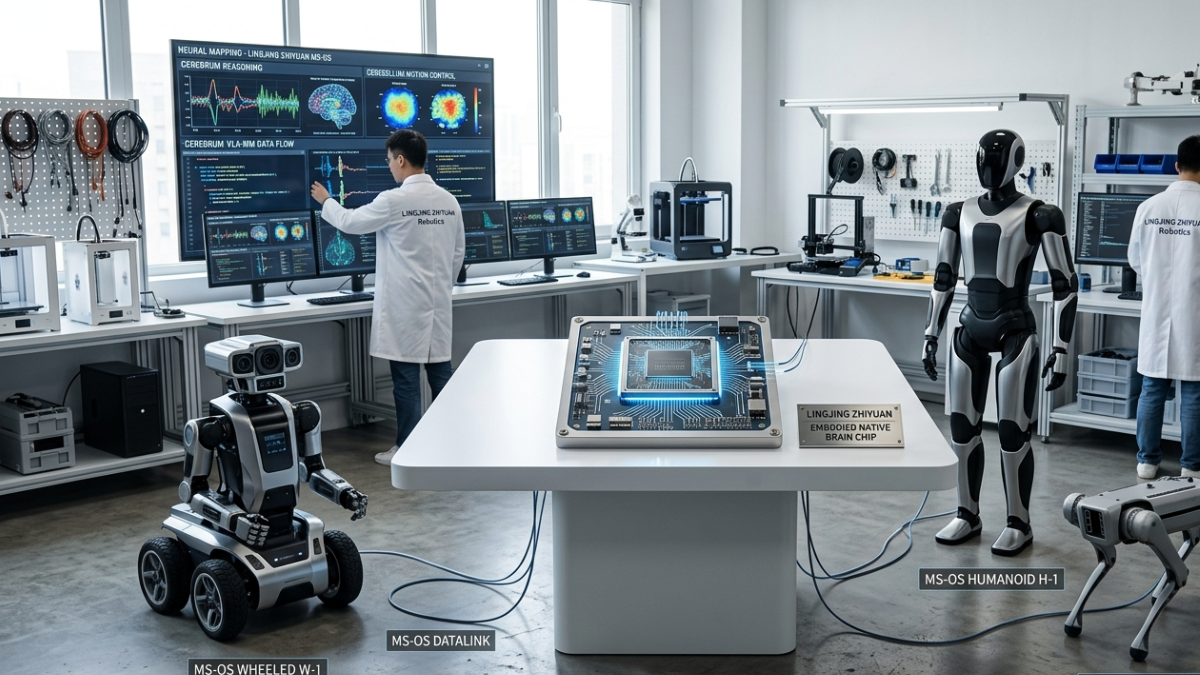
Something unusual happened in China's robotics sector this July. A company that had never issued a press release, never publicly disclosed funding plans, and had existed for barely a year quietly closed two consecutive financing rounds - both oversubscribed, both early, with dozens of top-tier investors cramming into due diligence windows shorter than two weeks.
That company is Lingjing Zhiyuan. And if you follow robotics infrastructure at all, you'll want to understand what they're building.
PE Daily exclusively reported that Lingjing Zhiyuan - incubated by the Shanghai Artificial Intelligence Research Institute - completed Angel and Angel+ rounds totaling over 100 million RMB. Matrix Partners China led both. State-owned Assets of Minhang District, Shanghai followed on strategically. The company's stated mission: build a full-stack embodied intelligence computing infrastructure native operating system - not an algorithm layer sitting on commodity hardware, but the foundational computing stack that everything else depends on.
They want to be the Android of the robotics era.
Why Capital Is Moving to Embodied Intelligence Computing Infrastructure Providers
The Lingjing Zhiyuan angel round funding Matrix Partners China led isn't random. It's a calculated bet on where value accumulates next.
Financing windows for major robot body manufacturers - Unitree, Agibot, Galaxy Universal - have largely closed. More than 20 domestic embodied companies now carry valuations above 10 billion RMB, most heading into IPO processes. Investors who missed the hardware wave are moving upstream: toward components, computing layers, and infrastructure. Robotics compute scaling has become one of the most contested spaces in the entire sector, and embodied intelligence computing infrastructure has emerged as a strategic layer everyone wants exposure to before it's priced out.
Matrix Partners China already holds positions across the value chain - Unitree Robotics, Galaxy Universal, Muxi, Minimax - all entering a harvest phase. Doubling down by taking the majority of shares across both rounds in Lingjing Zhiyuan isn't a hedge. It's a conviction call.
Why Traditional CPU and GPU Architectures Fail in Real-Time Motion Control
Here's the gap most robotics coverage misses. The problem isn't the algorithm. It's the compute architecture underneath it.
In today's robots, the "cerebrum" for cognitive decision-making and the "cerebellum" for motion control are typically built and run on separate systems. Standard compute stacks - the same kind found in an autonomous driving chip stack - can't deliver the millisecond-level closed-loop control that physical robot motion demands. Perception preprocessing lags. Motion control responses delay. Hardware and software scheduling lose sync.
Robots jitter. They hesitate. They fail under sustained real-world conditions.
This is exactly why Vision Language Action (VLA) model real world deployment has been so frustrating for the industry. Models perform well in controlled demos. They fall apart when the physical world moves faster than the architecture can respond. The bottleneck isn't intelligence - it's infrastructure.
Building the Native Operating System for Embodied Robots: What Lingjing Zhiyuan Actually Made
Lingjing Zhiyuan's answer isn't to tweak the model. It's to rebuild the entire computing platform.
The company has pioneered a super heterogeneous architecture based on "physical integration, logical separation." Their cerebrum and cerebellum integrated robot architecture 2026 puts both cognitive reasoning and real-time motion control on a single physical hardware platform, while maintaining independent iteration flexibility for each layer. Non-inferential instinctive responses are built directly into the control loop - reducing dependence on large general-purpose models for split-second physical tasks. Motion jitter drops. Response delays shrink. Long-term operation stabilizes.
Their MS OS - the native system for embodied intelligence robots - functions the way CUDA does for NVIDIA. It's the compatibility and orchestration layer that makes all hardware talk to all software, across humanoid, wheeled, and quadruped robot forms. It's fully domestically developed, making it a domestic, fully controllable hardware-software integrated solution with both commercial and national strategic value.
Heterogeneous computing platforms of this kind are increasingly a policy priority, not just a product choice. Their hardware offering - the Dvorak heterogeneous hardware computing solution - supports both mature overseas chip ecosystems and fully localized development stacks, giving customers flexibility without sacrificing domestic control.
The FPGA prototype has already completed full-process verification. For anyone tracking AI chip architecture advances in this space, the company plans to tape out a dedicated embodied native chip in 2027. Once that's done, Lingjing Zhiyuan will have a fully closed-loop domestic stack: chips, OS, models. It's worth noting how much supercomputing architecture design decisions at scale echo the same hardware-software interdependence problems Lingjing Zhiyuan is solving at the robot level.
The Team Behind It
Both co-founders bring over 20 years of industrial experience.
Sun Bo, CEO, holds AI degrees from Shanghai Jiao Tong University and a PhD from Zhejiang University. He previously co-founded JITI Measurement & Control, scaling it to over 1 billion RMB in annual revenue with a Hong Kong IPO in progress. Co-founder Xu Haijiang is the founder of BlueRidge Technology and a former core communications expert at Ericsson China R&D.
The Technical Committee includes Song Haitao - President of the Shanghai Artificial Intelligence Research Institute and co-leader of the National Information Technology Standardization Committee's humanoid robot working group - alongside Chief Scientist Yan Weixin. For a company less than two years old, that's an unusually strong anchor to national research infrastructure, and it translates directly into access to policy support, scientific resources, and state-owned capital that most early-stage startups can't touch.
200+ Embodied Intelligence Hardware Orders in Under a Year
Honestly, this is the part that stands out most.
Within 12 months, Lingjing Zhiyuan connected with over 300 embodied system manufacturers - more than 70% of the domestic market. Over 200 have moved past evaluation and placed small-batch production orders. Some leading customers are ordering more than 1,000 units each.
The customer list includes Leju, StarMap, Parsini, Zhifang, and Fourier Intelligence, covering both humanoid and quadruped robot forms. As humanoid robot identity systems and regulatory frameworks develop around physical robots, established supplier relationships become significantly harder to displace.
The B2B procurement framework for humanoid and quadruped robot brains is still being written. Lingjing Zhiyuan is writing some of the first real templates.
The Challenges - Because There Are Real Ones
Let's not gloss over the constraints.
2026 is being called the "first year of mass production" for robotics, with industry forecasts of 50,000 to 100,000 units shipped annually. That's still a limited market ceiling for any infrastructure provider. Physical AI deployment at genuine commercial scale is still years away from becoming mainstream. Full-stack chip-to-OS R&D requires sustained capital well before revenue validates the investment.
Building intelligent body AI agents at the physical infrastructure layer is also technically brutal - every new robot form factor requires adaptation, and edge cases compound fast. The company will need to keep raising through the 2027 chip tape-out and beyond.
That said, engineering depth and hardware-software co-optimization data are assets that compound. The parallels to how edge AI computing centers build operational data advantages - or how orbital data center constraints force the same efficiency-first design thinking - show that physical computing constraints, wherever they appear, tend to favor whoever builds the deepest engineering foundation first.
Once mass production scales, Lingjing Zhiyuan's accumulated frontline experience, customer data, and custom silicon will be very hard to replicate quickly.
The Infrastructure Layer Is Where the Robotics Decade Gets Decided
The robotics space has no shortage of companies building arms and legs. What it's been missing is someone serious about the nervous system.
Lingjing Zhiyuan's embodied intelligence computing infrastructure native operating system isn't a retrofit on existing GPU architectures - it's a ground-up rebuild of how robot brains compute, with custom hardware to match. That's a harder path, a slower path, and a more capital-intensive path than building application models on top of commodity compute.
But the companies that control the native computing infrastructure when robotics hits genuine mass production will be far harder to displace than those that only control the hardware casing or the AI model sitting above it. Matrix Partners China has seen this playbook before - with Unitree, with Galaxy Universal. Now they're betting on the layer below all of that.
Given the track record, that signal is worth taking seriously.