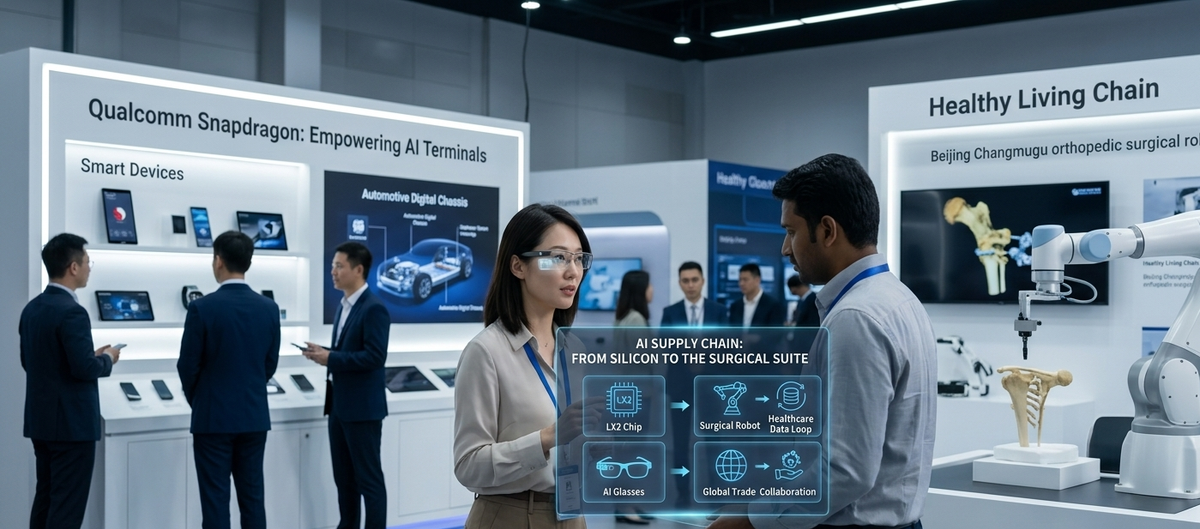
AI isn't sitting in a lab anymore. It's inside surgical suites, elderly care homes, and the earpiece of a pair of glasses you can buy today. And if you want a clear picture of the AI supply chain integration trends 2026 is producing, the 4th China International Supply Chain Promotion Expo in Beijing is one of the better places to look.
What made this expo different from a typical tech showcase? Most of it wasn't prototype territory. The surgical robots are already in hospitals. The radar monitoring systems are already running in care facilities. The AI wearables are already shipping. The gap between "this is what AI can do" and "this is what AI is doing" closed a lot this year, and that's what makes the 4th China International Supply Chain Promotion Expo highlights genuinely worth paying attention to.
Here's a walkthrough of what stood out - and what it actually means for how we work, age, and live.
AI Glasses and the Language Barrier That Supply Chains Keep Running Into
Cross-language communication is a genuine bottleneck in global industrial collaboration. When suppliers, logistics partners, and buyers can't communicate clearly, deals slow down. Errors creep in. Relationships strain. It's an unglamorous problem, but a real one.
iFlytek came to the expo with a direct answer. Their iFlytek AI glasses mobile office assistant delivers real-time translation and intelligent prompting across nearly any scenario - not just pre-set phrases or tourist vocabulary, but live, full-context multilingual conversation. Dong Bin, Deputy General Manager of iFlytek's brand marketing center, described the product as "not only a portable translation tool, but also a mobile office AI assistant."
The tech behind it runs on iFlytek's deep investment in intelligent voice recognition and AI inference, pulling together a full-stack AI translation system for commerce that covers core algorithms, terminal hardware, and software services in one stack. Consumer and commercial use cases are handled by the same product family.
AI glasses real-time translation 2026 would have sounded ambitious three years ago. Right now, it's a shipping feature solving a real supply chain problem. That shift matters for AI supply chain expo cross-language communication use cases across manufacturing, logistics, and trade - not just the consumer novelty angle.
Qualcomm, Snapdragon, and the Chip Layer Running Under Everything
Smart glasses need chips. Smart cars with digital chassis need chips. Smart bracelets, enterprise terminals, factory sensors - they all need chips designed specifically for AI workloads. That upstream dependency is easy to overlook when coverage focuses on end products, but it's where a big piece of the AI supply chain integration trends 2026 story actually lives.
Qualcomm has shown up at the Supply Chain Expo four years in a row, and that consistency says something. Qualcomm Snapdragon AI platform ecosystem updates were central to this year's presence, with Senior Vice President Qian Kun describing the event as a platform for "in-depth discussions with various partners on cutting-edge technology trends."
The argument Qualcomm keeps making - and keeps demonstrating - is that smart terminals and AI chip demand growth doesn't happen in a vacuum. Every digital chassis smart car Qualcomm Snapdragon integration, every B2B smart terminal hardware ecosystem product, every wearable AI device traces back to chip-level infrastructure doing the hard work quietly. That upstream-to-downstream relationship is exactly what the Supply Chain Expo is designed to make visible.
A Surgical Robot That Gets Knee Replacements Done in 30 Minutes
The Healthy Living Chain Exhibition Area brought together 169 companies covering health across the entire human lifespan. The product that attracted the most foot traffic was a domestically developed orthopedic surgical robot from Beijing Changmugu Medical Technology, and it's not hard to see why.
The workflow: after receiving a patient's CT scan, the system completes automated 3D bone reconstruction in 5 to 10 minutes. It then precisely calculates prosthesis size, placement, and angle. From there, the robotic arm - operating at sub-millimeter precision, robotic arm knee replacement standards - carries out the procedure. Total surgery time: roughly 30 minutes. The previous standard was two to three hours.
That's not incremental improvement. That's a qualitatively different procedure.
What's equally notable is the supply chain story behind the robot. Li Mengjie, the company's marketing manager, explained that product updates move from upstream R&D needs through midstream assembly to hospital deployment in about two weeks. That kind of speed is only possible with a tight two-way closed-loop industrial chain healthcare model - where downstream clinical feedback flows back to upstream developers quickly enough to actually change development priorities. The domestically developed orthopedic surgical robot’s precision, which this system delivers, is already in regular clinical use at multiple Beijing hospitals.
Radar That Watches Without Watching
Aging populations are one of the defining pressures of the next decade. Traditional monitoring tech - cameras, wearables, call buttons - tends to work reasonably well and generate consistent pushback from residents and families who don't want to feel surveilled. It's a real adoption problem.
General Technology Healthcare Company's approach sidesteps it entirely. Their millimeter wave radar smart elderly care system tracks vital signs - sleep status, time in and out of bed, heart rate anomalies, fall risk - without capturing any visual image at all. The privacy safe vital signs monitoring radar tech angle isn't just ethical positioning; it's what makes facilities comfortable adopting it in the first place.
Ma Tianxue, a staff member at General Technology's Meikang Senior Apartment, described how the data feeds directly to a nursing station display in real time, giving duty staff continuous awareness of every resident's status across the whole floor. 24 hours a day, no cameras, no privacy complaints.
The General Technology Healthcare smart elderly care solution is already deployed across multiple care institutions. It's live, it's working, and the feedback from facilities has been positive enough that expansion is ongoing.
What This Year's AI Supply Chain Integration Trends Are Actually Saying
Pull back and look at the pattern across all of these products, and something becomes clear. The AI supply chain integration trends 2026 isn't one story - it's several converging ones. AI glasses are compressing language barriers in global trade. Chip ecosystems are enabling an entire generation of smart terminals. Surgical robots are collapsing procedure times through precision automation. Radar systems are making elderly care safer without sacrificing resident dignity.
The latest innovations at Supply Chain Expo Beijing are useful to track precisely because they show how AI is transforming daily life supply chains - not in abstract terms, but in deployed, operational, real-world terms. Shorter iteration cycles. Tighter upstream-downstream feedback loops. Products that are already in clinical rotation or care facility deployment.
If you're trying to gauge where AI hardware integration in industrial chains is actually landing right now, not where it's being pitched, this expo is one of the more honest signals available. The demos are working. The hospitals are using the robots. The care homes are reading the radar data. That's where we are in 2026.