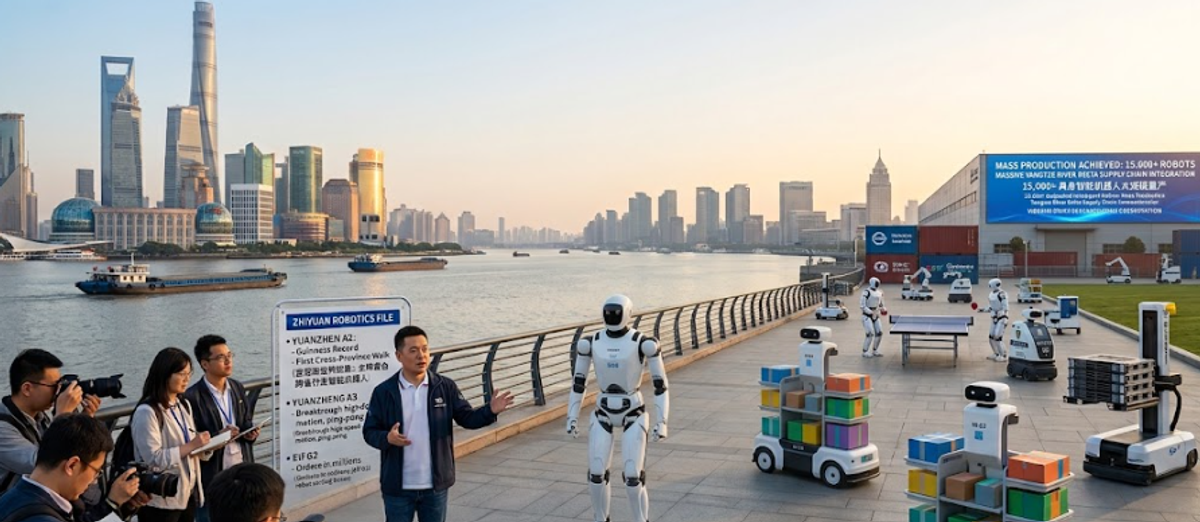
Standing on the banks of the Huangpu River, watching a humanoid robot nail a backflip isn't something you'd expect on a regular afternoon. But that's exactly what a group of journalists witnessed at Zhiyuan Innovation (Shanghai) Technology Co., Ltd. recently. Zhiyuan Robotics ‘ general-purpose embodied robot mass production has become one of the more remarkable industrial stories coming out of China in 2026 - and the company just rolled its 15,000th unit off the production line. To understand why that number matters, you have to go back to where it all started.
From 6 Prototypes to 15,000: Inside the Production Ramp
Six. That was Zhiyuan's entire robot inventory in 2023. Not 6,000. Just six prototypes running in a lab.
By March 2026, they'd crossed 10,000 units. Less than three months later, they broke through 15,000. That's the kind of production ramp that makes seasoned manufacturing engineers stop and pay attention.
Zhan Kun, Senior Vice President of Zhiyuan Supply Chain, confirmed these numbers directly to reporters from the "Vibrant China Research Tour" journalist group. His point wasn't just the headline figure - it was about what made the pace possible. As China's robot race goes public, investors are increasingly focused on which companies can actually move from showcase to scale. Zhiyuan's trajectory puts it squarely in that conversation.
"Delivery immediately upon production" used to be a marketing phrase. Now it's an operational fact. The Jingling G2 embodied robot Longcheer Technology factory deployment is the clearest proof of this: that robot rolled off the line and went straight into active use at Shanghai Longcheer Technology Co., Ltd., handling high-precision testing tasks including multimedia interface testing, radiated stray emission testing, and coupling testing. Success rate above 99%.
That's not a demo. That's a live production line.
Why the Yangtze River Delta Is the Real Competitive Edge
Here's the question worth sitting with: how does a robotics company go from prototype to 15,000 units without getting strangled by supply chain delays?
Geography, mostly.
Nearly 90% of Zhiyuan's product components can be sourced locally within the Yangtze River Delta. Some core parts can be delivered within hours of being requested. That kind of responsiveness is genuinely rare - and it's a structural advantage competitors outside the region can't easily copy.
The Yangtze River Delta embodied intelligence industry cluster didn't happen by accident. It's the product of years of deliberate industrial policy, supplier development, and infrastructure investment. Zhiyuan's A Chain standardized system was built specifically to take advantage of this density, coordinating the A Chain collaborative ecosystem across upstream and downstream partners to reduce lead times while maintaining quality at volume.
Think about what that means in practice. When a design change is needed mid-production run, adjusted components can arrive the same day. That's not just convenient - it's the difference between shipping on schedule and missing your window entirely.
For context on how supply chain thinking is evolving beyond robotics, the AI supply chain integration trends shaping 2026 show just how central this infrastructure layer has become to competitive differentiation.
Meet the Robots: Three Families, One Goal
Yao Maoqing, partner and president of the Embodied Robotics Business Unit, described a clear product lineup: three robot families - Yuanzheng, Lingxi, and Elf - designed to cover industrial handling, logistics sorting, and security inspection.
The Yuanzheng A2 is the headline product. The Yuanzheng A2 Guinness World Record humanoid robot holds the distinction of being the world's first humanoid robot to walk across provinces - a sustained navigation challenge that demonstrates real-world mobility at a level most competitors haven't matched.
Then there's the Yuanzheng A3. It plays autonomous ping-pong, which sounds like a party trick until you realize that the high-speed dynamic motion technology of the Yuanzheng A3 robot addresses one of the harder unsolved problems in robotics: real-time reaction to fast, physically unpredictable inputs. The Elf G2 - whose multimedia interface testing success rate Zhiyuan specifically highlighted - secured orders worth hundreds of millions of yuan at launch.
Not bad for products that didn't exist two years ago.
Each of these feeds into a broader push toward physical AI solutions for business that's reshaping how manufacturers think about automation beyond traditional robotics arms.
Shanghai's Policy Machine Is Backing This Hard
None of this happens in isolation. Shanghai has been deliberately constructing the conditions for general-purpose embodied robot scale manufacturing in China 2026 to become an operational reality, not a plan.
The Shanghai 15th Five-Year Plan names humanoid robots as one of ten core industrial clusters worth 100 billion yuan each - sitting alongside integrated circuits, biomedicine, and artificial intelligence. The Shanghai Embodied Intelligent Industry Implementation Plan followed, with task solicitations and rewards up to 10 million yuan for scenario-specific development including medical and nursing robots. Ongoing Shanghai "Artificial Intelligence+" action projects provide special funding to push robots into real production environments.
That policy density has a specific practical effect: it de-risks adoption for enterprise customers. When a factory has institutional support to trial a robot deployment, sales cycles get shorter. That directly benefits companies like Zhiyuan.
A similar dynamic is playing out elsewhere. The intelligent body investment wave coming out of Wuhan shows how regional governments are actively competing to host the next generation of embodied AI companies. The competition isn't just corporate. It's geographic.
From Demonstrations to Routine Operations
This is the shift that gets underreported. Robots performing at a media showcase is one thing. Robots hitting 99%+ success rates on high-precision testing tasks on consumer electronics production lines - that's an entirely different category.
Ai Wen, Project Director of the Genie Business Department, put it plainly: "delivery immediately upon production and immediate deployment upon leaving the factory." That's no longer an aspiration. Deployments like the SAIC GM Ultium Super Factory Buick ZhiJing E7 robotics integration show the machines are in factories doing actual work.
Chinese AI companies reshaping competition is no longer a projection - it's current events. The factory floor data that Zhiyuan and companies like it are accumulating through real deployments is something competitors without active installations simply cannot match right now.
What the 15,000 Milestone Actually Signals
Scale changes the game in ways that don't show up in unit count headlines. At 15,000 robots, you're building supplier relationships that compound. You're accumulating deployment data that feeds directly back into engineering. You're establishing the service and logistics infrastructure that enterprise customers require before committing to large contracts.
The humanoid robot digital ID rule China introduced this year adds another layer: regulators are beginning to treat humanoid robots as production assets, not experimental hardware. That's the kind of framework shift that typically precedes broader commercial adoption.
The macro context points the same direction. China AI sector explosive growth signals from state leadership and China’s manufacturing expansion signals in PMI data both converge on the same opportunity. Embodied robotics sits at the intersection of both trends.
There's also a larger innovation-led economic resilience blueprint at work - one that treats robotics as a near-term industrial pillar rather than a distant moonshot. On the talent pipeline side, intelligent manufacturing AI competition programs like Jingkai's national AI agent competition are producing the engineers these companies need to keep scaling.
CISCE AI exhibition highlights this year showed major global players paying close attention to what Chinese robotics companies are doing. And MWC Shanghai AI tech signals confirm how quickly the boundaries between mobile computing, edge AI, and physical robotics are dissolving.
Zhiyuan Robotics ‘ general-purpose embodied robot mass production - growing from six prototypes to 15,000 units in under three years - isn't just a milestone for one company. It's a proof point for an entire industry's readiness to move from lab floors to factory floors at real commercial scale. Most of Zhiyuan's international competitors are still working on their first thousand.