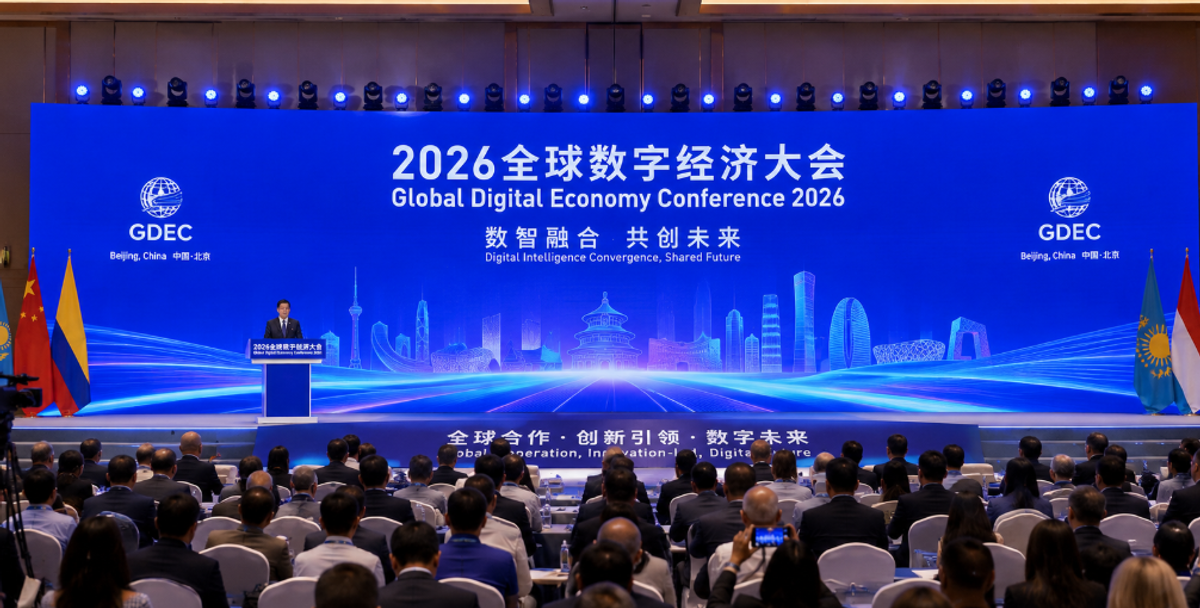
The 2026 Global Digital Economy Conference Beijing opened this week with a message that's harder to argue with than most conference themes: digital technology has to actually work for people. Tangible to residents. Useful for businesses. Accessible to society as a whole - not just those already comfortable online.
Minister-level officials from Kazakhstan, Colombia, and Chad attended alongside corporate executives and scholars drawn from over 200 countries. That geographic spread is worth pausing on. It tells you this isn't a Beijing tech showcase in multilateral clothing - it's become a working global platform for digital urban policy, and the attendance list reflects that.
What the 2026 Global Digital Economy Conference Beijing Released on Day One
Two major publications dropped at the opening ceremony, and both carry real policy weight.
The Global Digital Economy City Alliance report 2026 examines how digital technologies and cities shape each other. Its core argument is deceptively simple: cities can't run digital transformation as an internal government IT project. If residents can't feel the difference and businesses can't operate more efficiently, the transformation hasn't actually happened. Liu Weiliang, deputy director of the Beijing Economic and Information Bureau, put it plainly - digital technology must be tangible.
The second release is the Global Digital Economy Lighthouse Casebook, co-published by the International Telecommunication Union (ITU), the International Trade Centre (ITC), and the Global Digital Economy City Alliance. Thirteen real-world case studies. Six thematic areas. Cities that have already built something worth replicating - rather than just cities with impressive strategy documents.
For the latest AI developments underpinning these urban deployments, the casebook draws on technology already in active use across Asia and Europe.
Understanding the Thirteen Lighthouse Cases in the Global Digital Economy Casebook 2026
This is where the conference gets concrete.
The cities featured - Beijing, Jakarta, Madrid, Istanbul, and others - cover six areas: collaborative digital urban governance, inclusive public digital services, climate-resilient urban infrastructure, digitally enabled livelihood improvement, low-carbon smart mobility, and digital inclusion for vulnerable groups.
A few worth calling out specifically:
Jakarta's Jakin Super App consolidates city services into a single platform. Indonesia's digital economy push has been aggressive, and this case captures what's actually working at the user level.
Madrid's Digital Capital model shows a European city integrating data across departments to reduce bureaucratic friction. Not glamorous - but it's the kind of unglamorous work that scales.
Beijing's Jingban smart government platform is the local flagship for collaborative digital urban governance, connecting agencies, streamlining approvals, and increasingly cited as a reference architecture for cities building toward similar integration.
One case worth your attention: the digital twin deployment at Longfu Temple in Beijing, where digital twin technology integrates online and offline consumption across a historic site. Small in scale, but it shows smart city tools don't have to be purely administrative.
Curious about how Beijing AI and space computing feeds into this broader picture? That context helps explain why Beijing appears so prominently across the casebook.
Why "Digital Friendliness" Is More Than a Buzzword
Most smart city frameworks focus on infrastructure - fiber, sensors, platforms. The "building a digital friendly city" framing does something different. It asks whether the people who most need public services can actually access them digitally.
That means elderly residents navigating e-government portals. Migrants using city services in a second language. People with disabilities who need interfaces designed for them, not designed around them. Inclusive intelligence is the goal: systems that work across the full range of residents, not just the digitally fluent.
Honestly, this framing is long overdue. Why digital inclusion for vulnerable groups is crucial for sustainable city development keeps surfacing in global policy discussions, and the GDEC's emphasis on it this year signals the conversation is moving from awareness into actual implementation standards.
But there's a gap worth naming. Calling inclusion a priority and building genuinely inclusive systems are different things. The lighthouse cases give cities real models to follow, which is more useful than another framework document.
Inside the GDEC 2026 Program: AI, Humanoid Robots, and a City-Wide Experience
The conference runs through Sunday. Beyond the opening publications, the schedule covers industrial digitalization and AI as core tracks, digital talent development, and the Global Dialogue on Digital Friendly Cities forum.
The 2026 Digital Economy Industry Expo running alongside is the hardware angle. Beijing has been positioning Yizhuang as its flagship intelligent manufacturing zone, and the humanoid robot industry tour is drawing international delegations who want direct, floor-level exposure to China's intelligent manufacturing pipeline - not just a stage demo. It's one of the first launch and debut platforms for humanoid robots in Beijing, and the access is unusual for a conference setting.
The AIGC for Future Global Challenge competition is drawing interest too. If you're tracking the global startup ecosystem and want a read on where applied AI is heading for urban problems, the results are worth following. The immersive format - combining conferences, exhibitions, competitions, and live shows - makes this feel like more than a standard policy forum.
The Chaoyang Culture Sports Digital Intelligence Integration Tour route takes delegates through a real neighborhood to see how digital infrastructure plays out at ground level. Not every summit includes a field trip.
Why the 2026 GDEC Beijing Matters for Cities Outside China
The conference is explicitly framing itself around global digital governance, not Chinese tech promotion. The policy track is built around responding to core objectives of the Global Digital Compact 2026, which gives its outputs legitimacy in UN-adjacent policy circles.
Cross-border delegations aren't attending for optics. They're using the conference for resource connectivity - linking city governments with vendors, research institutions, and financing pipelines. That function matters more as cities move from digital strategies to actual procurement decisions.
China's open-source AI rise is reshaping which tools cities in the Global South actually have access to. China-UK economic cooperation signals that Western economies are recalibrating their engagement. And at the hardware level, BYD's self-driving chip and China's chip market ambitions are building the silicon foundation that low-carbon smart mobility solutions will run on.
Since 2021, GDEC has drawn over 10,000 companies and 150,000 participants, with five hundred technological outcomes published by the organizing committee to date. Those numbers tell you the event has built genuine gravity. GlobalByte News will be tracking developments as the conference continues through Sunday.
For broader tech and science coverage on what these announcements mean for global urban infrastructure, the weeks after the conference close are usually when the real-world impact comes into view.