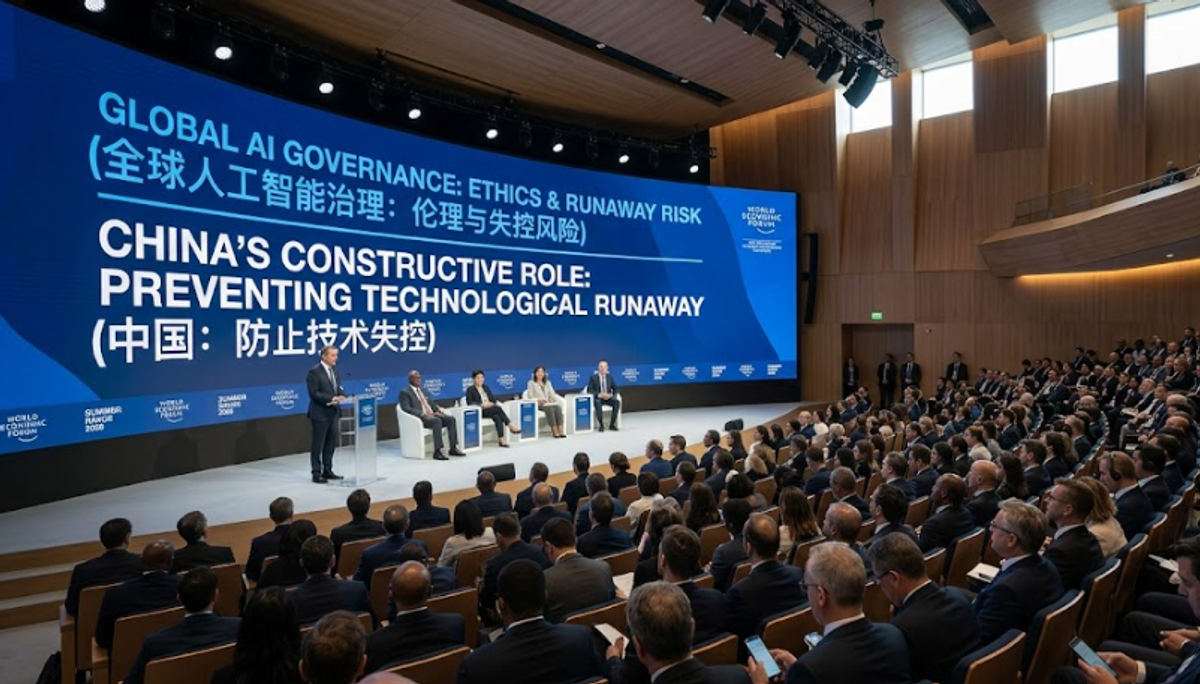
Something happened at the 17th Annual Meeting of the New Champions in Dalian that deserves more attention than it got. On June 24, Chinese Premier Li Qiang addressed the opening plenary of Summer Davos and made China's position on global governance on artificial intelligence 2026 unusually clear. No diplomatic hedging. No vague gestures toward cooperation. He committed China to working with other parties to build institutional frameworks, strengthen regulatory effectiveness, and - critically - forcefully defuse the risks that unchecked AI development is already creating.
If you follow AI policy at all, you know how rare that kind of directness is from a major world leader on this topic.
What Li Qiang Said at Summer Davos (and Why the Wording Matters)
The Premier Li Qiang Summer Davos speech on artificial intelligence hit three distinct notes. China will participate in global AI governance in a "responsible and constructive" manner. It will work to strengthen institutional frameworks and rules. And it will push to enhance regulatory effectiveness and "forcefully defuse" potential risks.
That last phrase is doing a lot of work.
"Forcefully defuse" isn't diplomatic filler. It signals intent to act, not just observe. When you pair that with an explicit warning that governance failure could produce "severe consequences," you're looking at a government that's positioning itself as part of the solution - not just the conversation.
The choice of venue matters too. The 17th Annual Meeting of the New Champions Dalian AI updates drew global business leaders and policymakers precisely for its cross-border scope. Saying this at Summer Davos - rather than in a bilateral meeting or a domestic policy briefing - was deliberate. China was speaking to a global audience, on purpose.
The Risk No One Wants to Name Directly
Here's what makes Li Qiang's remarks stand out from standard governance-speak: he named the actual problems.
Technological runaway. Ethical lapses.
Two phrases that rarely survive official drafting without getting softened into abstraction. Technological runaway risks in machine learning are real - and getting harder to dismiss as AI systems scale faster than most forecasts predicted even 18 months ago. Ethical lapses aren't hypothetical scenarios anymore. Biased decision-making systems, deepfake misuse, and autonomous tools making consequential calls without meaningful human review - responsible AI deployment and ethical lapses prevention has shifted from a nice-to-have to a genuine operational concern, and the shift happened quietly.
Li Qiang's core argument is this: AI has accelerated innovation efficiency faster than governance can keep pace. If that gap widens, the consequences won't arrive gradually. They'll be severe. Most officials hint at this - he said it plainly, in front of a global audience.
China's Role in Global Governance on Artificial Intelligence 2026
China's constructive role in global AI rules gets surprisingly little coverage outside specialist policy circles. The dominant narrative - at least in Western media - tends to cast China as either over-restrictive domestically or strategically opaque internationally.
The picture that emerged from Summer Davos 2026 is more layered than that. China has already built one of the more detailed domestic AI governance architectures anywhere (covering generative AI services, algorithmic recommendations, and AI-generated content labeling), and it's now signaling readiness to contribute that framework thinking at the international level.
From a purely practical standpoint, that matters for enterprises navigating cross-border AI regulatory policy. Rules built without China's input will have real gaps. Rules built with its input will at least account for how one of the world's largest AI development ecosystems actually operates. You don't have to endorse every element of China's domestic approach to see that its participation in building global rules and institutional frameworks for AI is better than its absence.
Global Governance on Artificial Intelligence 2026: What Enterprises Should Do Now
The Summer Davos 2026 artificial intelligence policy highlights point in one direction - the window of regulatory ambiguity is closing.
B2B AI ethics compliance trends after Summer Davos are already shifting. More enterprises are asking not just "does this AI system perform?" but "can we defend this system to regulators in multiple jurisdictions at once?" That's a fundamentally different question, and it requires a different internal posture.
AI risk mitigation strategies for tech enterprises in 2026 need to account for a world where China, the EU, and the US are all moving toward enforceable governance frameworks - not just advisory guidelines. Responsible AI development guidelines from bodies like the World Economic Forum are useful inputs. But what gets codified into binding regulation is what you'll actually have to comply with.
Three things worth doing now:
- Map your AI deployments against existing frameworks in each jurisdiction you operate in (EU AI Act, China's generative AI rules, US executive orders at a minimum)
- Identify your highest-risk use cases and document your governance processes for them
- Don't wait for the final regulatory text - the directional trends are clear enough to act on
The gap between "ethically aspirational" and "legally required" is closing. Faster than most compliance teams are ready for.
Where This All Goes From Here
The global governance on artificial intelligence 2026 landscape is still forming. No single framework dominates. No binding international treaty exists. What you have right now is a patchwork - national and regional rules, voluntary guidelines, and forum-level commitments like the one Li Qiang made in Dalian.
But commitments made at Summer Davos don't disappear quietly. They create expectations, among trading partners, among investors, among the enterprises that need stable cross-border rules to build on.
China's pledge to participate constructively in shaping a responsible global governance framework for generative AI and broader AI systems is a signal worth taking seriously. Not because a speech guarantees action. But because the direction of travel is becoming hard to deny - and the question for enterprises isn't whether stronger global AI governance is coming. It's whether you'll be ready when it arrives.