Summary
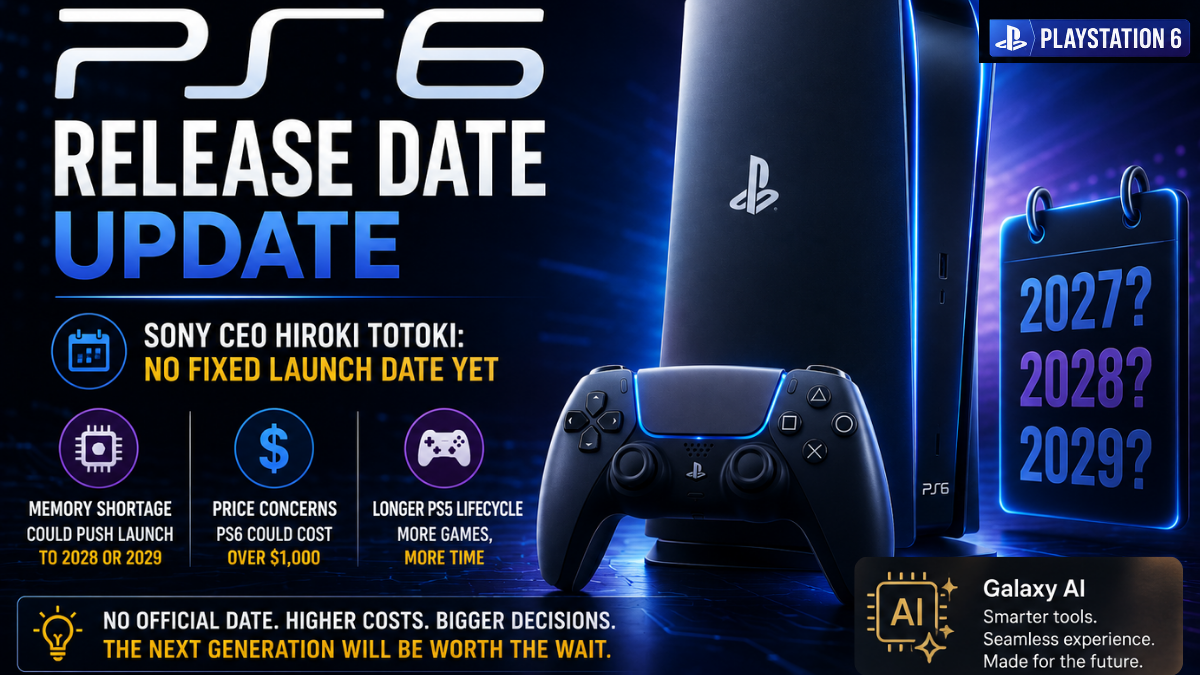
The PlayStation 6 release date update Hiroki Totoki price discussion has taken another turn after Sony’s CEO reportedly confirmed that the company still has not fixed a launch date for its next console.
That doesn’t mean the PS6 is in trouble. It does mean the old assumption of a 2027 release is looking less certain.
For years, a late-2027 launch felt neat and plausible. Sony released the PlayStation 4 in November 2013, then followed with the PlayStation 5 in November 2020. Another seven-year cycle would put a new machine in 2027. Nice pattern. Easy headline.
But console launches aren't arranged around nice patterns when component costs, supply limits, and shifting business priorities are involved.
Key Points
- Sony has not confirmed a fixed PS6 launch date, according to the discussion around Hiroki Totoki's comments.
- The lack of a confirmed date does not itself mean the PS6 has been delayed.
- A 2027 launch is becoming harder to treat as a certainty, despite the familiar seven-year gap between PS4 and PS5.
- Memory supply and component costs could influence Sony's decision on when to launch the next console.
- Reports have raised the possibility of the PS6 arriving in 2028 or even 2029, but those dates remain unconfirmed.
- Sony appears increasingly focused on hardware profitability, rather than accepting large losses on each console sold.
- A potential PS6 price above $1,000 is being discussed, but Sony has not announced an official price.
- Sony has already increased prices for some PS5 models and the PS5 Pro, adding another layer to the pricing question around its next console.
- A longer PS5 generation could actually benefit existing owners by giving Sony and developers more time to support the current console.
- The downside is that longer cross-generation development could limit how aggressively developers build games specifically for the PS6.
- Sony's gaming strategy now extends beyond consoles through PC games, PlayStation Plus, films, TV and other entertainment businesses.
- The PS6's final specifications, price and launch window are still unconfirmed, so detailed claims about its hardware should be treated carefully.
- The decision may ultimately come down to cost versus timing: Sony needs the PS6 to be powerful enough to justify an upgrade without making the launch price too difficult for mainstream buyers.
PlayStation 6 release date update Hiroki Totoki price: What was said
The latest PS6 release date Wall Street Journal interview reportedly included a brief but meaningful statement from Hiroki Totoki: Sony has not yet set a date for the console’s launch.
That’s the clearest public sign yet that a final production and release plan may still be in motion. The Sony PlayStation 6 launch date delay Hiroki Totoki comments don't confirm a delay by themselves, but they leave the door open to one.
And that distinction matters.
Companies can develop hardware for years without locking the retail schedule. Sony still needs to weigh manufacturing capacity, component availability, pricing, software support, and whether enough players are ready to leave the PS5 behind. You can design a powerful console, but if it lands at a price that makes people wince, the launch becomes a much harder sell.
The phrase Sony CEO confirms PlayStation 6 fixed launch date not set may sound dramatic, yet it’s really a reminder that rumors are not a launch calendar.
Why 2027 is no longer a sure thing
Reports have suggested Sony may be considering a later launch, possibly in 2028 or 2029, because memory supply could become a serious problem. The potential PS6 release date pushed to 2028 2029 memory chip shortage scenario is no longer just fan speculation.
Memory is a small word for a very expensive headache.
Gaming hardware relies on several costly components, including high-performance memory, processors, storage, cooling systems, and advanced circuit boards. A tight memory market affects the entire bill of materials. If Sony commits too early, it could face either slim hardware margins or a launch price that feels wildly out of reach.
You can already see the wider pressure in coverage of memory-price surge risks and why chip prices are rising. Those trends don't prove the PS6 will be delayed, but they explain why Sony may be reluctant to promise a date before the numbers make sense.
The PS6 next gen console release timeline Bloomberg report also raised the possibility that a shortage of memory chips could disrupt Sony’s preferred schedule. That would extend the PS5 generation, perhaps longer than many players expected.
Not everyone will hate that.
If you're still happy with your PS5 library, a longer cross-generation period could mean more games continue to support the console you already own. The downside is obvious, though. Developers may have to hold back certain technical ideas while they continue building for older hardware.
PlayStation 6 release date update Hiroki Totoki price and the $1,000 concern
No official PS6 price exists. Yet the PlayStation 6 price expected over 1000 dollars Hideaki Nishino discussion has gained traction because Sony has been increasingly vocal about hardware profitability.
Sony Interactive Entertainment CEO Hideaki Nishino told investors that the company does not plan to sell hardware at significant losses as a general principle. That marks a meaningful shift from the old console playbook, where manufacturers often accepted losses on hardware and made the money back through games, subscriptions, and accessories.
That model is getting harder to defend.
The Sony PS6 hardware profitability strategy pricing approach appears to be based on protecting margins from the beginning. In plain English, Sony may prefer a higher launch price over losing a huge amount on every system sold.
Simple. Effective. Not especially comforting for buyers.
A PS6 price above $1,000 would be a tough ask in many markets once taxes, accessories, games, and a second controller are added. It would also create an awkward split between enthusiasts who want the newest graphics and mainstream players who can simply keep using a PS5.
This is where the Sony Interactive Entertainment PS6 pricing strategy becomes more than an investor talking point. Sony has to persuade customers that the machine offers enough value to justify the upgrade, not just more pixels and faster loading.
The PS5 price increases are part of the story
Sony has already raised PS5 prices in several markets, including increases to certain digital models and the PS5 Pro. That makes the PlayStation 5 Pro price hike effect on PS6 launch impossible to ignore.
If current hardware is becoming more expensive while it is still mid-cycle, the next machine faces an even tougher starting point.
Sony has pointed to ongoing global economic pressures. Component costs, logistics, currency fluctuations, and demand for advanced chips can all move the final price upward. The broader market isn't making things easier either. Samsung’s chip shortage forecast points to sustained supply pressure, while an AI chip demand update shows why major manufacturers are competing for advanced capacity.
That competition spills into consumer electronics eventually. It always does.
Sony is also watching the PS5’s commercial life carefully. The company has strong reasons to keep the existing console relevant through new games, subscriptions, PC releases, films, and television adaptations. Recent reporting around Sony’s GTA VI outlook and PS5 memory cost pressures illustrates the balancing act: maintain momentum now while deciding how expensive the next step can be.
Sony may be thinking beyond console cycles
Totoki has also spoken about Sony’s move from a traditional electronics-focused company toward a wider entertainment business. That includes games, films, TV shows, music, and anime.
Here's the thing: the PS6 may be hugely important without being the only centerpiece of Sony’s future gaming strategy.
Sony owns valuable franchises and has spent years turning game properties into entertainment beyond the console. A longer PS5 lifecycle gives the company more time to reach people who might watch a show, buy a game on PC, or subscribe to PlayStation Plus without immediately purchasing new hardware.
There are other signs of that broader thinking too, from Sony’s Tamron buyout to the industry's wider semiconductor profit gains. Sony is operating in a far more interconnected entertainment and technology market than it was during earlier PlayStation launches.
That doesn't make a new console less likely. It makes the timing more strategic.
What this could mean for PS5 owners
A possible 2028 or 2029 release would give the PS5 a longer runway. If you bought one recently, that's not necessarily bad news.
You may see more high-profile games arrive on PS5 for longer, especially titles that need large audiences to justify their budgets. Sony also has a massive installed base to support, and abandoning it too quickly would make little commercial sense.
Still, there are real drawbacks. Cross-generation development can slow the arrival of games built entirely around new hardware. It can also make the PS6 feel less urgent at launch if most major titles are still available on the previous console.
The current PS6 console specs, price, release window updates are mostly rumor-driven. Sony has not detailed technical specifications, final performance targets, or a retail price. Until it does, treat exact claims about power, storage, or launch bundles with caution.
The wait for a PS6 may be longer, and more expensive
The PlayStation 6 release date update Hiroki Totoki price story points to a console generation shaped by economics as much as technology. Sony has not confirmed a 2027 launch, a 2028 or 2029 delay, or a price above $1,000.
What it has signaled is caution.
If production costs remain high, Sony may keep the PS5 active longer and launch the PS6 only when it can sell the system without taking heavy losses. That could frustrate players eager for a true next-generation leap. But if it prevents a rushed, overpriced launch, waiting may be the less painful option.
GlobalByte Perspective
The PS6 story is becoming less about when Sony can build its next console and more about when it makes financial sense to launch one.
Sony has reportedly confirmed that it has not fixed a launch date for the PS6. That doesn't mean the console has been delayed, and it certainly doesn't rule out 2027. But it does make the widely expected seven-year PS4-to-PS5-to-PS6 cycle less reliable as a prediction.
The bigger problem is cost. Memory supply is already under pressure, and the PS6 will need expensive components across the board. Sony also appears to be putting more emphasis on making hardware profitable rather than relying on selling consoles at significant losses and recovering the money through games and services.
That could put Sony in a difficult position. Launch too early and the PS6 could arrive with a very high price or uncomfortable hardware margins. Wait longer and Sony can give the PS5 more time to generate revenue while component costs and supply conditions become easier to manage.
The possibility of a $1,000-plus PS6 is particularly important, although there is still no official price. At that level, Sony would be asking consumers to make a very different kind of upgrade decision. A PS5 owner may simply decide that better graphics and faster hardware aren't enough to justify replacing a console that still has a large game library.
There is also a bigger business angle here. Sony is no longer relying on the PlayStation console alone. Games, subscriptions, PC releases, films, television and other entertainment businesses all form part of the company's strategy. A longer PS5 generation isn't necessarily a problem if Sony can continue making money from the existing user base.
GlobalByte Perspective: The PS6 may arrive later than fans expect, but the more important question is what Sony wants the next PlayStation to cost. A delayed launch would be frustrating for players waiting for new hardware, but launching a powerful console at a price that most people cannot justify could be an even bigger problem.