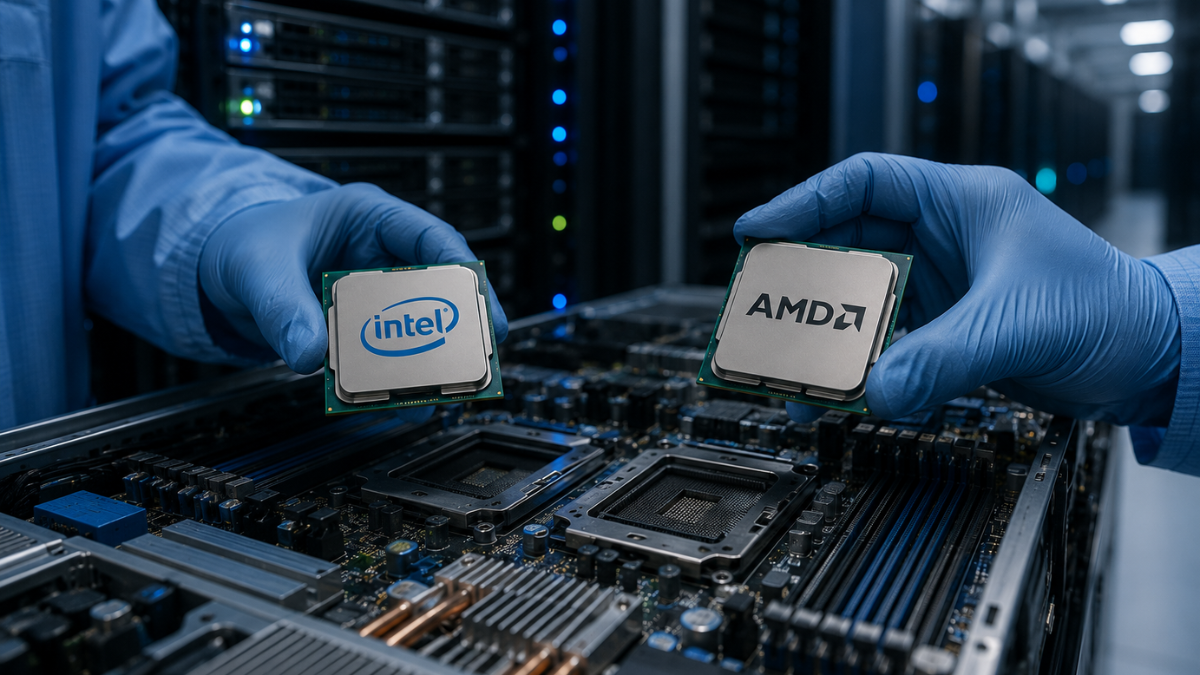
Here's the thing nobody expected a year ago: the AI chip crunch wouldn't stop at GPUs. It would spread into the boring stuff. Server CPUs. The processors that just... run everything else.
Intel and AMD are now signing longer-term purchase commitments with Chinese server customers, according to two people familiar with the talks, as the broader wave of Intel AMD China server CPU deals reshapes how buyers in the region secure supply. Prices are climbing fast. Some products are up more than 40% since January. And the two chipmakers, who've spent years competing on price and performance, suddenly have real leverage.
That's not a small shift. It's a sign of just how far the AI infrastructure boom has stretched.
Why Intel and AMD Are Locking In Longer Server CPU Contracts
The deals under discussion mostly lock in purchase volumes, not prices. Most run about a year. But some Intel and AMD China server CPU deals reportedly stretch to two years or longer for certain customers, according to one of the sources.
Think about what that means practically. A cloud provider in Shanghai or Hangzhou can't just place an order and wait for the best price anymore. They're committing to buy a set volume, months or years out, without knowing exactly what they'll pay. That's a very different posture than the CPU market has had in, well, basically forever.
Why now? Because AI data centers don't run on GPUs alone. They need CPUs to manage servers, handle storage, run networking, and process inference workloads that never touch a GPU at all. Nvidia-style accelerators get the headlines. CPUs quietly became the bottleneck everyone forgot to plan for.
China Server CPU Price Surge 2026: How Bad Is It, Really?
Pretty bad, if you're the one buying. Server CPU prices in China are still climbing, with month-on-month increases topping 10% for some products, according to one source close to the talks. Since the start of the year, certain CPU products have jumped more than 40%.
That's the kind of number that shows up in a CFO's inbox with a lot of question marks attached.
And it's not an isolated blip. Reuters reported earlier this year that Intel and AMD had already told Chinese customers to expect long waits, with Intel lead times stretching as long as six months for some products. Six months. For a component that used to ship in weeks.
Compare that to memory chips, where the same AI-driven shortage pushed buyers toward multi-year contracts well before CPUs followed suit. The CXMT-Tencent server DRAM supply deal is a good example of that pattern playing out first in memory, at a price tag north of $2.9 billion. CPUs are just catching up to where DRAM already went.
The AI Data Center CPU Shortage Isn't Just About GPUs
Everyone's been watching Nvidia. Fair enough. The Nvidia H200 chip purchase limits placed on Chinese buyers like Alibaba, ByteDance, and DeepSeek have dominated coverage for months, and understandably so.
But while everyone's eyes were on GPU export controls, the AI data center CPU shortage in China crept up from the side. Servers need CPUs regardless of what accelerator sits next to them. Storage arrays need CPUs. Networking gear needs CPUs. None of that stopped scaling just because GPUs got the export-control spotlight.
So demand piled up. And because CPUs had always been "the easy part" of a server build, nobody built in the same supply buffers that GPU buyers eventually learned to demand. Tighter supply now risks raising costs and slowing deployment timelines for Chinese cloud providers and internet firms racing to expand AI services, exactly when they can least afford delays.
Some Chinese firms are trying to route around the squeeze entirely by building domestic alternatives. Tianshu Zhixin's ByteDance GPU chip order is one example of a homegrown supplier stepping into a gap that used to belong entirely to US chipmakers. It won't replace Xeon and EPYC overnight, but it shows where the pressure is pushing buyers.
What's Driving Intel Xeon Server CPU Demand in China
Intel CEO Lip-Bu Tan told analysts back in April that demand "continues to run ahead of supply," specifically calling out Xeon server CPUs as a pressure point. He also mentioned a multi-year deal with Google as one of several long-term contracts Intel signed in the first quarter alone.
That's a notable admission from a company that spent years trying to convince the market it had excess capacity, not a shortage.
Part of the strain traces back to how Intel builds its chips in the first place. Intel's Panther Lake lithography shift toward ASML's High-NA EUV tools marks a genuine manufacturing pivot, and pivots like that don't happen without ripple effects on output timing elsewhere in the roadmap. Add in a broader AI infrastructure demand data center processor squeeze across the entire industry, and lead times start stretching in ways that are hard to unwind quickly.
The CPU shortage is expected to be a key topic when Intel reports quarterly results this Thursday. Worth watching what Tan says about lead times this time around.
AMD's Server CPU Bet on Agentic AI
AMD, due to report in early August, has already raised its server CPU market forecast to more than $120 billion by 2030. The reasoning: strong demand tied to agentic AI workloads, the kind of always-on, multi-step AI processes that lean heavily on CPU-driven orchestration rather than raw GPU throughput.
That's a big number. And it tells you AMD isn't treating this as a temporary blip either. Long-term supply agreements only make sense if you believe the demand curve keeps climbing, not flattening.
Both companies are riding a wave that's lifted the entire chip sector's financials lately. The semiconductor sector's historic profit gains have been hard to ignore this year, even with investors still nervous about how sustainable it all is.
Guangdong, Beijing, and the Data Center Buildout Behind the Squeeze
China is one of the largest server markets on the planet. Full stop. Rapid construction of data center racks, AI computing clusters, and national computing infrastructure projects across regions like Guangdong and Beijing has intensified competition for every Intel and AMD processor available.
This isn't abstract. Domestic players are scaling fast too. Sugon's 100,000-card AI supercluster launch shows the sheer scale Chinese firms are chasing, and clusters that size need mainstream server processors just as much as accelerators. Every rack needs a CPU managing it.
Lenovo's positioning itself for a piece of that growth too. Lenovo's China AI computing revenue target through its Wentian unit aims at $100 billion, a number that only makes sense if server CPU supply keeps pace with demand. Which, right now, it isn't quite doing.
What This Means for Chinese Cloud Providers and Buyers
If you're procuring servers for a Chinese cloud operation right now, you're facing a squeeze from more than one direction at once.
- Higher upfront costs from the China server CPU price surge 2026 trend
- Longer wait times, with Intel lead times hitting six months on some SKUs
- Pressure to commit to multi-year volumes just to guarantee supply
- Competition from domestic chip alternatives that aren't fully mature yet
Some buyers are hedging by diversifying suppliers. Others are just... eating the cost and passing it downstream. Neither option feels great.
There's also a broader supply chain angle worth noting. Korean fabless chipmakers targeting China at events like Electronica Shanghai 2026 show other players circling, hoping to grab share while Intel and AMD are stretched thin on delivery.
The Bigger Picture: Chips, Chokepoints, and Policy
None of this is happening in a vacuum. Chinese buyers face separate US restrictions on access to the most advanced AI GPUs, which have already pushed domestic innovation in directions like China's 3D-stacked AI chip push, an attempt to engineer around limits rather than wait them out.
Meanwhile, chip-driven trade flows keep shifting. China's AI chip-driven export surge showed exports up 27% in June, a reminder that the AI boom is reshaping supply chains well beyond just server rooms.
On the manufacturing side, global capacity is racing to keep up too. TSMC's Arizona expansion and AI chip demand show how even the world's largest foundry is scrambling to add capacity in response to the same underlying demand curve hitting Intel and AMD.
And regulators aren't sitting still either. China's overseas tech transfer security rules add another layer of complexity for any company navigating US chipmakers’ long-term deals in China, since compliance and national security concerns now sit right alongside straightforward supply-and-demand math.
Semiconductor supply chain leverage has quietly shifted back toward chipmakers for the first time in years. That's the real story hiding underneath all these Intel, AMD, and China server CPU deals.
Wrapping Up
So where does this leave things? Intel AMD China server CPU deals aren't a temporary fix. They look more like the new normal for at least the next year or two, as long as AI infrastructure buildout in China keeps accelerating at its current pace.
Prices probably won't drop soon. Lead times probably won't shrink fast either. If you're on the buying side, locking in volume now, even without price certainty, may honestly beat waiting and hoping things loosen up.