Summary
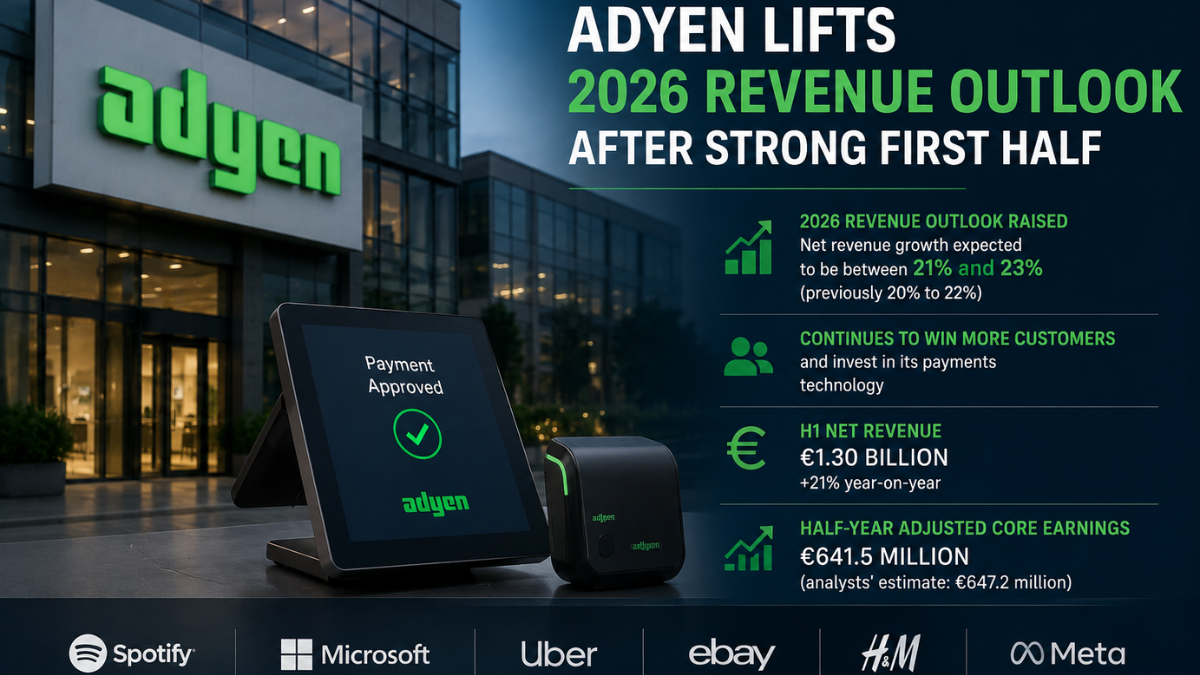
The Adyen 2026 revenue growth outlook forecast H1 earnings update gives investors a fairly clear message: the Dutch payments company is still winning business, and transaction demand remains healthy enough for management to lift full-year expectations.
Adyen now expects net revenue growth of 21% to 23% in 2026, up from its earlier 20% to 22% range. That may look like a modest adjustment. But forecasts usually move only when leadership sees stronger evidence in its merchant pipeline, processing volumes, and customer activity.
There is a catch, though. Profitability did not beat every expectation. Higher acquisition-related costs weighed on adjusted core earnings, reminding you that fast expansion can be expensive even when top-line momentum looks good.
Key Points
Adyen raised its 2026 revenue growth outlook to 21%–23%, compared with the previous 20%–22% range.
First-half net revenue reached €1.30 billion, up 21% year over year.
Adjusted core earnings stood at €641.5 million, slightly below the €647.2 million analyst estimate.
Higher acquisition-related costs put pressure on earnings during the period.
Adyen continues to focus heavily on large international merchants that need payments across online and physical channels.
Its integrated platform brings payments, risk management, data and point-of-sale services together in one system.
Major customers such as Spotify and Microsoft highlight the company's focus on large-scale enterprise payments.
Adyen continues to face strong competition from PayPal and Stripe, particularly in North America.
Its scale-based pricing approach can be attractive to high-volume merchants looking to reduce payment complexity and costs.
The biggest question now is whether Adyen can maintain revenue growth while improving margins.
Investors will be watching merchant growth, payment volumes, acquisition performance and North American expansion closely.
The broader result suggests that businesses are still investing in digital payment infrastructure, even while keeping a closer eye on technology costs.
Adyen 2026 revenue growth outlook forecast H1 earnings at a glance
The central figure is the Adyen 2026 net revenue growth forecast 21 to 23 percent. Management raised that target after reporting a solid first half, with net revenue climbing 21% year over year.
Here are the headline numbers:
- Net revenue reached €1.30 billion in the six months to June
- Year-over-year net revenue growth was 21%
- Adjusted core earnings came in at €641.5 million
- The previous 2026 growth guidance range was 20% to 22%
- New guidance calls for 21% to 23% growth
The result broadly topped revenue expectations. Adyen H1 2026 net revenue 1.3 billion euros compared with a Visible Alpha consensus of roughly €1.29 billion, based on expected constant-currency growth of 20.69%.
Revenue strength matters more than a single quarterly stock move because payment processors grow through volume, merchant adoption, and retained relationships. Those trends tend to build over time. Or they don't. That's what makes the next few reporting periods worth watching.
Why did Adyen raise its 2026 annual revenue outlook?
The short version: merchant activity remained stronger than expected, and Adyen continued adding customers while expanding its processing footprint.
The longer answer is more interesting. European fintech payment processing volume growth has benefited from the ongoing migration away from cash and fragmented payment systems. Online purchases, in-store digital checkout, subscriptions, marketplaces, and embedded payments all feed that shift.
Adyen sits in a useful position because it serves merchants through one platform rather than stitching together separate providers for online, point-of-sale, risk, and data tools. That approach can be attractive to large companies that operate in multiple markets and want fewer moving parts.
Its customers include major names such as Spotify and Microsoft. The phrase Adyen payment processing Spotify Microsoft digital payments may sound like a search term, but it highlights the actual commercial advantage: large merchants bring recurring volume, international needs, and a strong incentive to reduce payment friction.
And payment volumes don't rise in isolation. Growth in cloud infrastructure, enterprise software, devices, and consumer spending can all flow into transactions. For context, Amazon's AWS growth and Microsoft's Azure momentum show why digital business investment still matters to the wider payments ecosystem.
Revenue beat, EBITDA miss: why both can be true
Adyen reported Adyen adjusted core earnings EBITDA 641.5 million euros, slightly below the €647.2 million analysts expected. It wasn't a collapse. It was a miss of about €5.7 million.
Still, markets can be picky with a company priced for durable growth.
The main explanation was higher costs tied to recent acquisitions. Those expenses can pressure margins before acquired assets, talent, technology, or customer channels fully contribute to revenue. Investors should avoid treating every earnings miss as a sign of weakening demand. In this case, revenue performance stayed strong while the cost base rose faster than some analysts anticipated.
That said, how are acquisition costs affecting Adyen's profit margins? They can reduce near-term operating leverage by increasing integration, staffing, technology, and transaction-related spending. If those costs linger without corresponding revenue gains, the margin story gets less comfortable. If they support larger merchant wins, the pain may prove temporary.
This is also where the broader technology cycle gets messy. Rising enterprise AI spending can create more digital commerce and software activity, yet many companies are still trying to turn that spending into reliable profits. Payments firms aren't exempt from that tension.
Adyen 2026 revenue growth outlook forecast H1 earnings and competition
The Adyen 2026 revenue growth outlook forecast H1 earnings story isn't only about Adyen. It's also about the increasingly fierce contest among global payment providers.
Adyen vs PayPal Stripe North America payment competition remains a major topic because the US market is large, sophisticated, and expensive to win. PayPal brings consumer recognition and a huge installed base. Stripe is deeply embedded with digital-first businesses and developers. Adyen has aimed at enterprise merchants that want one integrated provider across channels and regions.
That focus can work well. It can also limit flexibility.
Large merchants often take longer to sign, negotiate hard on price, and expect service levels that smaller businesses may not require. A major account win can move the needle, but the sales cycle isn't always fast. And when an enterprise customer changes providers, it's usually a serious operational decision.
The ongoing Stripe-PayPal deal outlook is a reminder that competitive positioning and industry consolidation can reshape payments markets quickly.
How Adyen's pricing model helps high-volume merchants
The Adyen integrated payments platform pricing model is a core part of the company’s appeal. Rather than treating every transaction as a standalone event, Adyen can combine payment acceptance, risk tools, data, and channel management.
For high-volume merchants, scale can lower unit costs. More processing volume may improve authorization rates, produce better data, and support volume-based pricing discussions.
How does Adyen's tiered pricing model benefit high-volume merchants? It can reduce the effective cost per transaction as volumes grow, while giving merchants a clearer view of payments across online and physical stores. That isn't automatically cheaper in every case, and some businesses may prefer specialist providers. But for a large multinational retailer, simplicity has value.
Simple. Effective. Free to start? Not quite. Enterprise payment infrastructure is rarely simple, and switching providers can be painful.
What the H1 numbers say about digital payments in 2026
Digital payments ecommerce volume growth 2026 is being shaped by more than online retail. Subscription services, travel, food delivery, gaming, business software, physical-store terminals, and mobile wallets all add to the transaction pool.
Adyen's results suggest that large merchants are still spending on payment infrastructure even as they watch costs closely. That matches a broader fintech sector earnings report digital transaction surge narrative, where payments companies benefit when economic activity moves through digital rails.
But don't assume every macro trend helps equally. Apple's forecast pressures show how supply constraints can affect device sales and consumer demand, while Capgemini IT demand points to continued corporate technology investment. Payments providers operate between those two forces: consumer activity on one side, merchant technology budgets on the other.
Then there are regional differences. China consumer spending trends may affect cross-border commerce and payment volumes differently from European or North American spending patterns.
What could move Adyen shares next?
The Adyen share price stock market forecast 2026 will likely depend on whether the company can make its raised revenue target look conservative rather than ambitious.
Investors will be watching for:
- Sustained net revenue growth above 21%
- Progress in North American merchant acquisition
- Margin recovery after acquisition-related costs
- Payment volume growth among enterprise customers
- New wins in omnichannel commerce
- Changes in competition or pricing pressure
The biggest risk isn't that digital payments suddenly disappear. They're deeply embedded in global commerce now. The real concern is that growth decelerates while costs remain elevated, leaving investors to question how much operating leverage Adyen can deliver.
And sentiment can turn fast. Global market volatility can affect high-growth fintech valuations even when a company’s operating results remain sound.
A wider view of Adyen's position
The Adyen 2026 revenue growth outlook forecast H1 earnings update supports the view that the company remains a serious global enterprise payments contender. Its post-pandemic growth hasn't vanished, which matters because the easiest comparisons were always going to fade.
Management's higher guidance indicates confidence. The revenue beat supports it. The modest earnings shortfall adds a needed dose of realism.
For you as an investor or industry watcher, the next question is whether Adyen can convert its growing merchant base into stronger margins. Revenue is moving in the right direction. Now the company has to prove that its spending will pay off.
The larger backdrop remains supportive too. Digital economy growth should create more transactions across more channels, though no payments provider gets a free ride in a crowded market.
GlobalByte Perspective
Adyen’s latest results show that the company is still finding room to grow in an increasingly competitive payments market. Raising its 2026 revenue growth forecast to 21%–23% suggests that merchant activity and transaction demand have remained strong through the first half of the year. With net revenue reaching €1.30 billion, the company appears to be benefiting from continued investment in digital payments and from large businesses looking for a single platform to manage transactions across different markets and sales channels.
The more interesting part, however, is what happens to profitability as Adyen expands. Adjusted core earnings came in slightly below analyst expectations, partly because of higher costs related to recent acquisitions. That does not undermine the revenue story, but it does raise the bar for management. Adyen now needs to show that the money being spent on expansion, technology and acquisitions can eventually translate into stronger margins. For GlobalByte News, the key takeaway is simple: Adyen is still growing, but the next phase will be about proving that growth can become more profitable. Its ability to keep winning enterprise customers while competing with PayPal and Stripe will be just as important as the higher revenue guidance.