Summary
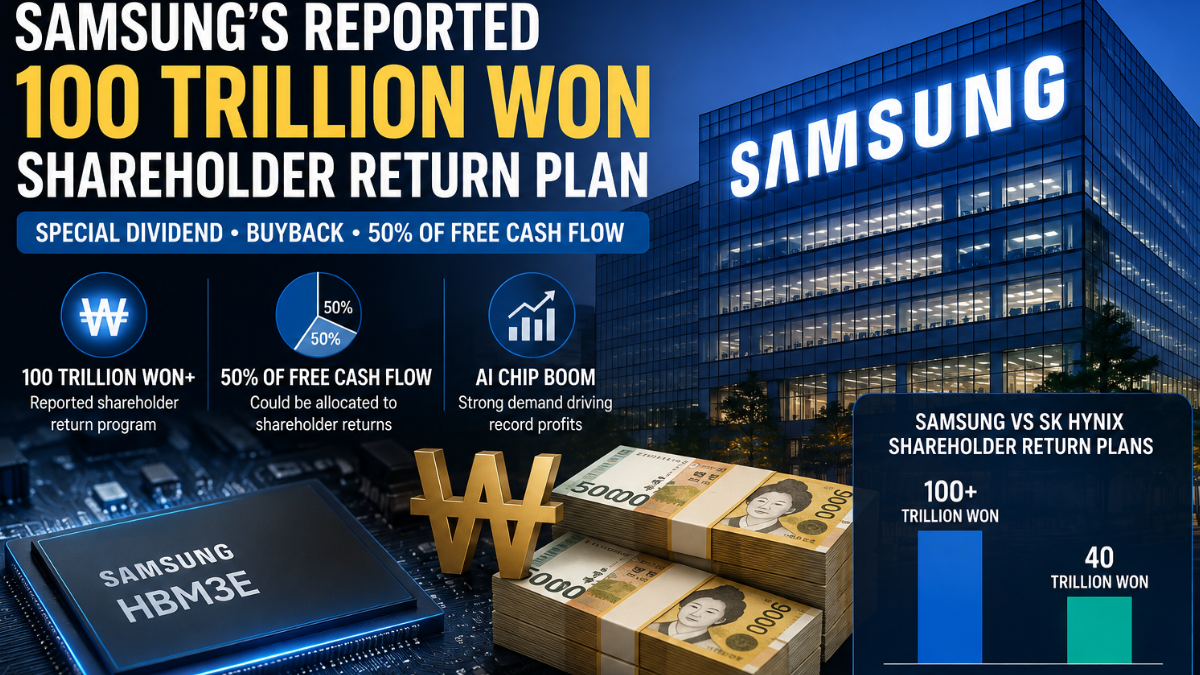
The reported Samsung shareholder return programme 100 trillion won special dividend could become one of the largest capital-return plans ever announced by a listed South Korean company. Samsung Electronics is reportedly preparing a policy worth more than 100 trillion won, or roughly $72 billion, as booming AI-related chip demand drives profits higher.
For you as an investor, the headline is exciting. But it isn't confirmed yet.
Reports say Samsung Electronics could bring the proposal to a board meeting in late August, with a special dividend and share-buyback measures among the possible components. Samsung has declined to comment, so the final structure, timing, and payout terms could still change.
Key Points
- 100 trillion won: Samsung is reportedly considering a shareholder-return programme worth more than 100 trillion won.
- 50% of free cash flow: The reported policy could direct half of Samsung's free cash flow toward shareholders.
- Special dividend + buybacks: The final package could include both, rather than being entirely a cash dividend.
- AI chip boom: Strong memory demand is giving Samsung more room to increase shareholder returns.
- SK Hynix pressure: SK Hynix's reported 40 trillion won buyback plan has raised the competitive pressure on Samsung.
- Big question: Samsung still needs enormous capital for new fabs, advanced memory and AI infrastructure.
- Not official yet: Samsung has not confirmed the reported 100 trillion won figure, payout structure or board decision.
- Investor takeaway: The eventual mix of dividends, buybacks and reinvestment matters more than the headline amount.
Samsung shareholder return programme 100 trillion won special dividend: What is being reported?
Local media reports indicate that Samsung Electronics may commit more than 100 trillion won to a new shareholder return policy. The reported Samsung Electronics shareholder return policy 100 trillion won would allocate 50% of the company's free cash flow to shareholder returns.
That could mean a mix of special dividends, regular dividends, buybacks, or cancelled shares. At this stage, investors shouldn't assume every won would arrive as a cash dividend.
The reported plan comes while the company benefits from the AI chip supercycle Samsung record profits dividend story that has been building across the memory sector. Demand for high-bandwidth memory, advanced DRAM, and data-center storage has changed the earnings picture fast.
Samsung's future spending still matters, though. Its planned manufacturing expansion, including Samsung’s 2029 fab target, will require serious capital investment even during a strong profit cycle.
Why is Samsung increasing its shareholder returns in 2026?
The basic answer is profits, pressure, and competition.
AI infrastructure spending has lifted memory-chip demand, while tight supply has supported pricing. Samsung's earnings could benefit heavily if this cycle holds. Still, memory is a famously volatile business. Prices can look unstoppable until they aren't.
The company is also facing a new benchmark set by its closest domestic rival. SK Hynix recently announced a 40 trillion won buyback and cancellation plan, reportedly the biggest shareholder return programme ever disclosed by a listed South Korean company. You can see why Samsung investors are watching closely after SK Hynix’s AI profit drew attention despite a weak market reaction.
This isn't only about generosity. It's about showing that Samsung can invest in future capacity while still sharing a meaningful portion of cash generation with shareholders.
Samsung shareholder return programme 100 trillion won special dividend and free cash flow
The key detail is the reported Samsung free cash flow 50 percent shareholder payout target.
Free cash flow is the cash left after a company pays for operating costs and capital expenditure. For Samsung, that matters because semiconductor manufacturing is expensive. New fabs, equipment, packaging technology, and memory development can consume enormous sums.
If Samsung truly allocates 50% of free cash flow, its shareholder return would rise and fall with the business cycle. That is usually more flexible than promising a fixed payout no matter what happens to profits.
And there are competing priorities. Samsung’s chip supply outlook suggests the company may need to keep funding capacity and supply commitments as AI demand expands.
Simple. Generous in a boom, but potentially less predictable in a downturn.
How does Samsung's payout compare to SK Hynix's 40 trillion won buyback?
The Samsung vs SK Hynix share buyback payout comparison is now unavoidable.
SK Hynix said it would allocate more than 50% of its free cash flow generated from 2025 through 2027 to shareholder returns, alongside its 40 trillion won buyback-and-cancellation plan. Samsung's reported 100 trillion won programme is much larger in headline value, but the plans may not be directly comparable until Samsung releases details.
A buyback reduces the number of shares outstanding when shares are cancelled. A special dividend sends cash directly to shareholders. Both can reward investors, though they affect tax outcomes, per-share earnings, and long-term capital allocation differently.
Samsung's scale makes the reported Samsung 72 billion dollar shareholder return plan notable. Yet scale doesn't automatically mean better value. The eventual mix is what counts.
When will Samsung announce its 100 trillion won shareholder return plan?
Reports point to a Samsung Electronics special dividend board meeting August, likely near the end of the month. The board would need to approve the policy before investors can treat it as official.
The exact Samsung special dividend payout announcement date has not been confirmed by the company. Keep an eye on Samsung's investor-relations notices and exchange filings rather than relying only on media reports.
That caution applies to the wider market too. Recent semiconductor profit gains haven't stopped investors from worrying about valuations, demand durability, and geopolitical risk.
What could the plan mean for Samsung stock?
Samsung Electronics trades in South Korea under ticker symbol 005930, so searches for Samsung Electronics 005930 stock price dividend yield will likely rise as more details emerge.
A confirmed capital-return programme could support sentiment because it signals management confidence in cash generation. It may also attract income-focused investors if a special dividend is approved. But dividends don't make risk disappear. Samsung remains exposed to memory prices, global tech spending, currency shifts, and its large investment requirements.
Those risks show up in unexpected places. Memory-price pressure can affect consumer-electronics margins, while an Asian chip-stock selloff can drag shares lower even when company fundamentals look strong.
Samsung's broader strategy will matter too. Investors following Samsung’s robotics strategy, Samsung’s US workforce changes, and the reported Samsung Biologics acquisition can see that capital allocation isn't limited to memory chips.
GlobalByte Perspective
Samsung’s reported 100 trillion won shareholder return plan is bigger than a dividend story. It shows how aggressively the company may be willing to share the cash generated during the current AI-driven chip boom while still funding its next wave of semiconductor investment.
The interesting part isn't simply the headline number. How Samsung divides that money between dividends, buybacks and long-term investment will matter far more. A huge payout may look attractive today, but Samsung still needs billions for fabs, advanced memory and AI-related capacity.
If the reported 50% of free cash flow commitment becomes official, it could give shareholders a stronger reason to stay invested while putting pressure on Samsung to maintain disciplined capital allocation when the memory cycle eventually cools.
For GlobalByte News, the bigger takeaway is simple: Samsung isn't just benefiting from the AI boom anymore; it's deciding how much of that boom should go back to investors.