Power is the new bottleneck for AI. Not chips. Not talent. Not even capital - electricity.
If you've been watching the AI space closely, you already know data centers are consuming electricity at a pace that would have seemed absurd five years ago. China's national computing infrastructure hit 170 billion kilowatt-hours in total electricity consumption last year alone. That number isn't slowing down. And the countries and companies that figure out how to keep the lights on - cheaply and cleanly - are going to hold real leverage in the decade ahead.
That's why AI and green energy infrastructure integration in 2026 has become more than a corporate buzzword. It's where serious strategic bets are being placed right now.
The Power Problem Is Actually an Opportunity
Here's something that gets lost in most coverage of AI's energy demand: the crisis framing is only half the story.
Yes, surging electricity demand is a genuine grid challenge globally. It's stretching infrastructure, pushing up costs, and forcing uncomfortable tradeoffs. But for regions with strong renewable capacity and smart grid investment, that same surge is a competitive opening. Low-cost electricity's role in global AI leadership isn't theoretical anymore - it's the actual calculus driving where data centers get built and who controls the compute.
Whoever controls affordable, clean electricity at scale controls where AI can run.
China's position here is significant. With roughly 60 percent of global production capacity across its energy equipment manufacturing base, and transformer exports reaching 60 billion yuan (around $8.82 billion) in 2025 - up more than 20 percent year-on-year - the country isn't just consuming energy infrastructure. It's producing it.
What AI and Green Energy Infrastructure Integration Actually Looks Like in 2026
The relationship between computing and power infrastructure used to be simple. Power companies generated electricity. Tech companies consumed it. Done.
That model's gone.
What's happening now with AI and green energy infrastructure integration in 2026 is far more layered. Computing infrastructure and energy infrastructure share deeply interconnected foundational technologies - grid management software, control systems, optimization algorithms. The organization that masters both sides of that equation, and can deploy them cost-effectively, doesn't just run cheaper AI. It runs better AI.
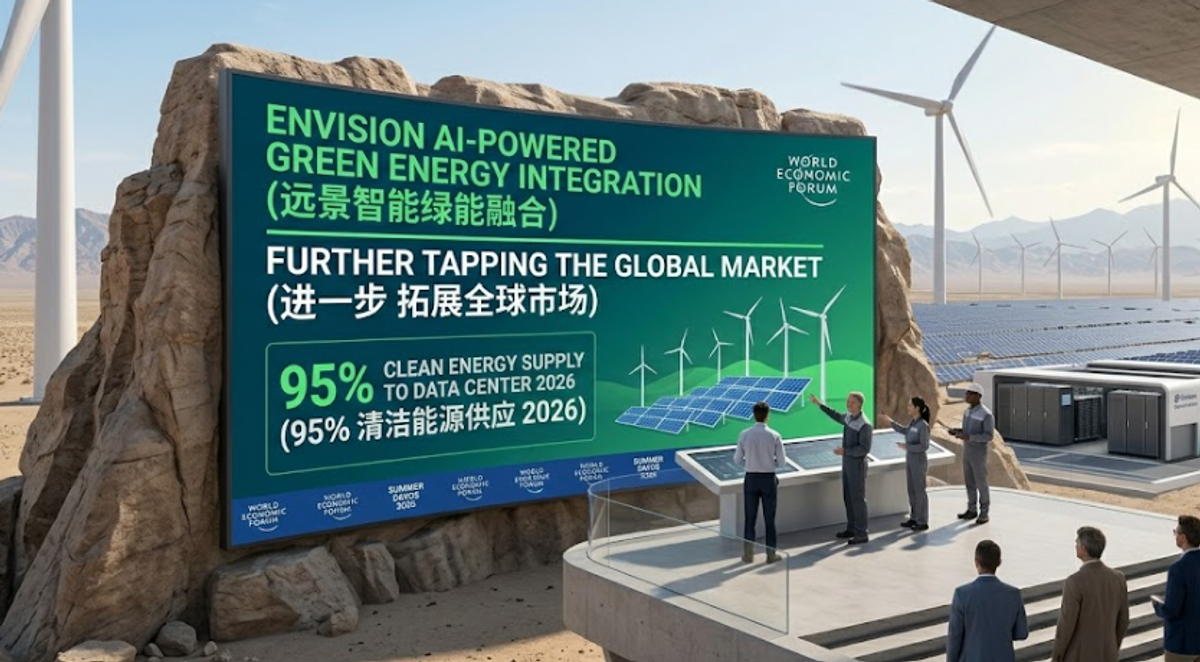
This thinking drives Envision Group's announced plan to build 5 gigawatts of green AI computing centers across global desert regions - including the Gobi Desert - by 2030. Desert environments, often dismissed as remote or inhospitable, offer exactly what large-scale AI computing needs: abundant renewable energy potential, land, and natural cooling in dry climates. Envision Group's green computing approach treats these locations not as a compromise but as an advantage. The goal isn't just clean infrastructure. It's cost-effective infrastructure that happens to be clean.
China's National Policy Is Already Setting the Direction
Policy matters here, and China's government has moved quickly.
The National Energy Administration recently issued a formal action plan targeting a significant increase in China's clean energy supply capacity for AI computing infrastructure by 2030. The plan goes beyond simply building more solar and wind. It calls for deeply embedding AI applications across the energy sector itself, opening high-value application scenarios, and strengthening AI model innovation within the energy field. That's not just an energy document - it's a technology strategy.
Last year, China established 42 massive-scale intelligent computing clusters. Those clusters pushed total electricity consumption across national computing infrastructure to 170 billion kilowatt-hours. The National Energy Administration's AI policy framework is designed to ensure that figure keeps growing without the clean energy supply lagging.
The interplay of AI and energy has shifted from one-way support to mutual reinforcement. AI optimizes energy grids; clean energy enables more AI. That loop, when it works, compounds.
Desert Computing and Remote Microgrids: The Global Angle
This isn't just a story about one country.
The opportunities in global energy infrastructure are genuinely wide, particularly in markets that are either grid-connected but strained, or off-grid entirely. In off-grid islands across Indonesia and the Philippines, small-scale renewable microgrids combining wind, solar, and battery storage can replace diesel generators entirely - providing stable power to local communities while enabling digital infrastructure that couldn't exist before.
In isolated mining districts across Africa and Australia, integrated energy solutions built around renewables substantially cut operating costs. Greener profile, lower fuel dependency, and no exposure to supply chains that get complicated fast in remote areas.
Green microgrids for remote computing infrastructure aren't a niche play anymore. In markets where grid extension would take a decade and cost a fortune, they're increasingly the only sensible path. B2B green tech investment trends are reflecting exactly that - capital is following the off-grid computing opportunity more aggressively than most coverage acknowledges.
Why the Technology Overlap Is the Key Variable
You'll hear a lot of people frame AI's energy demand as a supply problem. Just build more renewables, the argument goes. But the real competitive advantage comes from something more specific.
Computing infrastructure and power infrastructure share the same foundational technology layer. Grid management, frequency control, load balancing, predictive maintenance - AI can improve all of these dramatically. And in reverse, stable, low-cost clean energy is what makes it economically viable to run the compute-intensive research and development that produces better AI models.
How to convert AI power challenges into a competitive advantage isn't a philosophical question anymore. The answer is integration. The companies and countries that treat energy and AI as a single system - not two separate problems to solve sequentially - are the ones currently pulling ahead. Advanced energy model innovation and AI model innovation are converging faster than most coverage of B2B tech trends suggests.
Where This All Goes From Here
AI and green energy infrastructure integration in 2026 isn't a trend you can observe from the sidelines and revisit in a few years. The infrastructure decisions being made now - where to build, how to power it, which underlying technologies to deploy - are locking in capacity and competitive position for decades.
The organizations getting this right aren't just solving an energy problem. They're positioning themselves at the intersection of the two most capital-intensive technology sectors on the planet. Clean power isn't a sustainability footnote anymore. It's the foundation that makes large-scale AI economically possible at all.
And anyone who still treats those two things as separate has already fallen behind the conversation.