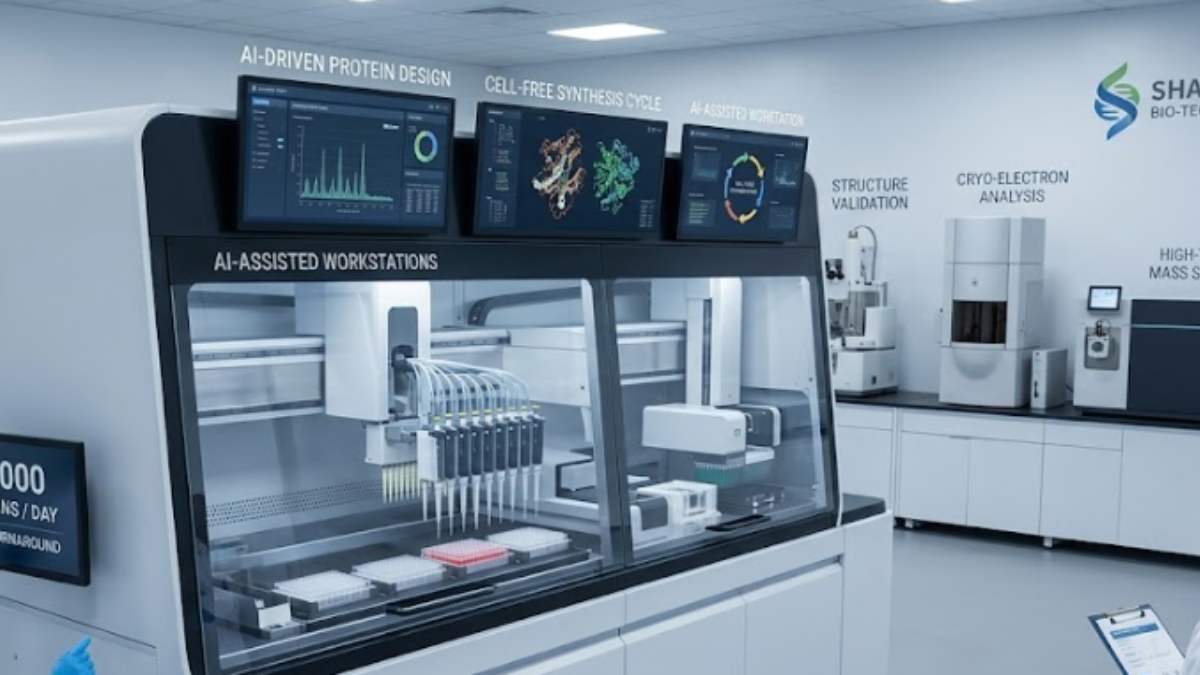
For decades, turning an AI-generated protein sequence into a physical, testable sample meant weeks of waiting - sometimes months. That lag wasn't a design problem. It was a manufacturing and verification problem. And as the global AI competitive landscape in biotechnology shifts fast, a new AI-assisted cell-free protein synthesis automated platform developed in Shanghai is now directly addressing it.
Built jointly by the National Facility for Protein Science in Shanghai and Kangma Shanghai Biotechnology, the system can produce up to 10,000 distinct proteins per day. It connects AI-driven protein design, automated synthesis, and structural verification into a single pipeline - something that's genuinely rare, even globally.
The Real Problem Wasn't Protein Design
Here's something counterintuitive: AI-driven protein design and high-throughput screening have already gotten fast. Very fast. AI models can generate thousands of protein sequences in hours. That part's largely solved.
The problem is what comes after. Every sequence still has to be physically synthesized and experimentally verified to confirm it actually folds correctly and functions as predicted. That experimental step hadn't kept pace with the design side.
Wu Jiarui, director of the National Facility for Protein Science in Shanghai, put it plainly: "The bottleneck is no longer protein design. AI can generate protein sequences very quickly, but they still have to be synthesized and experimentally verified. This platform bridges that gap."
So the question isn't about AI capability at the design stage - it's about how quickly you can get from sequence to physical confirmation. That's the specific gap this platform closes.
What Cell-Free Synthesis Does Differently
Traditional protein production depends on living cells. You use bacteria, yeast, or mammalian cell lines - insert genetic instructions, grow the culture, wait for the cells to manufacture the target protein, then extract and purify it. Slow, sensitive to conditions, and unreliable for certain protein types that cells don't handle well.
Cell-free protein synthesis removes the living cells entirely. Proteins are built directly from DNA templates using extracted cellular machinery - ribosomes, enzymes, energy molecules - in a controlled reaction environment. No culture growth cycles to wait on. No biological variability to manage.
The result: shorter production timelines, fewer failure modes, and the ability to synthesize proteins that cell-based systems struggle to produce at all. For a system built around laboratory robotics automation and throughput in the thousands-per-day range, that's a significant ceiling removed. It's why cell-free technology eliminates the core limitations of cell-based manufacturing in a way that makes this scale possible.
Nine Platforms, One End-to-End Pipeline
The facility behind this project isn't a pilot program. The National Facility for Protein Science in Shanghai operates nine major technology platforms - nuclear magnetic resonance spectroscopy, cryo-electron microscopy, mass spectrometry, and six others - that together provide everything needed to verify whether a newly synthesized protein has the right structure, stability, and biological function.
That verification step is the part most people underestimate. "Making a protein is only the beginning," Wu said. "It must then be analyzed and validated."
By housing AI-assisted design, automated synthesis, and structural verification under one roof, the AI-assisted cell-free protein synthesis automated platform gives researchers an end-to-end workflow for rapid protein structural and functional verification without coordinating across multiple sites or waiting in equipment queues. The compute demands supporting AI protein design at this scale draw on full-stack AI computing platforms and high-performance supercomputing infrastructure that keep the pipeline running continuously.
It operates as shared research infrastructure for biotechnology systems - open to universities, pharmaceutical companies, and independent research institutes that don't have the capital to build out nine analytical platforms on their own.
Kangma's D2P Platform and What It's Already Built
Kangma Shanghai Biotechnology has been working in this space since 2015, when it became the first Chinese company to scale up cell-free protein synthesis commercially. Their Automated DNA to Protein (D2P) platform integrates protein design, synthesis, and optimization into a single AI-assisted workflow. And it's already generating real commercial products.
One of them might surprise you. A high-sweetness protein ingredient developed through AI-assisted screening is now incorporated into children's and adult mouthwash products. It provides sweetness without conventional sugar or artificial sweeteners, made possible by cell-free production and the D2P platform's screening capabilities - not traditional formulation chemistry.
On the therapeutic side, Kangma is advancing GLP-1 drug candidates via cell-free production and has expanded manufacturing capacity in eastern China to support broader commercial scale. The combination of AI-driven intelligent manufacturing methods with cell-free biology is producing real outputs now, not just research papers.
Why This Fits a Larger Pattern
This platform isn't happening in isolation. Across sectors, physical AI automation systems are moving from software tools into physical processes - protein synthesis being one of the clearest examples of that shift materializing. The AI here isn't just designing sequences; it's directing what happens in the lab, continuously, at scale.
Next-generation AI chip architectures are making the compute side of large-scale protein design more accessible, tightening the feedback loop between AI-generated sequences and experimental results. That compression is where the real acceleration comes from. Accelerating industrial enzyme deployment via machine learning models follows the same logic - more candidates screened quickly, useful ones identified faster, deployment timelines shortened.
It's also worth noting that the pattern extends beyond biology.
What It Means if You're in Pharma, Biotech, or Food Science
Honestly, if you work in any field where protein engineering matters, the shared infrastructure model here is the part worth paying close attention to. You don't need nine analytical platforms. You don't need a cell-free synthesis line of your own. You access the full stack.
Advanced AI agent workflows and AI supply chain integration are reshaping how scientific research infrastructure gets built and shared, and platforms like this one are part of that shift. Therapeutic protein manufacturing breakthroughs in 2026 aren't coming only from the largest pharmaceutical firms - they're coming from collaborative systems that extend high-throughput capability to mid-size biotech companies and university research groups that couldn't otherwise afford it.
The D2P model - from AI-generated sequence to physical sample to structural confirmation - compresses a process that used to take months into something measurable in days. And that feedback speed is the whole point.
Key Takeaways
The AI-assisted cell-free protein synthesis automated platform built by the National Facility for Protein Science in Shanghai and Kangma Shanghai Biotechnology solves a specific, real problem: the gap between AI-generated protein sequences and experimental confirmation. At 10,000 proteins per day, it doesn't just speed up existing research - it enables types of large-scale screening that weren't feasible before.
Cell-free synthesis removes the biological constraints that made high-throughput screening slow. The shared infrastructure model extends the benefit well beyond well-resourced institutions. And the commercial track record - from mouthwash sweeteners to GLP-1 therapeutic protein candidates - confirms this is operational technology, not a speculative roadmap.
Among the emerging AI tech innovations reshaping applied biology right now, this one is among the most concrete. Wu Jiarui's point about the shifted bottleneck is the clearest way to understand what's happening here. Getting from sequence to physical verification fast - that's what this automated protein synthesis platform was built for. And based on the numbers coming out of Shanghai, it's doing exactly that.