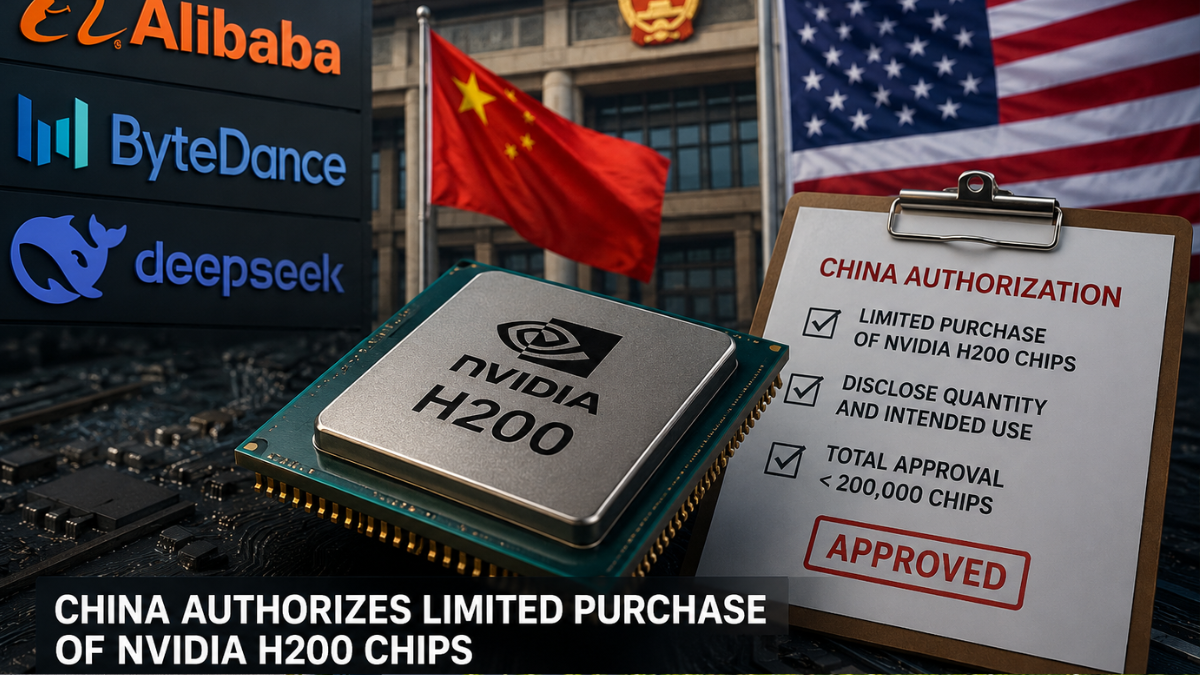
Reports from The Information confirm that China has moved to formally control H200 chip procurement for its leading AI companies. The China Nvidia H200 chip purchase limits affecting Alibaba, ByteDance, and DeepSeek are now one of the most closely watched AI hardware policy stories of 2026. The ceiling sits below 200,000 units combined. Every company must declare exactly how many chips it needs - and what it plans to do with them - before any purchase gets approved.
Nvidia closed at $204.12 on Wednesday, up roughly 3.6%. Markets liked the signal. But the fuller picture is a lot more complicated than one stock move suggests.
How the China Nvidia H200 Chip Purchase Limits Actually Work
Beijing isn't blocking H200 chips outright. It's managing them.
Each company applying for H200s must submit documented use cases. Training a frontier model from scratch may get approved. Running inference at scale on existing applications? That's where policymakers are now redirecting companies toward domestic silicon instead, not toward Nvidia.
This is the core of Beijing's AI compute stack training vs inference policy, and it's not subtle. Nvidia's Hopper architecture - with its high bandwidth memory and massive compute density - is most valuable at the training layer. For routine inference workloads serving millions of daily queries, Beijing wants those running on home-grown alternatives. The Nvidia H200 allocation cap under 200,000 units is a ceiling, not a guarantee. It's a B2B procurement framework for sovereign AI data center clusters dressed in regulatory language.
Huawei Ascend 910B enterprise adoption rate in China has already crossed 65% in key enterprise segments. That's not accidental. Companies have spent years being nudged - and sometimes pushed - toward domestic options, and Huawei's infrastructure has matured enough to absorb real inference load.
Why China Didn't Just Open the Floodgates
This is the part that gets compressed in most reporting. China isn't holding back H200 chips because it wants AI to slow down. China’s AI sector explosive growth is accelerating regardless. The restriction is about who controls the infrastructure underneath that growth, and what happens when the next round of export controls lands.
Two concerns are doing most of the work here. First, the Nvidia Hopper architecture chip export controls 2026 framework makes every imported H200 a geopolitical variable - chips embedded in sensitive AI systems carry cybersecurity exposure that Chinese authorities have cited explicitly, and it's not an unreasonable concern. Second, and more fundamentally, a mass influx of foreign AI processors before domestic alternatives hit scale would undermine the State Council's semiconductor self-sufficiency investment framework that's been years in the building.
For investors watching China national security tech transfers, the H200 situation signals a structural tightening - not a one-time exception. And China AI companies’ global competition strategies will increasingly be shaped by hardware constraints that don't show up on capability benchmarks.
DeepSeek Is Building Its Own Way Out
DeepSeek isn't just waiting on allocation clearance. The DeepSeek custom AI inference chip design project is real - early stage, but directional. Leung Man Fung, DeepSeek's founder, has spoken publicly about designing a chip optimized for high token throughput and memory bandwidth optimization rather than the general-purpose GPU compute Nvidia sells. The goal is reducing per-word inference costs through purpose-built AI model architecture. Not by buying more H200s.
That's a direct bet on ASIC architecture vs general-purpose GPUs for large language models - a debate DeepSeek is now entering with actual hardware investment, not just research papers. The comparison to OpenAI's custom inference chip strategy (the Jalapeno project developed with Broadcom) is obvious: both sides of this geopolitical divide are reaching the same conclusion about dedicated silicon. That said, high bandwidth memory supply constraints complicate any independent chip roadmap. It's not just logic design - it's about finding HBM supply that doesn't also run through export-controlled channels.
China is investing in workarounds at every layer. Chinese AI chips 3D stacking technology has attracted serious capital as one path forward. And the CXMT Tencent server DRAM deal - worth nearly $3 billion - tells you that memory supply chain domestication is already underway at a scale that can't be dismissed.
The Broader Ecosystem Moving in Parallel
ByteDance isn't sitting still. Recent reporting on the ByteDance GPU chips order from Tianshu Zhixin shows China's largest hyperscalers actively building domestic supplier relationships while H200 approvals remain pending. Hedging, basically.
Zhipu AI is in talks with chip design firms about a dedicated ASIC processor for its GLM model. The Zhipu AI dedicated ASIC processor GLM model project shows how far the custom-chip logic has spread - this isn't DeepSeek alone anymore.
Korean chipmakers targeting China markets at Electronica Shanghai 2026 are reading China's import constraints as a commercial opportunity, not a warning sign. And BYD self-driving chip and Huawei developments show domestic chip design expertise expanding into adjacent verticals - deepening the overall ecosystem that inference workloads can eventually migrate onto. For data center teams navigating mixed hardware environments right now, a heterogeneous computing platform approach is increasingly the practical answer.
What Beijing Is Saying Publicly
Liu Chang, spokesperson for the Chinese Embassy in the United States, put China's position plainly: mutual benefit through cooperation is the goal, and China opposes the "politicization, instrumentalization, and weaponization of technological and economic issues."
That statement aligns with China's broader diplomatic posture. The China UN AI accessibility statement, backed by 65 countries, frames AI hardware access as a development and fairness question - not purely an industrial one. And domestically, the ChatGPT market share China open source dynamic - where Chinese open source AI models are actively eroding Western dominance - shows the strategy working on multiple fronts at once.
The geopolitical technology export regulations and advanced semiconductors relationship isn't getting simpler. This is how the world's two largest economies are now directly shaping their algorithmic hardware computing footprints. Cooperation is the stated goal. Control is the actual mechanism.
What the H200 Allocation Tells You About Alibaba, ByteDance, and DeepSeek's Next Move
The final number - below 200,000 units total - matters less than the precedent it sets. H200s are now a controlled resource inside China, not a free import. Companies that work within that framework get limited access for approved use cases. Companies that push against it will need to build their own path, faster than they planned.
DeepSeek is building one. ByteDance is hedging. Alibaba is navigating. And Huawei gains ground with every month the approval queue runs long.
The China Nvidia H200 chip purchase limits for Alibaba, ByteDance, and DeepSeek aren't a temporary policy quirk. They're the new baseline for how frontier AI compute gets allocated inside China's borders - and every quarter these limits hold, domestic alternatives get a little closer to filling the gap.