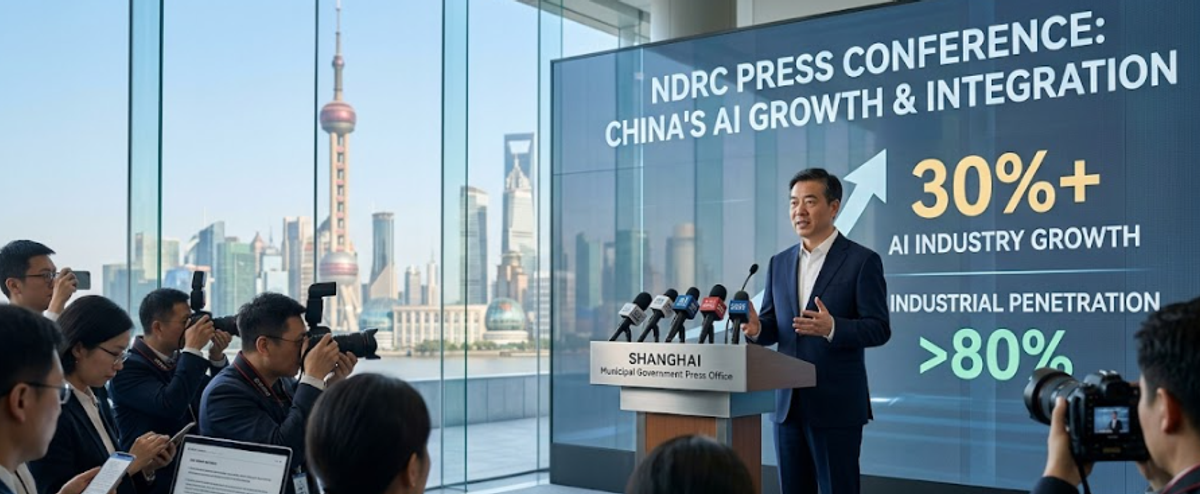
On July 7, Wang Ruomeng - Deputy Director of the Innovation and High-Tech Development Department of the National Development and Reform Commission - stood at a Shanghai Municipal Government press conference and delivered some of the most concrete AI growth data China has made public this year. Not projections dressed up as talking points. Actual numbers, with three clear policy pillars attached.
If you've been tracking China's AI sector growth from a distance, the National Development and Reform Commission China AI industry growth 2026 picture is worth looking at up close. Here's what the data actually says.
How the National Development and Reform Commission Frames China AI Industry Growth for 2026
Wang's remarks were organized around three pillars: promoting growth, promoting integration, and promoting innovation. Let's start with the first one.
China's AI-related industries crossed the one trillion yuan mark in 2025. That's already a major milestone. But the NDRC's preliminary forecast for this year puts growth at over 30% on top of that base - which would represent a significant acceleration, not a plateau.
Several AI companies went public during this period, with some hitting record market capitalizations. AI-driven market resilience has become a recurring theme in how analysts read China's A-share performance, and the IPO activity is a big part of why. State Council AI directives have been pushing industry integration as a national priority for several quarters. Wang's readout is, in part, a progress report on how those directives are translating into measurable outcomes.
Eighty Percent AI Penetration: What the Integration Numbers Actually Tell You
Here's where the data gets more interesting - and more nuanced.
The NDRC, working alongside relevant departments and local governments, has established over 30 national AI application pilot bases. Central and state-owned enterprises have now opened more than 1,000 AI application scenarios. And the overall AI penetration rate across key industries has crossed 80%.
Pause on that last figure. It tells you the question in China's industrial economy has shifted from "are we deploying AI?" to "how deeply is it embedded, and is it doing real work?" Wang explicitly called out the earlier problem of "superficial applications" - which is the government's way of saying cosmetic adoption doesn't count. Eighty percent penetration only means something if the tools are running actual production workflows, not sitting in a pilot lab somewhere.
China's industrial AI transition has been uneven across sectors, but the pilot base model appears to be accelerating genuine deployment rather than just producing press-release-friendly statistics.
The innovation-led economic blueprint China unveiled earlier this year set deep industrial integration as an explicit target. The 80% figure is, at minimum, consistent with that direction.
AI Smartphones About to Outsell Regular Ones - and the Agent Economy Is Already Here
Annual shipments of AI-powered smartphones, AI computers, and other smart terminals exceeded 100 million units in 2025. That's a large baseline. But the 2026 projection is the more striking claim: AI-powered smartphones and AI computers are expected to outsell non-AI products for the first time this year.
Think about what that means structurally. Not "AI features are being added to flagship models." The majority of devices sold - across price tiers - will be AI-native. That's a hardware market inflection point, and it's arriving faster than most industry forecasters had mapped it.
Chinese AI companies reshaping competition globally have been driving exactly this kind of shift, pushing capabilities that make AI functionality a baseline expectation rather than a premium differentiator.
The software-side demand signal is just as strong. Monthly visits to AI-native office intelligent agents in China now exceed 20 million. Daily average keyword calls to those agents reach trillions. That's not an install metric - it's a usage metric. The distinction matters. Billions of downloads tell you about reach. Trillions of daily interactions tell you about embedding.
Billion-yuan AI agent bets from regional governments are starting to look less speculative against numbers like these.
The WAEC 2026 Backdrop - and What's Driving the Broader Momentum
The July 7 press conference wasn't happening in a vacuum. It coincided with the World Artificial Intelligence Conference (WAEC 2026), a deliberate setting designed to amplify the National Artificial Intelligence Plus action plan achievements for 2026. That context matters - both for the timing and for the confidence with which these projections were stated publicly.
Government AI startup funding has been flowing into this ecosystem at sustained levels. The effects show up in deployment numbers, capital market performance, and increasingly in global positioning.
The AI industry unicorn rankings have shifted noticeably in China's direction over the past 18 months. And China's open-source AI momentum - which has meaningfully eroded competitors' global market share - is one of the structural forces making that shift sustainable, not just a one-year anomaly.
China's tech finance growth signals from the Lujiazui Forum pointed toward this kind of acceleration well before July. The NDRC's data is the confirmation.
Rapid growth at this scale does create real pressures, though. China's AI governance push is running alongside deployment - not as an obstacle, but as a necessary parallel track. How Beijing balances deployment speed with guardrails will shape the global AI story for years past 2026.