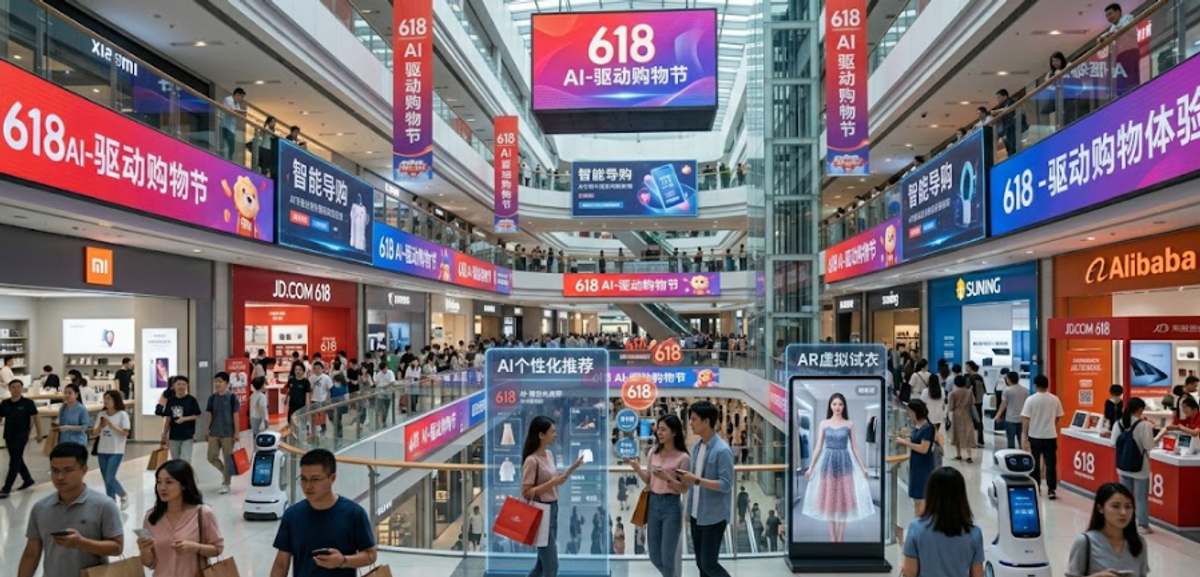
China 618 Shopping Festival 2026: How AI Is Rewriting the Rules of Online Retail
This year's China 618 shopping festival wasn't just about discounts. It was a live demonstration of how deeply artificial intelligence has embedded itself into China's retail ecosystem - and how quickly that's changing what merchants and consumers both expect.
From JD.com's AI-powered livestream hosts to Alibaba's conversational shopping assistant and ByteDance's recommendation engine, the 2026 mid-year festival marked a clear turning point. AI didn't just support the experience this time. It ran a significant chunk of it.
What the China 618 Shopping Festival Actually Is
If you're not already familiar, the China 618 shopping festival is one of the world's largest annual retail events, originally launched by JD.com to mark its founding date on June 18th. Over time, Alibaba, ByteDance, Kuaishou, and virtually every major Chinese platform joined in. Think of it as China's answer to Black Friday - except it runs for weeks, involves hundreds of millions of shoppers, and now, apparently, involves armies of AI hosts.
The 2026 edition pushed that tradition further than any previous year.
JD.com's AI Push - JoyAI and JoyStreamer
JD.com went all in. Within the first four hours of the festival, the number of merchants using JD's JoyAI model and its AI livestreaming host, JoyStreamer, had grown sixfold compared to the same period last year. Those AI-powered streams generated over 70 million yuan - roughly $10.3 million - in sales.
That's not a pilot program. That's infrastructure.
Cao Peng, chairman of JD's technology committee, described it directly: "This year's 618 shopping festival was JD's first to fully integrate AI across all scenarios and throughout the entire value chain." For merchants, the appeal is obvious. Running a live commerce stream traditionally requires hosts, production staff, and constant real-time product knowledge. An AI host doesn't take breaks. It doesn't have off days. And it scales instantly. The economics shift dramatically - which is exactly what JD.com is counting on.
How Alibaba's Qwen AI Changed the Search Experience
Alibaba took a different approach. Its Alibaba Qwen AI shopping assistant is now connected to the full product catalog on Taobao, letting users shop through conversation. You can ask it to compare two products, calculate whether a discount bundle actually saves you money, or just describe what you're looking for in plain language and get relevant results.
Xu Xiao, a 27-year-old bank employee in Beijing, uses the platform's AI virtual try-on tools when she's considering clothes in unfamiliar colors or styles. "It helps me avoid making bad purchases," she said, "and improves the chances that I'll be satisfied." That's the kind of specific, practical use case that actually moves conversion rates. It's not flashy. It just works.
The Alibaba Qwen AI integration in Taobao's marketplace signals something bigger than a search upgrade. It's a shift in how hundreds of millions of people interact with a catalog of millions of products. Keyword filtering is slowly giving way to intent-based conversation.
ByteDance, Douyin, and Kuaishou: Building AI Infrastructure at Scale
Douyin - ByteDance's Chinese short-video platform - made large-scale computing resources available to merchants during the festival. Its AI customer service tools handle repetitive queries automatically, cutting labor costs in ways that traditional support staffing can't match. ByteDance AI recommendation tools, paired with Douyin's short-video format, also create a product discovery experience that traditional search platforms still struggle to replicate. A product appears organically in your feed. You're halfway to buying it before you've consciously decided to shop.
Kuaishou deployed a different kind of AI: diagnostic systems that analyze seller performance in real time, flag operational problems, and suggest marketing adjustments on the fly. You don't wait for an end-of-week analytics review. The system tells you what's broken while you can still fix it.
From Keywords to Consumer Intent - the Bigger Shift
Here's where things get genuinely interesting. Liu Bangzheng, a senior executive at Alibaba's advertising unit Alimama, described a change that runs deeper than search functionality: "AI can move beyond understanding keywords and begin understanding intent."
He gave a specific example. A smart lock manufacturer - typically focused on homeowners - discovered through AI analysis that young women with long fingernails were a meaningful potential customer group, because keyless entry solved a real daily frustration. No keyword-based ad system would have surfaced that connection. That's the China e-commerce AI trend that actually matters for brands: finding demand that didn't previously exist.
According to Alibaba's Taobao and Tmall Group, roughly 70 percent of merchants on its platforms are already using some form of AI tool. Huatai Securities described AI as having evolved from a supporting feature into "critical operating infrastructure." That's a meaningful framing. It's not a nice-to-have anymore.
The Honest Limitations
Not everything is working cleanly. Worth saying that plainly.
Several consumers reported receiving AI recommendations that felt generic or off-target. Merchants using AI-generated business reports noted that the outputs often need significant manual verification before they're actually usable. Hong Yong, a research fellow at the Chinese Academy of International Trade and Economic Cooperation, framed the long-term questions well: whether AI recommendations genuinely serve users or become another advertising channel, whether smaller merchants can afford meaningful access to these tools, and whether platforms can credibly address concerns around privacy, pricing transparency, and accountability.
Those aren't abstract critiques. They're real constraints on how fast this technology can scale.
What This Means If You're Selling Into China
If you're a foreign brand planning your strategy for China's 618 shopping festival - or any major Chinese retail event - the AI shift has direct implications for how you approach the market. Consumer discovery is no longer primarily driven by paid keyword search. AI recommendation engines, conversational queries, and content-embedded product appearances increasingly shape it.
Product listings need to be structured for AI parsing, not just keyword matching. And understanding consumer intent - not just demographics - is becoming a genuine competitive edge. The infrastructure is there. The question is whether your approach is set up to work with it.
The China 618 Shopping Festival Is Now an AI Test Bed
The 2026 festival made one thing clear: AI isn't a feature China's e-commerce platforms are still testing. It's the direction they're building toward, at scale, with real revenue attached.
Every major platform ran AI at the core of this year's China 618 shopping festival. JoyStreamer generated tens of millions in sales. Qwen reshaped how consumers search on Taobao. AI recommendation engines found customer segments that human analysts missed entirely. That's not a test anymore.
Whether you're a merchant evaluating your tech stack, a brand mapping your China strategy, or just someone watching how generative AI in Chinese retail reshapes commerce globally, the 618 festival is now the annual benchmark worth tracking.