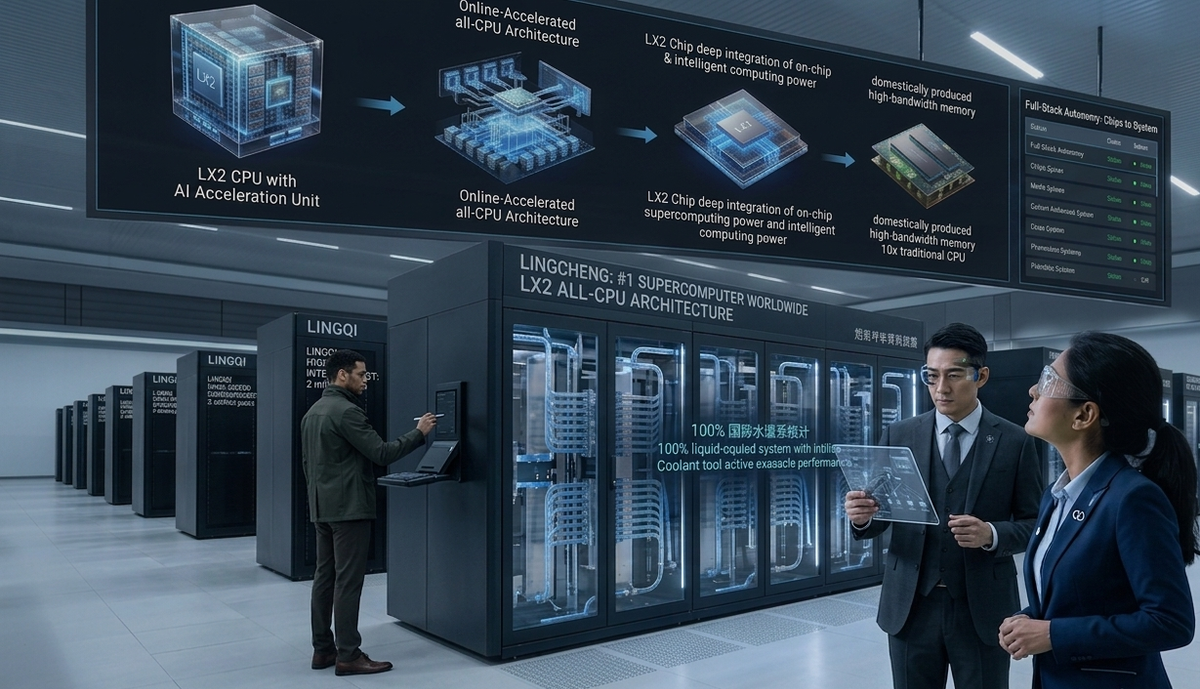
On June 23, 2026, at the International Supercomputing Conference in Hamburg, Germany, the latest TOP500 list was released. China's Lingcheng supercomputer topped it. Sustained double-precision floating-point performance: 2.198 EFlops per second. The U.S.-based El Capitan - the previous world leader - came in second at 1.809 EFlops.
That's not a narrow margin.
What makes this a bigger story than just a ranking shift is that China's Lingcheng Supercomputer Architecture was built from the ground up using entirely domestically developed technology. Chips, networking, storage, software - all of it. Nine years after China last held the top supercomputing position in the world, it's back. And this time, the approach is fundamentally different.
The Architecture Decision That Set Lingcheng Apart
Most high-performance computing systems today follow the same general blueprint. You pair CPUs with stacks of GPU accelerator cards, let the GPUs shoulder the heavy computation, and scale up from there. El Capitan does it. Frontier does it. It's the dominant paradigm - and it works.
Lingcheng didn't do it.
China's Lingcheng Supercomputer Architecture is built on what designers call an "online-accelerated all-CPU architecture." Instead of a separate GPU handling acceleration while a CPU handles control logic (with data constantly shuttling between the two), the Lingcheng approach embeds AI matrix acceleration units directly inside the LX2 CPU itself.
Lu Yutong, chief designer of the system and director of the National Supercomputing Center in Shenzhen, described this as "returning to the essence of computing acceleration." That framing matters. The CPU-GPU model was never designed for maximum efficiency - it was designed for flexibility and scalability. The LX2-based architecture trades some of that flexibility for the elimination of inter-chip data transfer overhead.
Turing Award winner Jack Dongarra put it plainly: Lingcheng "has shown the world a glimmer of hope for supercomputing to lead to a new system architecture for AI for Science."
That's a meaningful statement from someone who helped create the TOP500 list.
What Lingcheng Supercomputer Speed in EFlops Actually Means
2.198 EFlops. That's 2.198 quintillion floating-point calculations per second.
Here's a more practical frame: if every single person on Earth performed one calculation per second, it would take roughly 280,000 years to match what Lingcheng does in a single second. Which, admittedly, is still an almost incomprehensible number. But at this scale, multi-week simulations can compress into hours. That changes what science can actually get done.
The LX2 CPU core makes this possible through multi-precision matrix acceleration built directly into the chip. It also integrates the first domestically produced high-bandwidth memory, with memory bandwidth reportedly 10 times higher than traditional CPU-compatible memory. You eliminate the CPU-to-GPU transfer bottleneck, and then you add dramatically faster memory access on top of that.
The combination is what pushes Lingcheng past every existing exascale system. Not a single improvement - a compounding of several.
How Lingcheng Achieves Full-Stack Autonomy
If the 2016 Sunway TaihuLight represented a breakthrough in a specific chip technology, Lingcheng represents something broader. It's a fully domestically developed system across every layer of the stack.
The LX2 CPU handles compute. The Lingqi high-speed interconnect handles networking, supporting ultra-large-scale configurations with up to 2 million ports and 100,000 nodes. Storage uses a layered architecture that balances high-performance working areas against high-capacity data storage, scaling to exascale levels.
And then there's software. China's Lingcheng Supercomputer Architecture includes a custom full-stack software environment - including what Lu Yutong calls a "large-scale super-intelligent converged framework" - designed to release underlying hardware capabilities to applications in a way that's actually usable, programmable, and tunable for specific workloads.
That's the hard part most people overlook. Hardware performance numbers are one thing. Making that hardware accessible to researchers in atmospheric science, drug discovery, and materials modeling is another problem entirely.
On the energy side, Lingcheng pioneers 100% liquid-cooled computer cabinets throughout, achieving an energy efficiency ratio of 51 GFlops/W. For context: that's 51 billion floating-point operations per second for every watt consumed. Green computing efficiency at this scale of performance is genuinely difficult. Lingcheng does both simultaneously.
What Researchers Are Actually Running on Lingcheng
Performance benchmarks win rankings. What wins credibility is real output.
Since deployment, Lingcheng has supported work across atmospheric and oceanic science, engineering simulation, materials science, drug discovery, brain science, and large model inference. Its average scalability across large-scale parallel environments sits at 84.4%, which is a strong number for a system operating at this node count.
In remote sensing, Fu Haohuan's team at the National Supercomputing Center used Lingcheng to train large-scale remote sensing models and achieve high-compression reconstruction of eight years of global satellite time-series imagery. That work now underpins precipitation forecasting and disaster early warning systems.
The drug discovery application is striking. Professor Yang Yuedong at Sun Yat-sen University reports virtual screening of trillions of compounds per day using Lingcheng, combined with AI reinforcement learning methods. Screening efficiency has improved a thousandfold compared to prior approaches. The implications for precision medicine and drug development are direct, not theoretical.
These aren't planned use cases. They're running now.
Lingcheng Sets a New Benchmark - and Asks a Bigger Question
Nine years. That's how long it took China to return to the top of the world's supercomputing rankings. And this time, with China's Lingcheng Supercomputer Architecture, the return is built on something more durable than a single chip breakthrough - it's a fully integrated, domestically developed system from silicon to software.
The performance lead over El Capitan is real and measurable. But the architectural bet on all-CPU design with integrated acceleration may turn out to be the more lasting contribution. If that approach proves scalable and reproducible across generations of hardware, it could reshape how the next wave of supercomputers gets built.
For anyone working in climate science, drug discovery, AI research, or remote sensing, Lingcheng represents access to a resource capable of running what simply wasn't possible before. That's the real story behind the #1 ranking.