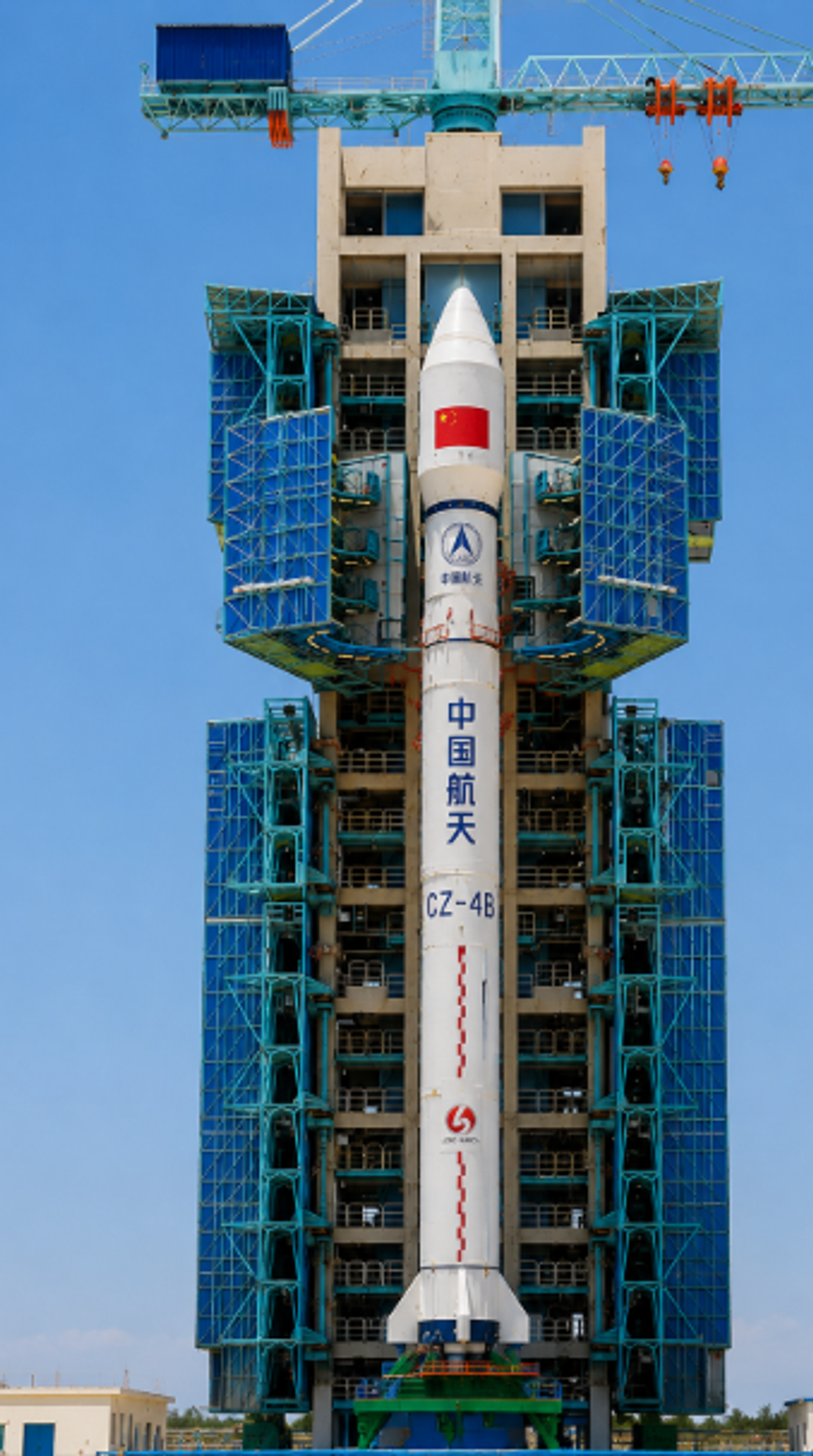
At 7:46 a.m. on July 2, the Long March 4B successfully launched the Haiyang 2E satellite from the Jiuquan Satellite Launch Center, placing it precisely into its predetermined orbit. If you follow Chinese space missions or marine monitoring programs, this one's worth your attention.
Not because it was flashy. Because it finished something.
Haiyang 2E: What This Satellite Does and Why It Matters
The Haiyang 2E satellite was developed by the Remote Sensing Satellite Department of the Fifth Academy, China Aerospace Science and Technology Corporation. Its primary mission covers safeguarding maritime rights and disaster mitigation, supporting marine resource development, and powering ocean scientific research. It's also replacing Haiyang-2B, which launched back in 2018.
By networking with the already operational Haiyang-2C and Haiyang-2D satellites, Haiyang-2E completes the second phase of China's marine dynamic environment satellite constellation project. That's the significant part.
Think about what you're actually monitoring when you watch an ocean. Surface winds, wave heights, sea levels, tidal patterns, currents - all constantly shifting. A single satellite passes over any given area only periodically. Three coordinated satellites can cover the same regions far more frequently, approaching continuous coverage. For typhoon tracking, storm surge prediction, and disaster prevention applications, that frequency gap is the difference between useful data and actionable data. The networking of Haiyang-2C, Haiyang-2D, and Haiyang-2E together is what turns individual assets into a functioning system delivering continuous marine environment monitoring services.
Haiyang 2E also carries technical upgrades to its payload, improving observation capabilities in nearshore coastal waters considerably. Coastal zone monitoring just got meaningfully sharper.
How Long March 4B Successfully Launches Haiyang 2E Satellite Under Extreme Summer Heat
The Long March 4B carrier rocket mission that delivered Haiyang 2E is built and operated by the Eighth Academy of China Aerospace Science and Technology Corporation. It's a room-temperature liquid three-stage launch vehicle. That means propellants don't need cryogenic temperatures, which gives the ground team more flexibility in handling and preparation.
Sun-synchronous orbit payload capacity for Long March 4B tops out at 2.5 tons at 700 kilometers altitude - enough to cover a wide range of Earth observation satellite types, including single and multi-satellite deployments.
Now here's where this mission gets technically interesting.
For the first time, the team adopted a parallel propellant loading mode under high-temperature conditions. Conditions at Jiuquan in early July were genuinely challenging - hot, dry weather combined with strong winds and dust storms. Standard sequential propellant loading carries real risk when ambient temperatures spike like that. You're dealing with liquids sensitive to temperature variation, inside a vehicle that needs to fly.
The solution was running loading across multiple rocket stages simultaneously, cutting the total time propellants spend exposed to heat. But the team didn't improvise this on the spot. They drew on experience from previous summer launches, ran multiple rounds of calculations and testing, and continuously refined prevention and control strategies for rocket propellant loading until they were genuinely confident in the approach before committing to it on a live mission.
It worked. The satellite reached orbit.
Managing launch operations during summer dust storms and strong winds rarely makes headlines. Solving it properly - through preparation and accumulated experience rather than shortcuts - is what reliable orbital access actually looks like. That patient engineering approach reflects China's self-reliant tech strategy visible across sectors: when external conditions are difficult, the answer is building better internal solutions.
Long March 4B's Haiyang 2E Satellite Launch: Mission 654 in Perspective
The Long March 4B successfully launches Haiyang 2E satellite as the 654th flight in the Long March series carrier rockets' history.
Six hundred and fifty-four. That doesn't happen by coincidence. It represents decades of iterative development, flight-by-flight data accumulation, and continuous refinement across a rocket family that handles China's primary orbital access needs. The experience is baked into every procedure the team runs.
And when you need to modify your propellant loading approach mid-summer because of a dust storm? That's the kind of call you make confidently when 654 flights of accumulated engineering knowledge are backing you up.
Why This Launch Fits a Bigger Pattern
This mission isn't happening in isolation.
For anyone following space science coverage closely, the Haiyang 2E satellite launch in Jiuquan represents one node in China's methodical build-out of scientific infrastructure - consistent, deliberate, and long-horizon. From cutting-edge Chinese science at the quantum hardware level to active programs like this one, the scope of ambition is consistently large.
The economic dimension matters too. China's industrial expansion and China's tech-led economic momentum fund long-horizon infrastructure programs like marine satellite constellations - which don't return value in a quarter, but serve fisheries, shipping logistics, offshore energy operators, and disaster management agencies for decades.
China's rocket engine advances provide the orbital access that makes missions like this one possible in the first place. China's billion-yuan tech investments in AI and intelligent infrastructure are increasingly positioned to use the high-frequency Earth observation data that a mature marine constellation generates. And where China's AI-driven data ambitions eventually intersect with satellite-sourced ocean datasets is one of the more interesting long-term developments worth watching.
What the Long March 4B and Haiyang 2E Satellite Launch Tell You
The Long March 4B successfully launched the Haiyang 2E satellite on July 2 and, on the surface, went about as planned. Rocket lifts off. Satellite reaches orbit. Done.
But look a little closer. A first-ever parallel propellant loading approach under high-temperature conditions - developed through systematic testing, not improvisation. The completion of a marine dynamic environment satellite constellation now capable of near-continuous ocean monitoring. And mission number 654 in a launch series that remains China's primary orbital backbone.
Routine on the surface. Not routine underneath.