Summary
Institutional investors quarterly 13F filings tech holdings paint a more cautious picture than the headline market rally might suggest. Major funds haven't abandoned technology. But many appear fully allocated, close to internal risk limits, and less willing to add aggressively after a long run in megacap names.
A review of 6,371 filings from pension funds, hedge funds, wealth managers, and other professional investors found a narrow divide between buyers and sellers during Q2. That matters. When positioning is this evenly split, price moves can become jumpy because there aren't many obvious buyers left to absorb selling pressure.
Key Points
- Institutions aren't abandoning Big Tech: The filings show both buying and selling, with the difference between the two sides relatively narrow.
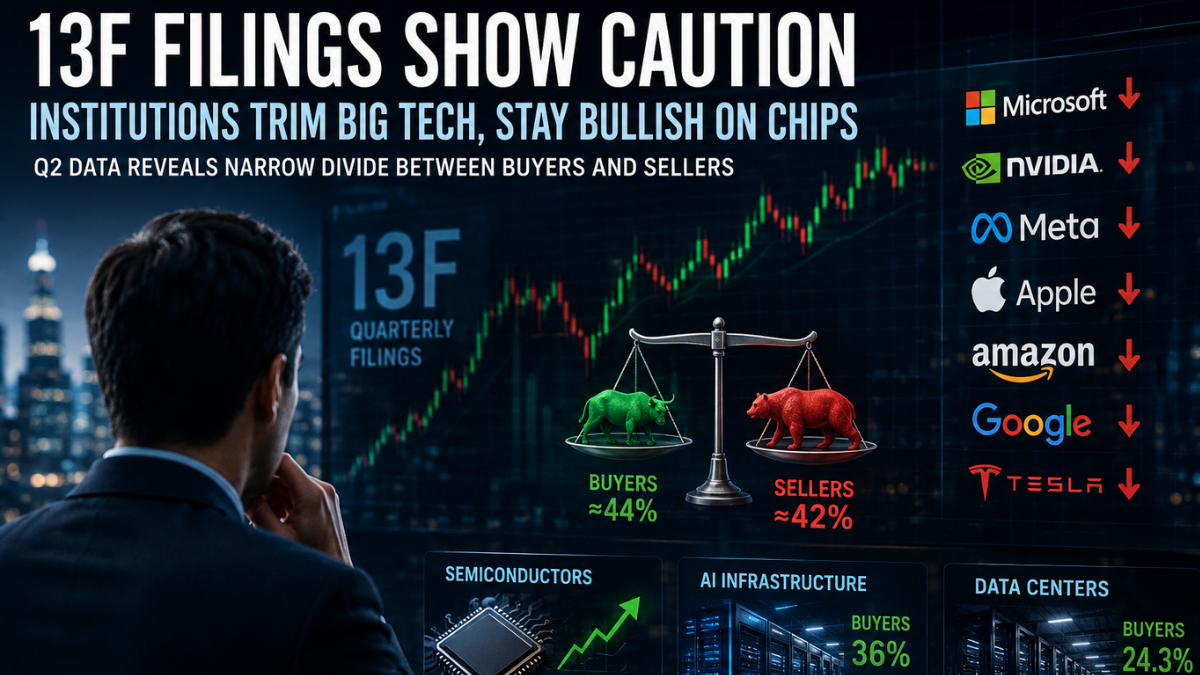
- Magnificent Seven positioning is becoming more cautious: Around 44% of reporting investors reduced their positions, compared with 42% that started or increased them.
- Risk limits matter: Some funds may be trimming large technology positions simply because those holdings have grown too large within their portfolios.
- Semiconductors remain the strongest area: Institutional buying was higher than selling, suggesting continued confidence in the chip industry's role in AI infrastructure.
- AI infrastructure is becoming a crowded trade: Companies linked to data centers and AI hardware continue to attract money, but institutional conviction is far from unanimous.
- Tiger Global's moves stand out: The fund reduced exposure to several major technology names while increasing its Intel position, showing that some investors are rotating rather than leaving technology altogether.
- Data-center stocks have a divided investor base: Buying and selling activity was almost evenly balanced, reflecting uncertainty around power availability, construction costs, financing and future AI demand.
- Energy positioning was more defensive: More institutions reduced major energy positions than added them during the quarter, despite higher oil prices.
- 13F filings have limitations: They are delayed disclosures and don't show short positions, options or the reasons behind individual trades.
- Crowded ownership can increase volatility: When many funds hold the same stocks, even modest selling can have an outsized effect when investors move toward the exit at the same time.
- The market is becoming more selective: Investors appear increasingly interested in companies that can turn AI spending into actual revenue and profits rather than simply benefiting from the excitement around the sector.
- The next earnings season matters: The most useful signal will be whether company results support the valuations investors are currently willing to pay.
What institutional investors quarterly 13F filings tech holdings reveal
The latest US quarterly 13F filings institutional tech stock holdings show that 44% of reporting investors trimmed Magnificent Seven positions, while 42% started or increased them. The difference is slim, yet it still points to a market without a clear institutional consensus.
That isn't necessarily a bearish call on AI or Big Tech. Often, it reflects portfolio math. A fund that already owns a large Microsoft, Nvidia, or Meta position may like the business but be unable to buy more without exceeding its own concentration rules.
That helps explain why strong earnings don't always produce a sustained rally. If long-term holders are already at their preferred allocation, good news may attract fewer incremental buyers. Recent attention around Microsoft's value surge shows just how quickly those valuation expectations can become demanding.
Why are hedge funds trimming stakes in Magnificent Seven stocks?
Hedge fund portfolio rebalancing Big Tech risk limits appear to be a key part of the story. Funds have enjoyed substantial gains in the biggest technology companies, but gains also create concentration. Selling a small portion can be a risk-management decision, not a prediction of a collapse.
The Magnificent Seven tech stocks hedge fund selling Q2 data is especially relevant because these names have carried so much of the broader market's performance. Investors are also debating whether current Apple and Nvidia valuations fully reflect future earnings growth.
There are real concerns underneath the optimism. Spending on chips, data centers, and models remains huge, while investors continue to question AI capex pressures. Nobody disputes that AI investment is happening. The argument is over which companies will capture the profits.
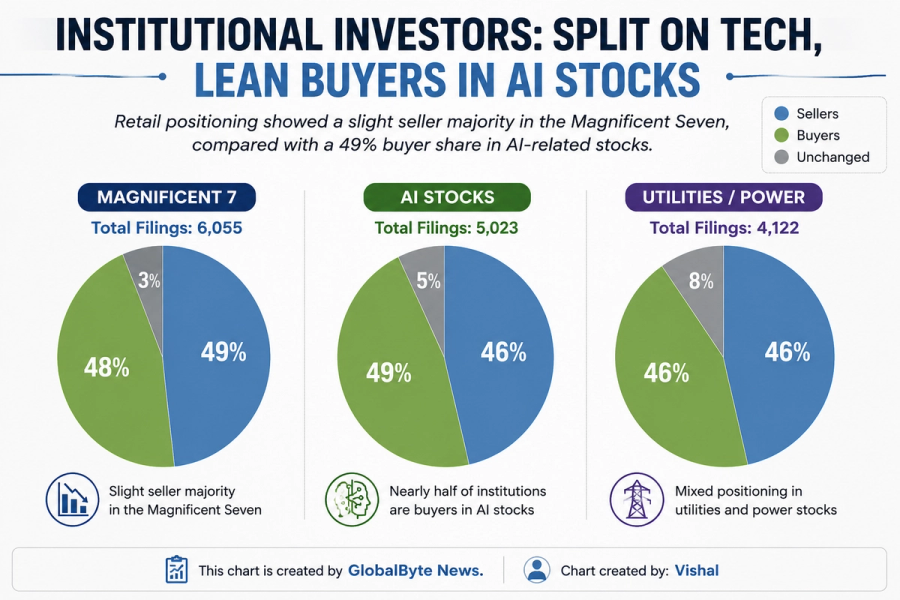
Institutional investors remain divided across major tech and AI-related stocks, highlighting a cautious market mood. Chart by GlobalByte News - Vishal.
Tiger Global's Q2 moves: Alphabet down, Intel up
Tiger Global 13F filing Microsoft Nvidia Meta stake cut activity stood out among widely followed disclosures. The fund reduced positions in Microsoft, Nvidia, Meta, and Taiwan Semiconductor while increasing its Intel holding.
How much did Tiger Global cut its stake in Alphabet? Tiger Global Alphabet stake reduction 45 percent was the headline figure, taking its Alphabet exposure to 5.8 million shares.
This doesn't automatically mean Tiger Global has turned negative on AI. It may simply be rotating exposure, taking profits, or adjusting for a portfolio that had become too dependent on a handful of familiar winners. Still, the filing highlights why institutional investors trim Magnificent Seven tech holdings according to latest 13F filings.
And there are company-specific risks, too. For example, Apple supply bottlenecks can quickly change the near-term outlook even when the long-term story remains intact.
Semiconductor stocks maintain a bullish institutional tilt
Are institutional investors still bullish on semiconductor stocks in 2026? Compared with broader tech, yes. Semiconductor stock institutional net buyers Q2 reached 48%, while 34.5% were net sellers.
That gap suggests semiconductor stocks maintain bullish institutional sentiment despite broader tech pullbacks. Chips sit at the center of AI computing demand, and the market is still watching semiconductor profit trends closely.
But bullish doesn't mean easy. Semiconductor shares can be brutally volatile when guidance disappoints or inventory expectations change. The opportunity is real; so is the cyclicality.
AI infrastructure stocks became a crowded trade
Why are institutions taking a cautious approach to AI infrastructure stocks? Because a fundamental growth story can turn into a leveraged momentum trade faster than most investors expect.
About 36% of institutions were net buyers of AI-related companies such as CoreWeave, Arista Networks, and Broadcom. Yet 13F filings show narrow gap between institutional buyers and sellers in AI stocks, particularly around data-center exposure.
Why did crowded tech trades cause market volatility in July? When many funds own the same winners, an exit becomes crowded too. Selling feeds on selling, liquidity thins, and investors lock in gains at the same time. That is why crowded tech stock unwinds trigger market volatility as funds lock in gains.
The long-term thesis hasn't vanished. Nvidia AI infrastructure bet, AI supply-chain growth, and China's chipmakers pricing all show how broad the investment cycle has become.
Energy sellers and split data-center positioning
Institutional energy sector net sellers 13F report data showed 40.3% of investors reducing major energy-company exposure, compared with 28% buying. That was notable given higher crude prices during the quarter.
Some funds still found selective opportunities. New positions in BP, Devon Energy, geothermal provider Fervo Energy, and data-center operator Keel Infrastructure suggest hedge funds are reallocating capital into geothermal and AI power infrastructure rather than making a blanket sector bet.
Data center stocks institutional positioning Q2 was almost perfectly balanced, with 24.3% net buyers and 24.3% net sellers. Data center stocks see split consensus among major institutional wealth managers because power availability, financing costs, construction timing, and AI demand are all pulling in different directions.
Outside the United States, China tech stock rally and China A-share resilience offer a useful reminder: AI capital isn't moving through one market alone.
What Q2 13F filings mean for your market read
Institutional investors quarterly 13F filings tech holdings don't predict the next quarter. They are delayed disclosures, and they don't reveal options, short positions, or the reasoning behind every trade.
Still, they can show where conviction is thinning. What institutional 13F filings reveal about stock market sentiment entering late 2026 is a cautious, selective market: investors remain interested in semiconductors and AI, but they are less united on megacap tech, energy, and data centers.
How do 13F filings signal shifts in market momentum and consensus? Watch the gap between buyers and sellers, then compare it with price action and earnings. When that gap narrows after a crowded rally, volatility often follows.
The cautious case for tech remains intact
Institutional investors quarterly 13F filings tech holdings suggest a market shifting from broad enthusiasm to stock-by-stock judgment. Semiconductors still have the strongest institutional support. Big Tech remains widely owned but increasingly constrained by valuations and risk limits, while AI infrastructure and data centers are attracting interest without a unified view.
For you, the practical message is simple: don't confuse a trimmed position with a broken thesis. Look for where institutional conviction is strengthening, where ownership is crowded, and where the next earnings report could change the consensus.
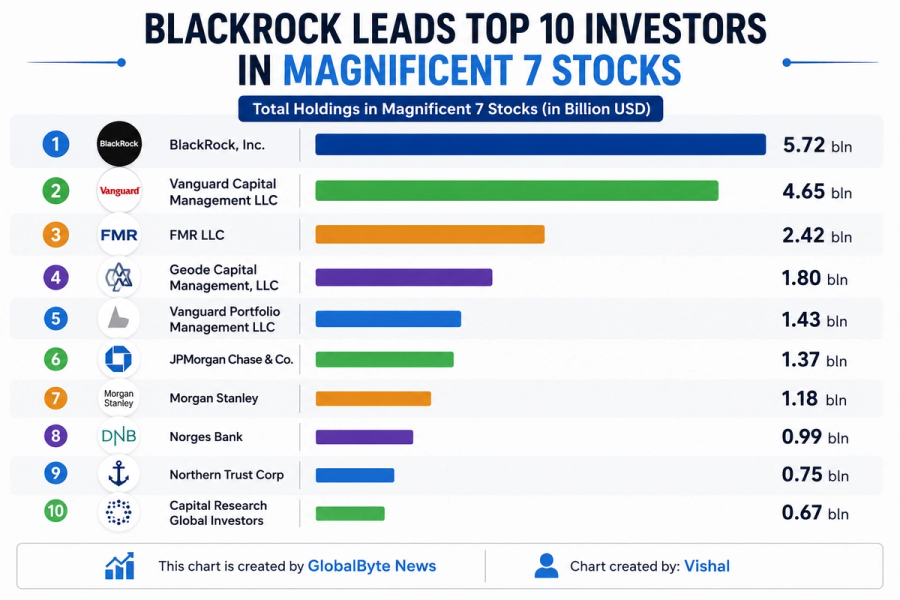
The largest institutional investors continue to hold substantial positions across the Magnificent Seven, led by BlackRock and Vanguard. Chart by GlobalByte News - Vishal.
GlobalByte Perspective
The latest 13F filings don't show institutional investors walking away from technology. They show something more subtle: investors are becoming more selective after a long run in Big Tech and AI stocks.
The near-even split between institutions adding and reducing Magnificent Seven positions is important because it suggests there is no longer a clear consensus that these stocks should simply keep getting bigger allocations. For some funds, the issue may be valuation or concentration rather than a change in their view of the underlying businesses.
Semiconductors stand out as the stronger part of the picture. Institutional buying remains noticeably higher there, which makes sense given how closely chip demand is tied to the continuing expansion of AI infrastructure. But even in that area, investors will likely become more demanding if spending keeps rising faster than profits.
The bigger concern is crowding. When too many investors own the same AI and technology winners, even a relatively small shift in sentiment can create a sharp move. A fund doesn't need to believe Nvidia, Microsoft or Meta is a bad business to sell. It may simply decide that the position has become too large or that the gains should be locked in.
From GlobalByte's perspective, the 13F data points to a market moving from “buy the AI story” to “show me where the returns are.” That is a healthier environment in the long run, but it could also mean more volatility as investors separate the companies benefiting from AI spending from those whose valuations have simply risen alongside the theme.