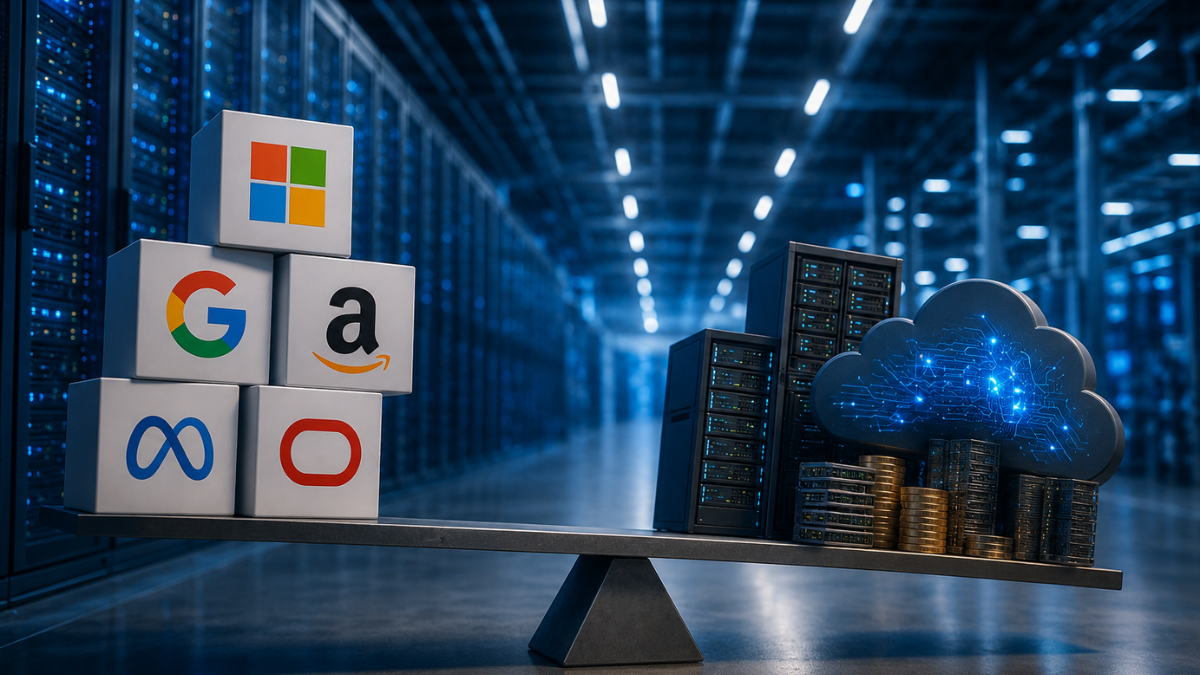
Here's the thing nobody at these companies wants to say out loud: the AI boom is starting to cost more than it's bringing in, at least on paper. Big Tech AI capex free cash flow trends are diverging fast, and investors have noticed. Microsoft, Alphabet, Amazon, Meta, and Oracle are on pace to spend more combined on data centers, chips, and servers than they generate in free cash flow by 2027. That's not a hunch. It's what LSEG's own consensus estimates are showing right now.
And the gap isn't small.
Why the Numbers Don't Add Up Anymore
Operating cash flow across the five hyperscalers is expected to rise by roughly $340 billion between 2025 and 2027. Sounds great, until you see the other number. Capital expenditures are projected to climb by about $534 billion over the same stretch. Do the math, and you get something like $1.57 in new spending for every extra dollar of cash flow. That ratio is the whole story, honestly. It's why the Big Tech AI capex free cash flow gap has become the thing every analyst wants to ask about on earnings calls, starting with Alphabet this week.
Shay Boloor, chief market strategist at Futurum Equities, put it bluntly: investors are underestimating how fundamentally AI is changing the Big Tech business model. These were asset-light businesses once. Software scaled without much physical cost. Now? Cloud economics, advertising, and AI products all lean on enormous physical infrastructure spending, and that changes the valuation math investors have used for a decade.
None of this is theoretical, either. Current-year capex estimates for the five companies jumped from about $485 billion in January to around $730 billion by July. That's not a rounding error. That's a fundamental repricing of what it costs to compete in AI.
Oracle Is the Cautionary Tale Everyone's Watching
If you want to see what happens when capex outruns cash flow, look at Oracle. Its free cash flow turned negative this year. Shares are down 36% since January. Oracle's capex as a percentage of operating cash flow rose from 47% in fiscal 2022 to a staggering 174% in fiscal 2026, which wrapped up in May. Capex hit $55.7 billion against operating cash flow of just $32 billion.
Oracle now plans to raise $45 billion to $50 billion in debt and equity just to keep funding its cloud infrastructure expansion. That's the Oracle free cash flow capex deficit in a nutshell, and it's exactly the scenario David Russell, global head of market strategy at TradeStation, warned about: "Earnings growth may not be enough to justify investment if capex is depleting cash. Companies exist to make money, not spend money."
Microsoft and Amazon Aren't Immune Either
Microsoft reported $35.8 billion in operating cash flow last quarter, against $37.5 billion in capex (including finance leases). Spending edged past cash generation. Not dramatically, not yet, but the direction matters.
Amazon's story is more dramatic. Trailing 12-month operating cash flow rose 30% to $148.5 billion in the first quarter. Free cash flow, though, fell all the way to $1.2 billion. That's the Microsoft AWS AI revenue run rate story cutting both ways: Microsoft says its AI business has topped a $37 billion annual run rate, and AWS posted 28% growth. The revenue is real. So is the spending eating into it.
The Global AI Infrastructure Race Isn't Just a U.S. Story
While American hyperscalers wrestle with this tradeoff, China's tech sector is running its own version of the same experiment, just with different constraints. Export controls have shaped what's available there, including new H200 chip purchase limits affecting Alibaba, ByteDance, and DeepSeek. In response, domestic players have pushed hard on self-reliance. Sugon's 100,000-card AI supercluster launch is one example. Lenovo's ISG unit has set an ambitious AI computing infrastructure revenue target of $100 billion, showing just how much capital is chasing this buildout outside the U.S. too.
Memory supply is part of it. A server DRAM supply deal between CXMT and Tencent, worth nearly $2.94 billion, underscores how tightly chip supply and cloud buildout are now linked. Meanwhile, a GPU chip order reshaping China's AI supply chain shows domestic silicon gaining real traction, and a wider survey of firms leaving Nvidia for local AI suppliers backs that trend up with actual numbers, not just anecdotes.
It's not only China building capacity, either. Samsung's semiconductor wafer fab construction near Yongin got pulled forward specifically to meet AI-driven chip demand. Capital markets are reacting too. A recent share placement driving a tech stock rally from Zhipu AI moved the entire Hong Kong tech sector in a single session. Even energy sourcing is shifting, with China's green electricity AI data center now live and running.
None of this has rattled the broader market as much as you'd expect. Despite volatility, there's been genuine tech-led A-share market resilience, and regional bets keep landing, like Wuhan's $1 billion bet on AI agents through its Optics Valley initiative. Even policymakers are paying attention. This year's Lujiazui Forum produced what many are calling the clearest tech finance growth signal yet for how capital markets plan to support this buildout going forward.
Are Buybacks and Dividends Actually at Risk?
Not yet, for most companies. Microsoft, Alphabet, and Meta still generated enough free cash flow last fiscal year to cover both dividends and buybacks, according to their SEC filings. But "still" is doing a lot of work in that sentence.
If capex stays this elevated and AI monetization takes longer than expected, something has to give. Freddy Lavric, senior trader at Winthrop Capital Management, framed the stakes well: over the next two to three years, companies need to show AI is driving incremental revenue, expanding margins, and improving cash flow. If those benefits aren't showing up by then, the market starts asking whether the whole investment cycle went too far.
Worth noting too: shares of four of the five hyperscalers have trailed the S&P 500 over the past year. Only Alphabet has kept pace. That alone tells you how skeptical investors have become about hyperscaler share performance versus the broader market, even as the underlying AI products keep improving.
Where This Leaves Investors
Big Tech AI capex free cash flow pressure isn't a crisis yet. It's a warning sign. Oracle shows what happens when spending outruns cash generation for too long. Microsoft and Amazon still have room, but the room is shrinking. And with capex estimates rising every few months, the question isn't whether AI will pay off eventually. It's whether it pays off fast enough to keep the current spending pace defensible. Watch the next round of earnings closely. That's where you'll get your answer.