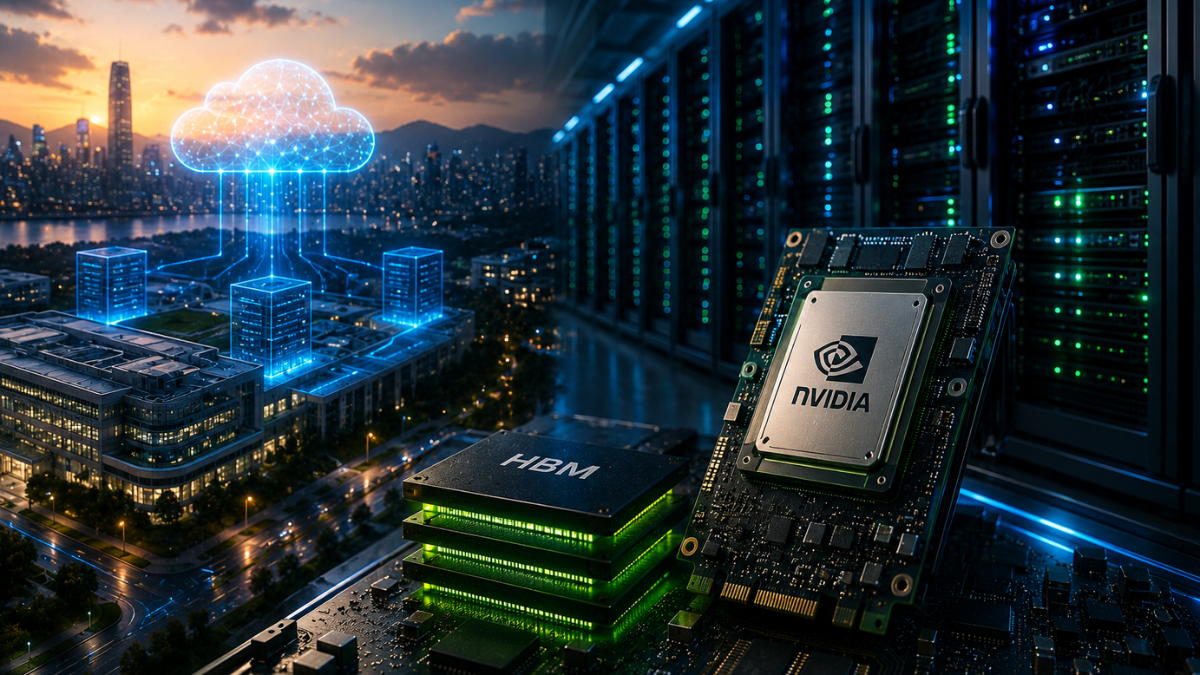
Nvidia and South Korea's SK Group just announced something hard to overstate. The Nvidia SK Group AI data center partnership, unveiled in San Francisco on July 24, is worth more than $500 billion and spans next-generation memory chips, massive new data center campuses, and a supply relationship that will shape AI infrastructure for years. It pulls in some of the biggest names in Korean tech, SK Hynix, SK Telecom, and, through a related deal, Naver. Nvidia's fingerprints are on all of it.
So what's actually in this thing? Let's get into it.
What's Actually in the Nvidia SK Group AI Data Center Partnership
Strip away the press-release language, and you're left with three moving pieces. First, a long-term memory supply agreement between Nvidia and SK Hynix. Second, a 2-gigawatt AI data center from SK Telecom. Third, an expansion of Naver's AI data center footprint, backed by Brookfield.
Each piece matters on its own. Together, they position Korea as something closer to a core AI manufacturing hub than a supplier on the sidelines. That's not a small shift. South Korea's AI chip infrastructure has faced real strain over the past year, from power constraints to talent shortages, and this deal is essentially a bet that those problems get solved rather than get worse.
SK Hynix and the Race for HBM4 Memory
Here's the part that matters most for anyone tracking chip supply chains: Nvidia and SK Hynix are locking in a long-term deal for next-generation memory. Specifically, we're talking about the Nvidia Vera Rubin chips HBM4 memory deal, where SK Hynix will supply high-bandwidth memory built for AI training, AI agents, and physical AI applications (think robotics, autonomous systems, anything that needs to process the physical world in real time).
HBM4 is the next step up from HBM3e, and it's not a minor upgrade. It's faster, denser, and built to keep pace with chips that are pushing more data through memory than anything before them. Without a reliable SK Hynix high-bandwidth memory partnership, Nvidia's roadmap for Vera Rubin simply doesn't work as fast as planned. Memory has quietly become the bottleneck in AI hardware, not the GPU itself, and this is Nvidia's way of getting ahead of it.
It's worth putting this next to what's happening elsewhere in the memory market. China's CXMT recently struck the DRAM supply deal for AI servers with Tencent, a sign that memory supply is becoming a geopolitical chess piece, not just a component line item. Meanwhile, Samsung isn't sitting still either. Samsung's Yongin wafer fab expansion just got pulled forward, which tells you the whole Korean semiconductor sector is racing to keep up with AI demand, not just SK Hynix.
SK Telecom's 2-Gigawatt AI Data Center: Coming in 2027
SK Telecom is building a 2-gigawatt AI data center powered by Nvidia's newest chip architecture and SK Hynix's HBM4 memory. The first facility is expected to come online in 2027. Two gigawatts is a genuinely massive number, roughly enough to power a mid-sized city, and it signals SK Telecom isn't dabbling here. It's going all in.
This facility will run on chips from Nvidia's Vera Rubin AI system, Nvidia's platform built specifically for the next wave of agentic and physical AI workloads. That's not a coincidence. Vera Rubin needs memory that can keep up, and SK Hynix's HBM4 is designed to do exactly that.
Power is the real question mark, though. A data center this size needs serious grid capacity, and South Korea will have to figure out how to source that power sustainably. Some operators elsewhere are already experimenting with cleaner approaches, like a green electricity AI data center running largely on renewables. Whether SK Telecom follows a similar path for its 2027 facility is still unclear.
For context on scale, compare this to other recent AI infrastructure bets. A billion-dollar AI data center lease in Texas made headlines earlier this year, and even that looks modest next to what SK Telecom is planning here.
Naver, Brookfield, and Expanding Korea's AI Footprint
Separately, but very much part of the same push, Nvidia, Naver, and Brookfield are teaming up to expand Naver's existing AI data center in South Korea. Naver already runs one of the country's largest AI infrastructure operations, and Brookfield's involvement brings serious capital and real estate expertise to the table.
This isn't the flashiest part of the announcement. But it's arguably just as important, because it shows the Nvidia SK Group AI data center partnership isn't limited to a single company or a single facility. It's a broader alignment across Korea's AI ecosystem, with Nvidia positioned at the center of nearly all of it.
Why This Deal Matters Beyond Korea
Zoom out, and this starts looking less like a regional infrastructure story and more like a signal about where Nvidia is placing its chips (pun intended). Nvidia has been juggling supply commitments across multiple countries, including Nvidia's chip allocation deals tied to China market access. Korea is now getting a much larger, more direct slice of that attention.
It also reinforces Korea's role in the chip world beyond just memory. Korean fabless chipmakers have been pushing into new markets recently, and a deal of this size only strengthens Korea's negotiating position globally.
None of this happens in a vacuum, either. Nvidia's own stock has been on a wild ride lately, with Nvidia's market valuation swings making headlines just as often as its chip announcements. Big infrastructure deals like this one are partly about locking in supply, and partly about reassuring investors that demand isn't slowing down. Given rising AI chip demand across nearly every sector right now, that reassurance matters more than it might seem.
Key Takeaways
The Nvidia SK Group AI data center partnership isn't a single announcement so much as three connected bets: on memory (SK Hynix), on infrastructure (SK Telecom), and on expansion (Naver and Brookfield). All three lean on the same underlying idea: that AI hardware demand isn't slowing down, and whoever controls memory and power at scale controls a good chunk of the AI race. Korea just made a very public case that it intends to be one of those players. Whether the 2027 timeline holds is another question entirely.