At the 2026 Summer Davos Forum in Dalian, a robotic arm tracked human body movements in real time and responded instantly. Across the room, a humanoid robot handed someone a freshly made coffee - no script, no operator, no cue. Just a machine reading its environment and acting.
These weren't stunts. They were a preview.
Physical AI solutions for business are crossing a threshold that researchers and investors have been circling for years. Artificial Intelligence is moving off the screen. Into the physical world and the implications for basically every industry are real, and they are accelerating. Artificial Intelligence is going to change a lot of things. We are talking about Artificial Intelligence having an impact on the world.
Artificial Intelligence is not something we see on our computers or phones anymore. Artificial Intelligence is now a part of the world. The implications of Artificial Intelligence are real. They are happening fast. Every industry is going to feel the effects of Artificial Intelligence.
What Is Physical AI in Business, Exactly?
Worth answering before the hype takes over.
Physical AI is AI that can perceive the real world, understand how physical laws operate, and control devices to act autonomously in real environments. Think less "chatbot" and more "surgical robot adjusting its grip mid-procedure based on live tissue feedback."
The key enabling technology is the world model - a computational framework that lets AI simulate how the physical world behaves. Friction, gravity, wind resistance, and object fragility. World models and physical AI explained together represent one of the most significant leaps in applied AI right now, because they let machines reason about physical consequences before acting, not just react after the fact.
"I think world models and physical AI will become very important," said Catherine Daniel, Dean of the School of Cybernetics at the Australian National University. "Model training will not only use text, but also visual information and the overall environment to understand the world, which will bring about a significant change."
The 2026 Davos Forum's official "Top Ten Emerging Technologies" report listed world models as one of the key technologies most likely to reshape industry over the next five years. That's not a minor footnote.
Where Physical AI Solutions for Business Are Already Showing Up
Manufacturing is the obvious early territory. Physical AI solutions for business in industrial settings are already handling high-precision welding, real-time quality inspection, and assembly tasks that were too variable for traditional automation. Examples of physical AI in manufacturing reveal a clear advantage: adaptability. A conventional robot follows a fixed path. A physical AI system reads the environment and adjusts.
Healthcare is close behind. Surgical robots are being developed to perceive live changes in human tissue and dynamically reroute operation paths - reducing intraoperative bleeding and improving outcomes. That's not an efficiency upgrade. That's a fundamental shift in what surgery looks like.
Transportation has its own version. Autonomous vehicles that can calculate friction, predict wind behavior, and estimate center-of-gravity shifts perform meaningfully better in adverse weather than vehicles relying on static rule sets. Physical laws, understood computationally, become a safety feature.
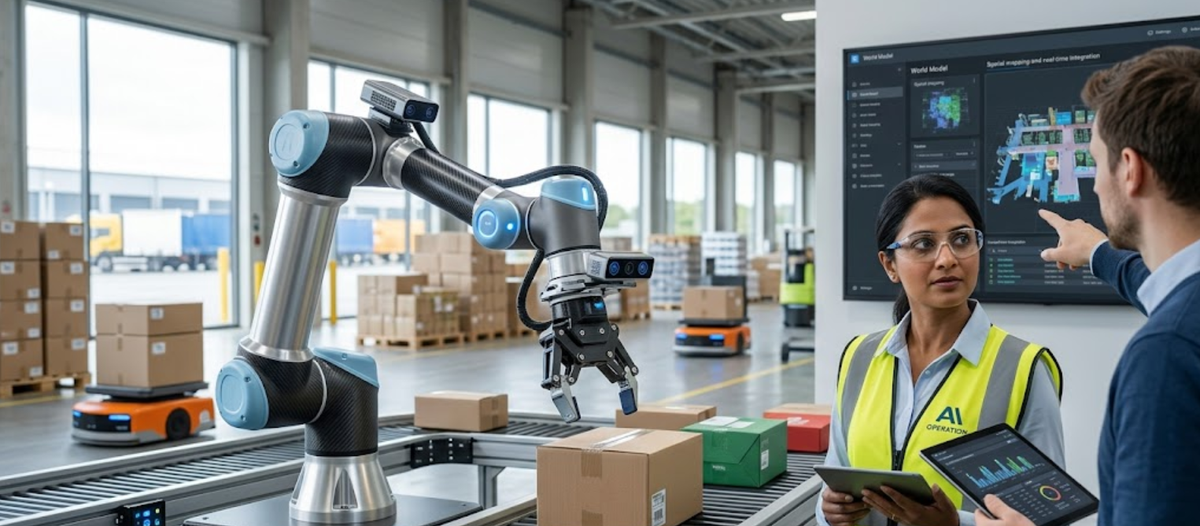
And then there's logistics. Physical AI tools for logistics automation are handling warehouse sorting, inventory tracking, and navigation without human direction. These systems don't need perfect conditions - they learn to work around the mess. Industrial intelligent systems using physical AI are already showing measurable ROI in high-volume distribution environments.
What about the home? That's further out. Zhang Yaqin, founding dean of the Institute for Intelligent Industry at Tsinghua University, puts general-purpose home robots at least five years away - possibly ten. The home environment is too unpredictable, and reliability standards are much stricter when the machine is living around your family.
The Market Numbers Are Hard to Ignore
According to the Future Markets report, the global Physical AI market is worth around $383 billion in 2026. The market is expected to grow a lot and reach $3.26 trillion by 2040. The Physical AI market will see a jump in the next few years. Future Markets’ "Global Physical AI Market 2026-2040" report says Physical AI will be a deal. The physical AI market will be worth a lot more in 2040.
The future of the physical AI market growth is, in a word, steep.
Abdulaziz Ajazili, deputy CEO of the Dubai Future Foundation and a voice behind the 2026 Emerging Technologies report, was direct: "Physical AI will see significant development in the next stage." Enterprise physical AI solutions providers are already competing for position in sectors that barely registered as viable markets three years ago.
For businesses thinking about where to place their bets over the next decade, that trajectory is worth taking seriously.
The Challenges Nobody's Glossing Over
Here's where it gets honest.
Physical Artificial Intelligence is not ready to be used just yet. The Artificial Intelligence models we have now are still having a time dealing with real-world situations that are unpredictable. There is a difference between a lab where everything is controlled and a real factory floor where things are actually happening. Physical Artificial Intelligence systems are just not ready for this kind of environment. Interactive training data is scarce. The disconnect between virtual simulations and real physical conditions remains unsolved - and it's one of the core physical AI integration challenges and solutions that researchers are actively working through.
Security is a separate, serious issue. When AI systems operate in the physical world, a software failure doesn't just crash an app. It can crash a vehicle. Misdeliver medication. Shut down public infrastructure. Physical AI cybersecurity best practices are still being written, which means enterprises adopting these systems need to think about physical failure modes, not just data breaches.
Autonomous vehicles make this concrete. Every point in the operating loop is software-dependent, and a single compromised link could mean a vehicle out of control. Or consider an AI-driven drug sorting center - if the system is tampered with quietly, the downstream consequences aren't a corrupted database. They're patient safety events.
Regulation is the third pressure point. Experts at the Forum were consistent: governance frameworks need to move faster than they have been. Physical AI applications in healthcare robotics, transportation, and smart infrastructure can't wait on slow regulatory cycles - but they can't scale responsibly without guardrails either.
International Cooperation and What Comes Next
One of the quieter themes at the Forum was how much physical AI's progress depends on shared knowledge across borders.
Zhang Yaqin made the point well: open-sourcing research and publishing findings allows international teams to build on each other's work. That exchange isn't just about goodwill - it accelerates the timeline for everyone. The way physical Artificial Intelligence is changing how things are made and delivered around the world will vary greatly depending on how countries and companies work together to share what they know and keep everything safe. Physical Artificial Intelligence is really going to change things in hospitals where doctors operate and in factories where things are made. If countries and companies can share what they know about physical Artificial Intelligence and make sure it is used safely, then physical Artificial Intelligence will be very good for supply chains and manufacturing floors.
Deng Zhonghan, an academician of the Chinese Academy of Engineering, said we need to work in three key areas. One area is large-model ecosystems. We also need to agree on data governance rules. Another area is energy- computing infrastructure. Not flashy. Foundational.
Top physical AI trends in 2026 point in the same direction: the next wave isn't built by one country or one company. It's a global infrastructure project.
Where This Is All Heading
Physical AI solutions for business are moving from demonstration to deployment. Slowly in some sectors, fast in others. The robots at Davos making coffee and mirroring human movements weren't just impressive demos - they were the early edge of a curve that's getting steeper every year.
For companies that are thinking about how Artificial Intelligence fits into their work, the question is not whether Artificial Intelligence will be important. The question is whether your business will be ready to use Artificial Intelligence when the systems are in place and the rules are clear.
The technology is moving. The harder work - security, regulation, data infrastructure, global cooperation - is where the real bottlenecks live. But those bottlenecks are being actively addressed, and that matters more than the hype.