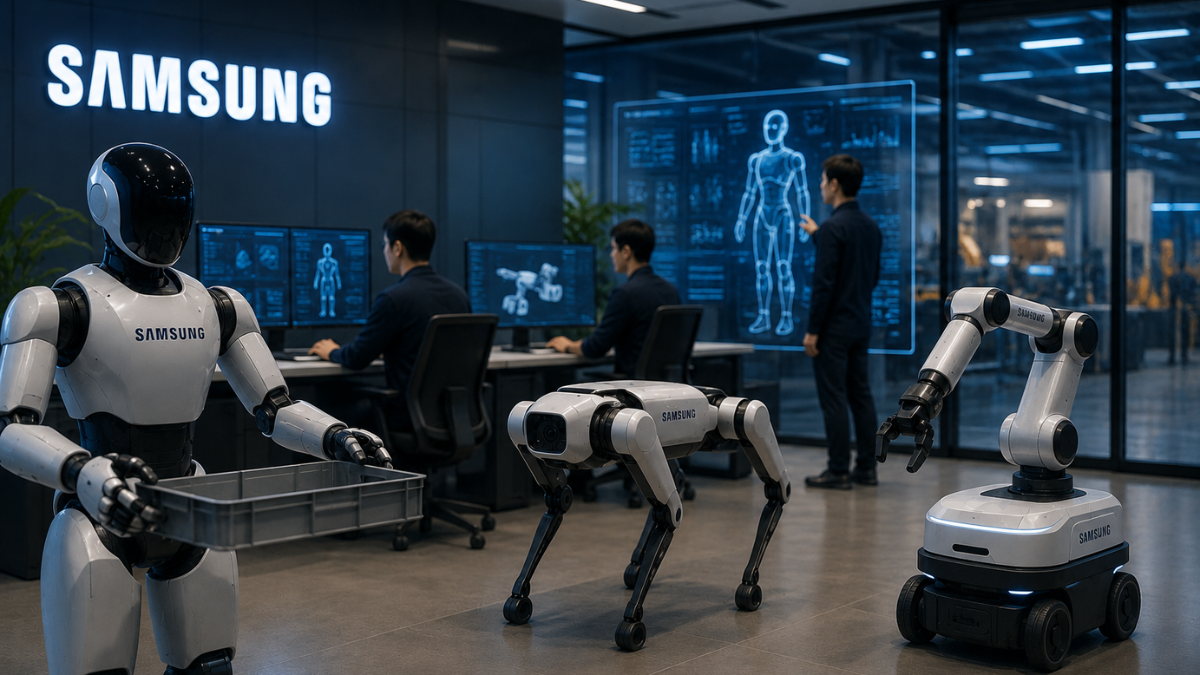
Samsung Electronics just made one of the most consequential enterprise robotics moves of 2026. On July 21, the South Korean tech giant announced a brand-new division called RX - "Robotics eXperience" - reporting directly to the CEO. If you've been watching how humanoid robotics in manufacturing has been developing, this isn't just a corporate org chart update. It's Samsung saying, publicly, that robots are a top-tier business priority.
Not a side project. Not a skunkworks experiment. A dedicated division, built from scratch, with C-suite access.
Who's Running It and Why That Matters
Heading the Robotics Strategy Team is Lee Dongkun, Executive Vice President at Samsung and former director of robotics strategy at Hyundai Motor Group - where he helped oversee Boston Dynamics. That résumé carries real weight. Boston Dynamics has spent years pushing the physical limits of what robots can actually do in real-world conditions, and Lee was part of setting the strategic direction for that work.
Samsung didn't promote an internal engineer. They recruited someone who's already built humanoid robotics strategy at one of the most credible programs in the world.
The RX division will handle mid-to-long-term robotics strategy, core technology development, and business execution - all under one roof, all reporting to the top. For anyone tracking B2B manufacturing automation trends shaping this decade, that structural choice is telling. When robotics gets buried inside another division, it competes for budget with established business lines. Standalone, CEO-direct? It gets resources, and it gets them faster.
Samsung also announced plans to pursue investments and acquisitions to accelerate development, partnering with local technology companies where needed. If you're tracking a robotics investment portfolio, Samsung's M&A activity over the next 18 months will be worth watching closely - their acquisition targets will reveal which parts of the technology stack they consider gaps. Meanwhile, the Unitree Robotics IPO approval shows financial markets are beginning to price enterprise robotics as a real asset class, not just a venture-capital experiment.
Physical AI Is What Actually Changed the Equation
Here's the thing: Samsung didn't just decide to do robots because the idea sounded good. The company specifically cited advances in physical AI as a key reason the robotics business is now commercially viable. That language is deliberate.
Physical AI - AI that operates in and adapts to the real physical world through robotic hardware - separates today's factory robots from those of a decade ago. Traditional industrial robots were precise but rigid. Program them for one task, one layout, one set of conditions. Change the part geometry, shift the production line, introduce a new cable harness, and you're reprogramming from scratch. Not exactly scalable.
Physical AI solutions break that dependency. Robots that perceive real-time variability in their environment and adapt without full reprogramming are genuinely different machines from their predecessors. That's the actual unlock for humanoid robotics in manufacturing at scale - not just that the hardware exists, but that the AI inside it can handle the unpredictability of real factory floors without constant human intervention.
The broader data supports this direction. As AI accelerates industry growth across logistics, electronics, and high-tech manufacturing, the industries showing the clearest productivity gains are the ones with measurable, repeatable workflows. Factories, in other words.
Manufacturing Comes First - Then Homes, Then Retail
Samsung was specific about the deployment sequence: manufacturing sites first, then home environments, then retail. That order isn't arbitrary - and if you've followed how AI deployment strategies typically unfold across industries, it probably sounds familiar.
Factories are controlled environments. Tasks repeat. The cost of errors is quantifiable. And every hour a humanoid robot spends on a production line generates behavioral data - how it handled a misaligned component, how it corrected a grip, how it navigated a crowded aisle - that feeds directly into AI training. The factory isn't just the first market. It's the training ground for everything that comes after.
This transition from pilot to commercial scale is already visible elsewhere. The rise of general-purpose embodied robots reaching 15,000-unit production volumes isn't a research pilot anymore. That's early commercial deployment. Samsung's entry adds enterprise-level demand to a supply chain that's been quietly building capacity for exactly this moment.
Precision cable insertion in electronics manufacturing, autonomous material handling, and assembly-line quality checks are the tasks where collaborative humanoid assembly robots show early, measurable ROI. Real problems on real production floors. Intelligent manufacturing AI agents are being tested against these problems competitively right now, which means solutions are improving faster than most roadmaps account for.
None of it works in isolation, either. AI supply chain integration is increasingly the connective tissue tying humanoid robots into broader factory operations - from inbound materials to outbound logistics. Robots that communicate with AI-orchestrated supply networks deliver more value than standalone units.
The Global Hub Strategy and the Infrastructure Question
Samsung plans to establish robotics research hubs in the U.S., China, and Japan - each chosen for a specific reason. U.S. for AI talent and semiconductor integration. Japan for precision manufacturing expertise and deep robotics history. China for production speed and scale.
The China manufacturing expansion back into PMI growth territory provides useful context here. A recovering manufacturing PMI isn't just a macro data point - it reflects renewed factory investment, including automation infrastructure. Samsung positioning itself inside that ecosystem now, rather than reactively, matters.
But hardware and R&D hubs alone won't win this. The less obvious challenge is infrastructure. Building next-generation factory robotics integration at enterprise scale requires the embodied intelligence infrastructure - the computing systems, native operating environments, and data pipelines - that make humanoid robots trainable, updateable, and deployable without massive per-site engineering overhead. Companies that nail that layer will have a compounding advantage.
Regulatory frameworks are shifting fast too. Staying current on developments like the humanoid robots 2026 digital ID requirements - where governments are assigning formal identity and compliance records to robots - will matter for any robotics strategy and commercialization plan that operates across multiple jurisdictions.
What This Means for You
If you're evaluating smart manufacturing robotics strategy for your own operations, Samsung's announcement is worth reading as more than just news. It's a framework signal. The companies with the resources to build this from scratch are mapping a roadmap that early adopters can learn from - without having to absorb all of the cost.
The industrial humanoid robot deployment wave isn't arriving all at once. It's coming facility by facility, production line by production line. Pilots first, proof of ROI, then scale. If you're thinking about how to implement humanoid robots on electronic manufacturing lines, or trying to model the cost of integrating physical AI robots in smart factories, the right time to learn the landscape is before the leaders have pulled too far ahead (which, if you've been following this space closely, you know is happening faster than most expected).
Where Humanoid Robotics in Manufacturing Goes from Here
Samsung isn't the first major company to commit to this space. But the structure it's building - dedicated division, CEO reporting line, experienced leadership, physical AI focus, global R&D footprint, and a clear manufacturing-first deployment sequence - suggests it intends to be one of the ones that actually delivers at scale.
The competitive pressure this adds to the field is, honestly, good for the technology. When enterprise players with real manufacturing relationships enter seriously, adoption accelerates. The step-by-step roadmap for B2B enterprise robotics integration stops being theoretical and starts being quarterly planning.
If you want a sense of where the broader ecosystem is heading - investment flows, policy shifts, and the infrastructure being built underneath all of this - the signals are already there to read. The question for most companies is whether they're reading them early enough.