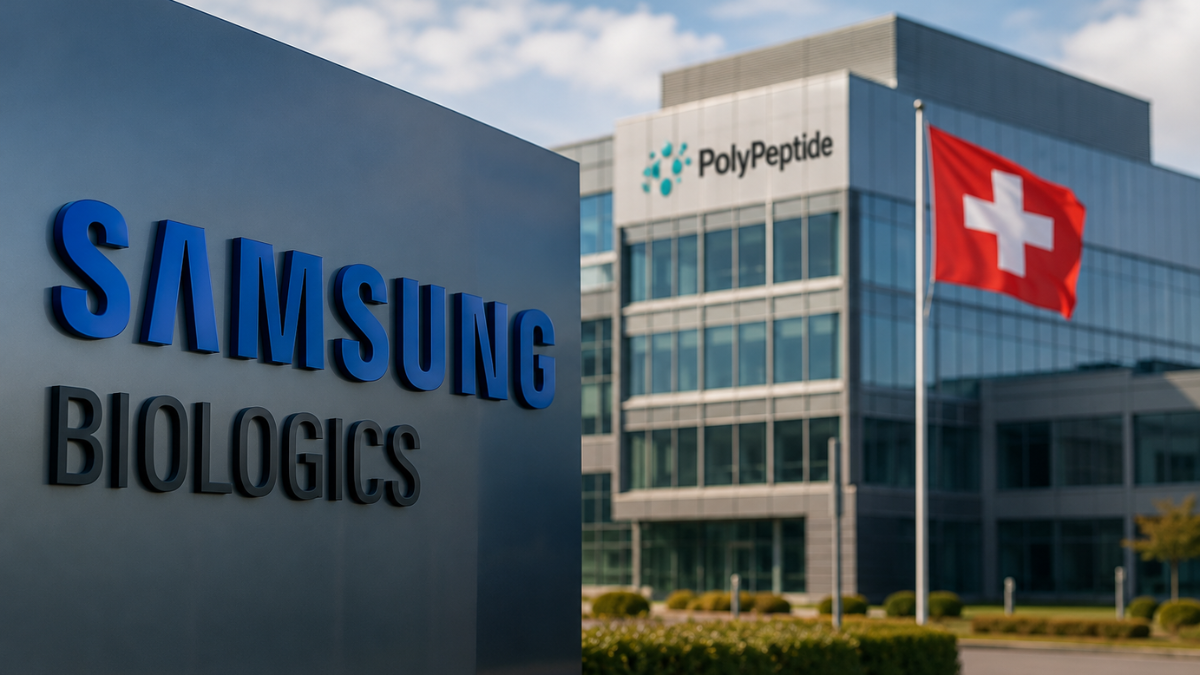
South Korea's Samsung Biologics is making a move that could reshape its position in biopharma for the next decade. The Samsung Biologics PolyPeptide acquisition all-cash bid update - announced July 20, 2026 - confirms a 1.46 billion Swiss francs ($1.81 billion) offer to take over Swiss contract drugmaker PolyPeptide Group AG. The deal is fully funded, the board has already recommended it, and the majority shareholder has pledged its shares. Here's the full breakdown.
What Samsung Is Actually Paying
The offer lands at 44.31 Swiss francs per share. That's a 6.1% premium over PolyPeptide's last close of 41.75 Swiss francs on the previous Friday.
Generous? Not dramatically so. But context matters here. PolyPeptide's largest shareholder was already running a publicly disclosed strategic review, which tends to compress negotiating dynamics before any formal bid lands. When a majority owner signals it wants out, markets often price that in early. The PolyPeptide share price premium in Swiss francs looks modest against typical acquisition benchmarks, but it came with something valuable: a unanimous board recommendation and almost no friction from the ownership side.
The deal is also completely clean - no stock swap, no earnouts, no complicated contingencies tied to future performance. That kind of structure appeals to shareholders who've watched plenty of deals collapse mid-process. Compared to where global unicorn valuation benchmarks are sitting right now, an all-cash offer with a committed majority seller is actually quite compelling for PolyPeptide's minority holders too.
Why GLP-1 Drugs Are the Real Story Here
You can't understand why Samsung Biologics acquired Swiss drugmaker PolyPeptide without talking about GLP-1.
Obesity and diabetes treatments - particularly GLP-1 receptor agonists like semaglutide and tirzepatide - have created a manufacturing bottleneck that the entire industry is scrambling to resolve. These drugs rely on peptide synthesis: a specialized process with high technical barriers, long lead times to scale, and very few qualified providers globally. GLP-1 drug contract manufacturing has become one of the most strategically valuable capabilities in pharma, and Samsung Biologics peptide-based therapeutics capacity expansion through this deal gives it a running start.
Building that infrastructure from scratch would take years. Acquiring it takes months.
The broader biomedicine innovation funding trends across multiple geographies reinforce the urgency - capital is chasing peptide-capable facilities right now, and supply can't keep up with the demand curve being projected for GLP-1 therapies through 2030. The competition to lock up manufacturing nodes is real.
How fast this frontier is evolving becomes clear when you look at adjacent developments like the cell-free protein synthesis platform work now moving at scale in Asia. Peptide manufacturing is a moving target. Whoever owns the capacity early shapes the market.
The strategic parallel to Samsung's other divisions is worth drawing out. If you've been following Samsung semiconductor expansion timelines across its hardware business, this biopharma push fits the same logic: secure critical infrastructure now, compete from a position of strength later.
The Draupnir Factor - and Who's Actually Behind It
This deal has an ownership layer that's worth understanding before the headlines simplify it.
PolyPeptide's majority shareholder is Draupnir Holding, which controls roughly 55.65% of the company. Draupnir itself is linked to the Cryosphere Foundation - an entity connected to Swedish billionaire Frederik Paulsen. In April 2026, PolyPeptide disclosed that the Draupnir Holding strategic review of its majority stake was formally underway. That's typically code for "we've decided to sell, we're just figuring out to whom."
So when the Samsung Biologics PolyPeptide acquisition all-cash bid updates came out this month, Draupnir had essentially pre-announced its exit. The foundation has now confirmed it will tender all its shares into the offer. That means Samsung enters this process with more than half the company already committed. For all practical purposes, the deal is done - what remains is the regulatory process and timeline.
Understanding how this kind of majority-led exit plays out in practice requires familiarity with Korean tech deal dynamics and how Korean conglomerates structure cross-border acquisitions. This isn't an unusual playbook - but Samsung is executing it with unusual efficiency here.
It also helps to look at large-scale supply deal structures in adjacent sectors for framing. When a strategic buyer integrates a specialized supplier, the goal is rarely just cost savings. It's about controlling a critical node in a supply chain where capacity constraints give leverage.
Timeline, Delisting, and What Comes After Closing
Samsung Biologics expects to formally launch the Samsung Biologics 1.8 billion dollar tender offer for PolyPeptide by the end of August 2026. The offer period runs through year-end.
After closing, Samsung has confirmed it will pursue a squeeze-out of any remaining minority shareholders - standard procedure once certain ownership thresholds are crossed. Combined with the confirmed PolyPeptide Group AG SIX Swiss Exchange delisting timeline, this Swiss-listed company is heading for a clean exit from public markets. No partial ownership, no residual float - wholly owned subsidiary.
For those who monitor capital market listing rule shifts across jurisdictions, the process of a Korean acquirer voluntarily delisting a SIX-listed European target is a structural trend worth tracking. It reflects a shift in how Asian buyers approach European public-market companies - particularly those with majority shareholders ready to exit cleanly.
Regulatory clearance will also require navigating the EU-Swiss framework. Overseas tech transfer regulations and bilateral review processes have been tightening in recent years, and while nothing in current filings suggests opposition, cross-border scrutiny on biopharma infrastructure deals is real. Samsung will need to manage that carefully.
At a macro level, deals like this carry signals. Biotech IPO market signals and M&A activity tend to move together - when strategic buyers pay full cash for public assets, it usually reflects confidence in long-term sector fundamentals that goes well beyond the specific target.
Watch Hong Kong tech stock rally dynamics and Korean equity moves in parallel. Samsung Biologics (207940.KS) is a bellwether for how South Korean conglomerates are allocating capital into life sciences right now, and this acquisition signals that bet is getting significantly larger.
The geopolitical layer adds one more dimension worth noting. Active international trade investment consultation processes between Europe and Asian acquiring entities are tightening - which could add review friction to Korean buyers targeting Swiss or EU-linked biotech assets over the next 12-18 months. This deal appears to be ahead of that curve.
The Bigger Picture
The Samsung Biologics PolyPeptide acquisition all-cash bid updates confirm what the biopharma industry has been anticipating for months: the race to lock up peptide manufacturing capacity is accelerating fast, and the window for clean acquisitions is narrowing.
GLP-1 drugs aren't a cycle - they're a structural shift in how the world treats metabolic disease. The manufacturers who can produce these molecules at scale are going to matter enormously to drug developers, health systems, and patients for years to come. Samsung is betting $1.81 billion that PolyPeptide gives it the platform it needs.
The board agreed. The majority shareholder agreed. And with the Samsung Biologics PolyPeptide acquisition all-cash bid updates now public, what's left is watching the offer launch and close - likely without a competing bid.
Though in M&A? You never say never.