Summary
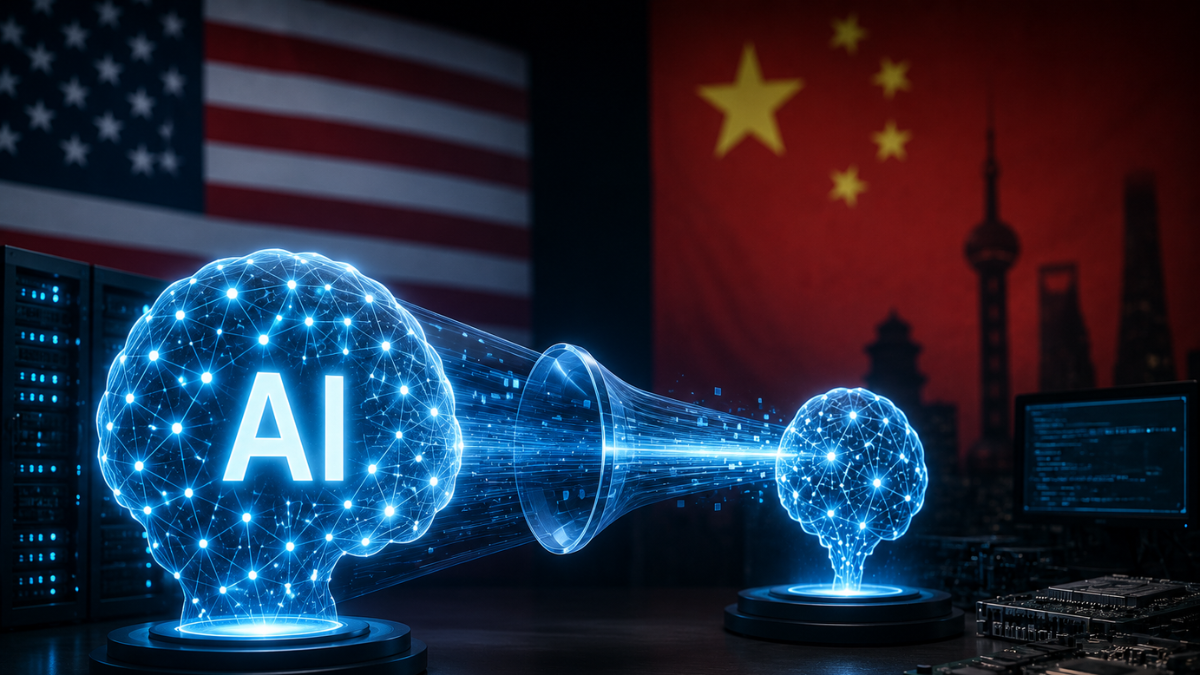
If you think the high-stakes battle for silicon supremacy is just about physical microchips, you’re missing the real story. A quiet, software-driven revolution has spiraled into a major geopolitical crisis. An engineering shortcut known as model distillation has transformed the U.S.-China race for AI dominance, and it’s happening right under the noses of global regulators. By training lightweight "student" models on the highly polished outputs of massive "teacher" systems, Chinese firms are bypassing expensive hardware limits and Western export bans.
This process isn't just an academic trick; it's a strategic weapon. Silicon Valley leaders now accuse Chinese rivals of executing systematic, unauthorized extraction of intellectual property from Western proprietary models. The resulting diplomatic friction has created a deep, growing dispute over technological leadership. As Washington tightens access to cloud services, this technical loophole has become the ultimate flashpoint. You're looking at a structural shift in how global powers build, steal, and defend artificial intelligence systems. It’s a conflict that could permanently alter the balance of technical power by 2026. And fast.
The Invisible Engine of Modern AI Training
To grasp the geopolitical friction of today, you need to understand the way these giant digital minds learn. When you talk to a current system, you're actually talking to a den of servers that has been built and trained for hundreds of millions of dollars. But what is AI model distillation? Imagine an expert chef teaching an apprentice and giving him all her lifetime of secret recipes. Rather than spend a handful of decades testing out recipes, the master gives him a good book. Hardly anyone saw this coming.
In the digital world, this translates to a teacher-student AI model training distillation process. The giant teacher model generates millions of high-quality responses, reasoning paths, and complex code blocks. The smaller student model then digests this curated data stream, absorbing the larger model's smart behaviors without needing to inherit its massive architecture. You don’t need a supercomputer to run the student model. Instead, it runs on cheap, everyday hardware while retaining an astonishing amount of the teacher's original intelligence.
This efficiency explains why the technique has taken the tech world by storm. It slashes training costs by up to 99%. But this cost-cutting miracle is exactly why we're seeing an intense AI model distillation US-China conflict. Western creators spend billions on clean data and massive electricity bills, only to watch rivals pull those hard-earned capabilities through a public API for pennies on the dollar.
The Geopolitical Fault Line: Why Distillation Triggers Washington
You might wonder why a standard research methodology has suddenly sparked an international incident. The answer lies in the hardware chokehold Washington has placed on Beijing. For years, U.S. export controls aimed to starve Chinese companies of high-end graphics chips, hoping to freeze their progress on large-scale training. But Chinese engineers found a brilliant workaround: they didn’t need thousands of banned chips if they could simply distill existing Western frontier models.
This clever sidestepping has turned the technology into a primary US-China AI dominance battleground for 2026. By using distillation, Chinese firms can completely bypass the frontier model distillation hardware requirements that usually keep smaller players out of the race. They’re achieving near-parity with American systems while using older, domestic chips. It’s a logistical nightmare for U.S. trade officials. You can easily track shipping containers of physical microchips, but you can’t easily block the invisible flow of API outputs across the internet. Hardly.
As Chinese teams get better at this, the gap between open-source models and tightly guarded corporate algorithms is shrinking. Many experts believe that open-source AI systems fueled by distilled Western data will soon dominate the global market. That’s a terrifying prospect for U.S. tech giants who expected their massive capital investments to guarantee a multi-year lead.
The Anatomy of an Accusation: Anthropic vs. China's AI Pioneers
The simmering tension boiled over into public accusations recently. The Anthropic DeepSeek model distillation accusation represents a major turning point in corporate warfare. Anthropic, a heavily funded Silicon Valley startup, publicly claimed that Chinese entities targeted its Claude models. They pointed fingers at prominent names like DeepSeek, Moonshot, and MiniMax, alleging that these companies ran coordinated campaigns to extract proprietary capabilities.
According to industry insiders, the Anthropic Claude outputs harvested by DeepSeek, Moonshot, and MiniMax weren’t just simple chatbot answers. The targets were highly sophisticated reasoning traces. If you only look at the final answer a model gives, you’re missing the true secret sauce. The real gold lies in how the model thinks, the step-by-step logic it displays before concluding.
When you capture these reasoning traces, you’re basically downloading the model’s cognitive DNA. Researchers have shown that extracting reasoning steps makes student models far stronger and less prone to hallucinations. It’s the digital equivalent of stealing a competitor’s blueprints rather than just reverse-engineering their physical product. OpenAI has reported similar concerns, noting that Chinese developers frequently attempt to extract capability to boost their own local systems, often ignoring AI safety protocols in the process. Here’s why.
From Stanford Alpaca to the Modern Legal Gray Zone
But don't be under the illusion that this is a brand new thing. This has been done in the tech circle for a long time. If you go back a few years, you'd find both of the famous case studies for model distillation, like the Stanford Alpaca project and the Microsoft Orca project. Stanford took the OpenAI GPT-3 output and used it to teach a tiny open-source model called Alpaca for less than $600, a stunning achievement at the time, and Microsoft later followed with its Orca project to prove the point.
But there’s a critical difference between those early academic experiments and today’s corporate espionage. The early projects were open-source research efforts designed to push the boundaries of transparency. Today, we’re seeing commercial enterprises use these methods to build competing, closed-source models without paying for the underlying research and development.
This has sparked an intense debate over industry standards. Is this practice illegal, or is it just smart engineering? Currently, copyright laws and API terms of service are incredibly muddy on this point. While OpenAI’s terms explicitly forbid using its outputs to train competing models, enforcing those rules across international borders is nearly impossible. As long as Chinese firms can access these interfaces, they’ll continue to siphon off Western capabilities to bypass their own domestic computing power shortages.