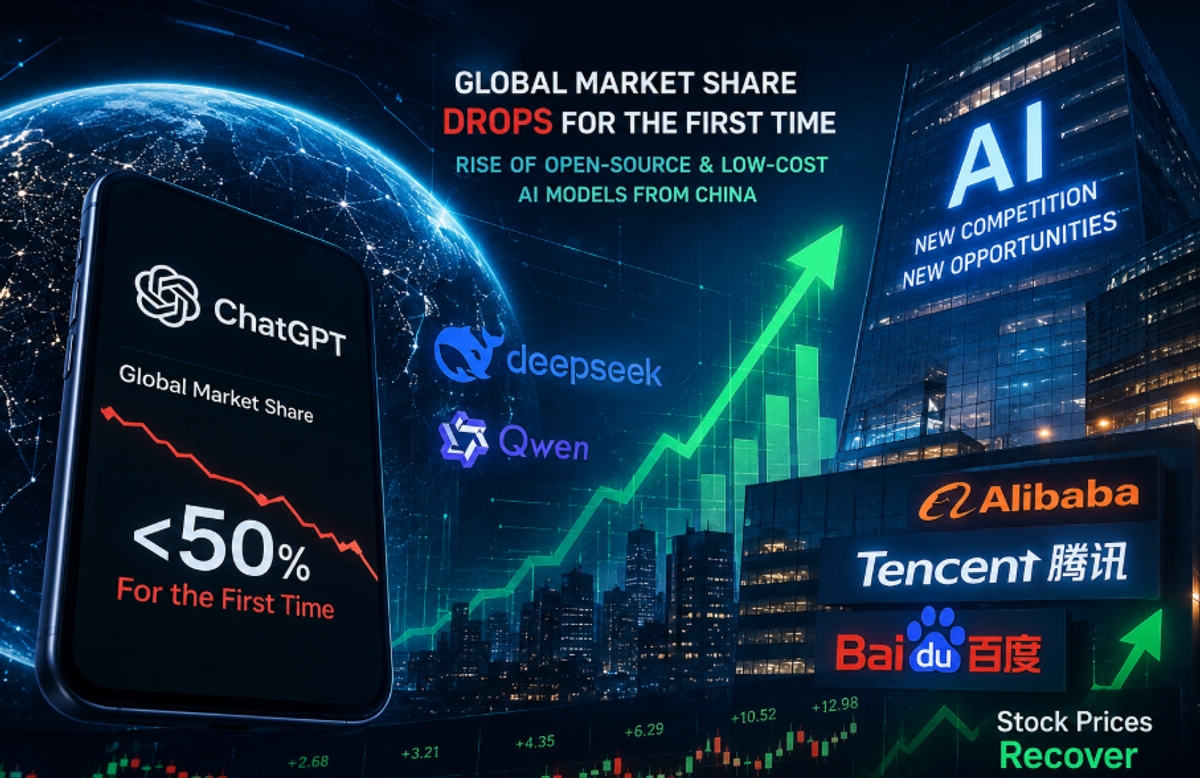
Something seismic just shifted in the global AI market. According to Sensing Tower's "2026 AI Industry Report," the ChatGPT global market share drops story is now confirmed: OpenAI's assistant has fallen below 50% of the global AI assistant market for the first time. China open-source AI is a central reason. And the fallout is already visible in Hong Kong, where Alibaba, Tencent, and Baidu all staged multi-day price rebounds heading into the second half of the year.
Why ChatGPT Global Market Share Drops Below 50% for the First Time
The Sensing Tower report, published June 16, doesn't bury the lead. ChatGPT market share falls below 50 percent after years of what looked like unbreakable dominance. More competitors. More fragmentation. And a fundamental shift in how enterprises are now thinking about AI model procurement.
Look, Microsoft's CEO has publicly called for breaking giant AI monopolies and shifting toward cheaper alternatives that give users more choice. Reports indicate Microsoft is actively evaluating open-source Chinese models - including DeepSeek V4 - to cut inference costs. If you've been watching enterprise AI trends, that's a bigger signal than it might seem. Microsoft adopting open-source Chinese AI models like DeepSeek would represent one of the most consequential pivots in enterprise software infrastructure in years.
The cost equation is what makes all of this work. CITIC Securities has flagged that leading manufacturers are driving a continuous decline in the marginal cost of large-scale AI model inference through underlying architecture optimization. As that cost floor drops, commercializing AI in high-frequency B-end scenarios - think customer service, document processing, logistics routing - stops being aspirational and starts being economically viable at real scale. That's the structural edge China's open source models have built, and it's what's eating into ChatGPT's share.
China Open Source AI and the K-Shaped Divergence No One Predicted
Look at first-half stock performance, and you find one of the stranger splits in recent memory.
Newcomer AI names absolutely ripped: Zhipu surged 1,710.67% after its IPO, MINIMAX-W gained 152.73%, and Xunze climbed 141.19%. Meanwhile, established tech players took a beating from capital expenditures eroding profits - Alibaba fell 34.40%, Kuaishou dropped 33.83%, Meituan lost 33.69%, Tencent declined 27.41%, and Baidu slipped 16.65%.
This Chinese AI model newcomers stock performance divergence is what analysts are calling an extreme "K-shaped" pattern. Startups get priced as optionality. Incumbents get priced as capex drag. That narrative isn't wrong, exactly - but the valuation gap it's produced (which is now measured in hundreds of billions of dollars) is getting hard to justify.
Zhipu's market cap has hit HK$800 billion. Baidu - which runs a dominant search engine, a leading autonomous driving division, self-developed Chinese AI chips, and the Wenxin suite of large-scale models - trades at just HK$300 billion. Whether the Baidu stock price is undervalued compared to new AI startups is becoming a harder question to dodge with each passing quarter. Current startup ecosystem trends still favor pure-play names, but these gaps tend to close. And Meituan's trillion-parameter AI model launch is a useful reminder that these "incumbents" aren't watching from the sidelines - they're spending heavily, and the products are following.
The Hang Seng Internet Index: 95% AI Content at a 10-Year Valuation Low
The Hang Seng Internet and Technology Index has corrected nearly 45% since October of last year. Its current PE-TTM sits at 19.4x - which puts it at the 8.54th historical percentile over the past decade. That means the index is cheaper today than it was in roughly 92% of all trading months over the last ten years.
Cheap can get cheaper. Worth saying upfront.
That said, the composition makes the valuation conversation genuinely interesting. The Hang Seng Internet and Technology Index is widely considered the purest "AI application" index in the Hong Kong market, with approximately 95% AI content weighting. Its holdings span Alibaba, Tencent, Baidu, Kuaishou, Xiaomi, Kingsoft, and Meitu - companies squarely at the center of China's tech sector rise and the AI application commercialization ecosystem analysts have highlighted as the next growth driver. The combined BAT weighting (Baidu, Alibaba, Tencent) sits at around 37%, which is heavy exposure to exactly the names that look cheap relative to their underlying AI positioning.
If you're looking for AI application exposure in Asia at a compressed valuation, this index is the most direct answer on the table. Broader macro signals point in a helpful direction too. China manufacturing expansion returning to positive territory has historically preceded improved tech investment cycles by a quarter or two - not a guarantee, but worth watching alongside the AI commercialization thesis.
How to Get Exposure Without Picking Individual Stocks
Two options here, depending on your market access.
The Hang Seng Internet ETF ChinaAMC (513330.SH) is the largest A-share ETF tracking the Hang Seng Internet and Technology Index, listed on the Shanghai Stock Exchange. For investors without direct A-share trading access, the ChinaAMC Hang Seng Internet ETF Linked Fund C (013172.OF) provides an off-exchange route to the same underlying index. Neither of these is a personal investment recommendation. They're the structural vehicles available if you decide the thesis makes sense for your portfolio.
This Is Part of a Much Larger Story
The ChatGPT global market share drops development doesn't exist in isolation. China's AI push is happening alongside a broader surge in domestic technology investment across multiple sectors. China's quantum refrigerator numbers have attracted serious attention from the research community. The Haiyang satellite launch completed China's marine monitoring satellite network. The China reusable rocket engine test recently ran for 620 seconds - a significant milestone in reusable launch economics. None of these are isolated achievements. They reflect the same sustained investment pattern that's now producing low-cost AI models capable of challenging ChatGPT's global position in ways no one fully anticipated two years ago.
For comprehensive China tech and science news and full AI category coverage, the pace of development shows no signs of slowing.