Summary
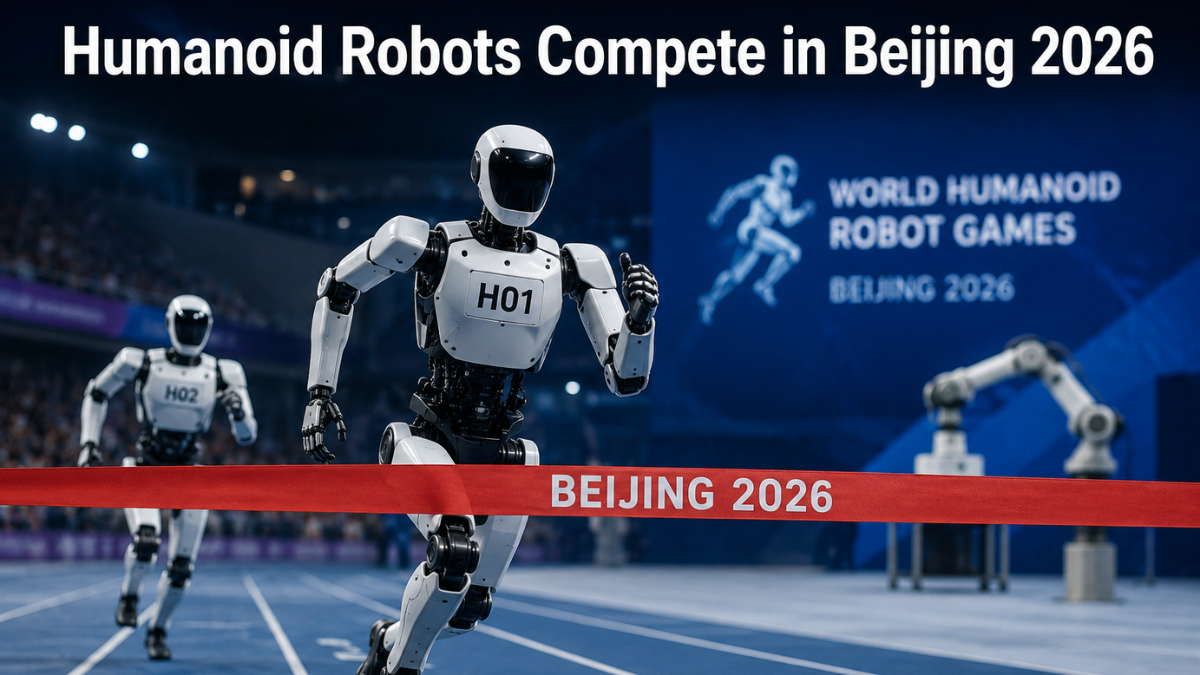
At the World Humanoid Robot Games Beijing 2026 record sprint autonomous tasks event, robots didn’t just race for headlines. They had to work.
That distinction matters. A humanoid that can sprint 100 metres in record time is impressive, sure. But can it recognise a charging cable at an awkward angle, grip it without crushing it, and plug it in correctly without a person stepping in? That’s where the spectacle turns into something useful.
Across five days in Beijing, the games brought together 51 events, including 30 sports competitions and 21 scenario-based challenges. The setting also fits the city’s growing role in robotics and Beijing digital economy leadership.
Key Points
- 51 events were held across sports and real-world scenario challenges.
- Some humanoids reportedly beat Usain Bolt's 9.58-second 100m record, but braking remained a problem.
- A reported 39.7-second 400m result showed how quickly robot athletic performance is improving.
- More than 40% of events required autonomous operation, making software and decision-making central to the competition.
- EV charging and cable plugging tested vision, dexterity, alignment and force control.
- Warehouse and industrial tasks were arguably more important than the sporting events for future commercial use.
- Tennis and other sports tested balance, coordination, perception and reaction speed.
- The biggest challenge remains reliable autonomy in imperfect real-world conditions.
- The real commercial question is no longer just speed or strength; it's whether robots can repeat useful tasks safely, independently and at scale.
World Humanoid Robot Games Beijing 2026 Results Go Beyond the Track
The opening-day sprint results were wild. Reports said two humanoids beat Usain Bolt’s 9.58-second 100m record, answering the question many people were asking: did a humanoid robot run faster than Usain Bolt at the Beijing Robot Games?
Yes, according to the event results.
But there was a flaw. Fast-running humanoid robots still faced braking issues, with some machines crashing into thick safety mats beyond the finish line. China’s humanoid robots sprinted 100 meters in under 9.58 seconds but struggled with precise braking, which is a pretty big reminder that top speed and real control are not the same thing.
One robot also set a humanoid robot 400m sprint record of 39.7 seconds, beating Wayde van Niekerk’s 43.03-second human world record. So, what is the 100m sprint time for the fastest humanoid robot in 2026? The reported result was faster than 9.58 seconds, although the more interesting question may be whether it could stop safely afterward.
Battery management and thermal dissipation challenge high-intensity humanoid robotics too. A brief race is one thing. Repeating demanding movements through a full shift is another.
Why Autonomous Tasks Matter More Than a World Humanoid Robot Games Beijing 2026 Record Sprint
More than 40 percent of events at the World Humanoid Robot Games require full autonomy via Huawei technology. That means no remote operator quietly correcting every mistake.
And honestly, that’s the test you should care about.
The World Humanoid Robot Games Beijing 2026 record sprint autonomous tasks programme includes EV charging, warehouse handling, restaurant work, emergency response, industrial assembly, and material loading. In other words, from EV charging to warehouse handling, Beijing tests humanoid robots in simulated factories where timing, precision, and recovery matter.
A robot must deal with small physical imperfections:
- A cable connector that isn’t perfectly aligned
- A package that shifts while being lifted
- An object partly hidden from its cameras
- A surface that changes grip or footing
Those tiny problems are brutal for machines. Why real-world physical imperfections pose the ultimate challenge for autonomous AI robots is simple: the physical world doesn’t cooperate.
For wider context, physical AI solutions are increasingly judged on useful work, not flashy demos.
Cable Plugging Is a Small Task With Huge Stakes
Why is cable plugging a major test for humanoid robot dexterity? Because it combines vision, alignment, hand control, force sensing, and error recovery in one deceptively ordinary movement.
The humanoid robots EV charging cable connection test asks a machine to understand where the connector is, position its body, rotate its wrist correctly, apply enough force, and stop before damaging the equipment. Humans barely think about this. Robots have to calculate every part of it.
That’s why humanoid robots hand dexterity precision tasks industrial assembly could matter more than sprint medals. A factory doesn’t need a worker who can run 100 metres at absurd speed if it can’t load materials reliably or handle a fragile component.
As Lumos Robotics CEO Yu Chao put it, Lumos Robotics Yu Chao autonomous robot industrial value depends on solving real end-user problems. Running and jumping alone don’t improve productivity.
Simple. Effective. Useful.
Tennis, Tai Chi, and the Race for Autonomy
Sports still have a role here because they expose balance, perception, coordination, and reaction speed under pressure. Robots competed in tug-of-war, weightlifting, Tai Chi, and pitch-pot, a traditional Chinese target game using arrow-like sticks.
Meanwhile, Galbot autonomous humanoid tennis match WRC 2026 demonstrations featured robots attempting singles and doubles tennis. Can autonomous humanoid robots play singles and doubles tennis? They can attempt it, but tracking a fast ball, serving, moving into position, and returning shots without human intervention remains a demanding test.
Booster Robotics humanoid robots at the Beijing National Speed Skating Oval drew attention through sprint performance, while Booster Robotics and Galbot showcased autonomous tennis and formation walking at Beijing Games. The event also reflects an industry moving toward embodied robot mass production, not just one-off prototypes.
The Bigger Industrial Question
Zeroth’s Hua Rong raised the issue that follows every robotics showcase: can the product solve a customer’s problem after it’s sold?
That’s the right question. Zeroth robotics Hua Rong industrial humanoid deployment will be judged in warehouses, production lines, and service environments, not only in front of cameras.
You can see the surrounding pressure building through robotics in manufacturing, MIIT humanoid robot data, and China's humanoid robot ID rules. Scale creates opportunities. It also creates accountability.
The business race is becoming more public too, as shown by Unitree's public-market push. Elsewhere, Tokyo's physical AI bet and China’s intelligent body gravity plan show how international the competition has become.
What Beijing’s Robot Games Actually Showed
The World Humanoid Robot Games Beijing 2026 record sprint autonomous tasks story isn’t really about whether robots can beat human athletes.
They can, at least in some controlled races.
The bigger development is whether they can work independently when the cable is crooked, the box slips, the floor isn’t perfect, or the task has to be repeated hundreds of times. That’s also why advances such as self-dressing robot technology matter. Dexterity, perception, and dependable physical interaction are where humanoid robots either become practical or remain expensive entertainment.
GlobalByte Perspective
The Beijing Humanoid Robot Games are interesting for one reason: they are starting to test what robots can actually do, not just how impressive they look.
Breaking sprint records makes for a great headline, but the more important tests were happening away from the track. Plugging an EV charger, handling packages, performing industrial tasks and responding to imperfect situations require a combination of vision, balance, dexterity and autonomous decision-making.
That is where humanoid robotics still has a lot to prove. A robot that can run incredibly fast but crashes while trying to stop is a good example of the industry's current reality: raw physical performance is improving faster than reliable control.
For GlobalByte, the biggest takeaway from Beijing is that the robotics race is gradually moving from “Can a robot do it?” to “Can it do it repeatedly, safely and without a human correcting every mistake?” If manufacturers can solve that second question, humanoid robots become far more interesting as commercial machines rather than impressive demonstrations.