Summary
The Tiangong Ultra humanoid robot Usain Bolt 100m record Beijing story made headlines for a reason. At the World Humanoid Robot Games, China’s Tiangong Ultra completed a 100-metre preliminary heat in 9.39 seconds, ahead of Usain Bolt’s human world-record mark of 9.58 seconds.
That’s a startling number. But it doesn’t mean a robot has beaten Bolt under normal athletics rules.
Tiangong Ultra raced in a purpose-built robot event, on a controlled course, with no requirement to slow down naturally after the line. And, frankly, the finish was messy. Still, the Tiangong Ultra 100m sprint record 9.39 seconds signals how quickly humanoid running hardware is improving.
Key Points
- Tiangong Ultra recorded 9.39 seconds in its 100m preliminary heat.
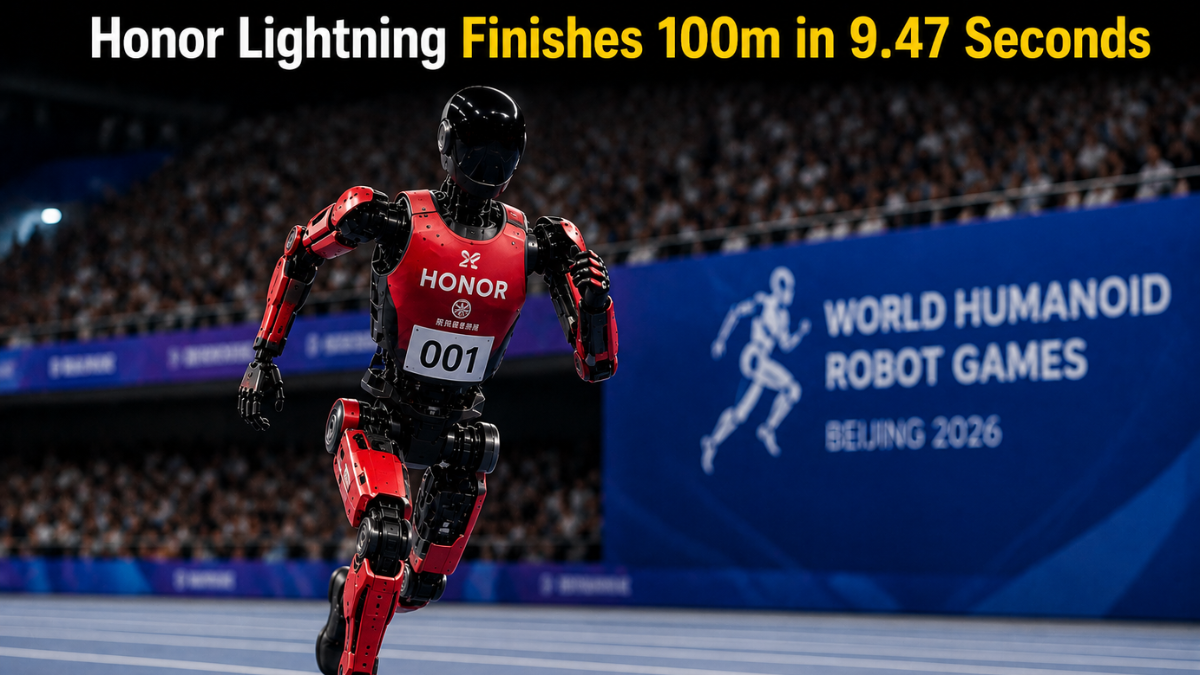
- Honor Lightning reportedly finished in 9.47 seconds.
- The robot times cannot be directly compared with human athletics records because the competition conditions and rules are different.
- The biggest weakness was stopping and maintaining control after the finish.
- Tiangong Ultra reportedly improved from 21.50 seconds to 9.39 seconds in roughly a year.
- The 2026 Beijing event featured 51 competitions involving more than 2,000 robots from 16 countries.
- Sprinting tests several important robotics problems at once: balance, motor control, traction, power management and recovery.
- The next challenge is turning spectacular speed into safe, repeatable and useful real-world mobility.
- Bottom line: Humanoid robots can now move astonishingly fast. Learning how to stop safely may be just as important.
Tiangong Ultra humanoid robot Usain Bolt 100m record Beijing results
Developed by the Beijing Humanoid Robot Innovation Center Tiangong Ultra, the robot won its opening-day heat after recovering from an early deficit.
Honor’s Lightning led initially. Then Tiangong Ultra closed the gap near the finish and crossed in 9.39 seconds. Lightning followed in 9.47 seconds, another time faster than Bolt’s 9.58-second benchmark from the 2009 World Athletics Championships.
The Chinese humanoid robot Tiangong Ultra runs 100m in 9.39 seconds breaking Usain Bolt record claim needs context, though. Bolt’s record came in a human competition governed by track-and-field rules, while these robots are engineered around a different challenge: balance, force, traction, software timing, and surviving the run.
Different machines. Different race conditions. Very fast numbers nonetheless.
Why did the robots crash into mats after the finish?
The race did not end gracefully.
Both robots ran directly into thick safety mats intended to stop them. Tiangong Ultra stumbled toward the sidelines, causing nearby spectators to step aside, while Lightning collapsed and was removed on a stretcher.
Why Chinese running robots struggle to stop and slam into mats after breaking speed records comes down to control. Sprinting forward is one engineering problem. Rapidly reducing momentum without falling, damaging hardware, or veering into people is another.
Humans instinctively brake, shorten their stride, and adjust posture. A humanoid robot has to calculate those changes in milliseconds while managing motors, joints, battery load, and balance. The dramatic crashes looked almost comic, but they exposed a very real limitation.
Honor Lightning humanoid robot 100m sprint: A close second
The Honor Lightning humanoid robot 100m sprint was hardly a weak showing. Its 9.47-second official heat time put it just 0.08 seconds behind Tiangong Ultra.
State media had previously reported a 9.32-second preparatory test and an Honor Lightning 100m peak speed 14.5 m per second. Before the race, its researchers also reportedly increased Lightning’s leg length from 95 centimetres to 1.05 metres. The robot stands 169 centimetres tall, so that is a substantial design change.
Longer legs can help cover ground faster. They can also make control harder, particularly when the robot needs to stop. That trade-off was visible at the line.
From a 21.50-second run to 9.39 seconds
Tiangong Ultra improves 100m time from 21.50 seconds to 9.39 seconds in just one year, based on the results from the inaugural competition and this year’s heat.
That pace of improvement is the bigger story.
Last year, Tiangong Ultra won the 100 metres in 21.50 seconds. It also won the first humanoid robot half-marathon in Beijing. This time, Honor Lightning took the longer-distance spotlight, with a humanoid robot half-marathon 50 minutes Beijing result of 50 minutes and 26 seconds.
From half-marathons to 100m sprints: How Chinese humanoid robots are shattering speed limits is really a story about more than race results. Running tests the same basics needed for useful machines: perception, balance, energy use, joint reliability, and recovery after an error.
The World Humanoid Robot Games are getting much bigger
The World Humanoid Robot Games 2026 Beijing 100m race was one event among 51 contests at the National Speed Skating Oval Beijing humanoid robot games. The programme included football, dance, and industrial-task competitions.
More than 2,000 robots from 666 teams across 16 countries and six continents competed, up sharply from 280 teams at the first event. That scale reflects China’s humanoid robot push, which is increasingly tied to regulation, research funding, and commercial deployment.
And the race is not only about spectacle. Work on humanoid robot digital IDs suggests that governments are starting to think about how robots will be identified and managed outside the arena.
Why China is investing so heavily in humanoid robotics
China strategic emerging industry humanoid robotics policy treats these machines as a potential part of manufacturing, logistics, and consumer services. The logic is straightforward: if AI can make a robot see, reason, move, and work safely, it could eventually assist in environments designed for people.
That remains a big “if.” A robot that can sprint into a mat can’t automatically work a warehouse shift.
Still, investor interest is intense. Unitree 688836 SS Shanghai stock market surge reportedly pushed the company’s value to roughly $50 billion after its trading debut. For a broader view of the business stakes, China’s robot race is moving from laboratory demos to public-market expectations.
The practical test will be embodied robot production, not a single viral sprint. Companies must build machines that are affordable, repairable, safe, and useful on ordinary workdays.
What these speed records really tell you
Did the Tiangong Ultra humanoid robot run faster than Usain Bolt? By the reported clock time, yes. By the standards of a human world-record race, no direct comparison is valid.
That distinction matters.
A 9.39-second robot sprint proves remarkable motion control and hardware progress. It does not prove that humanoid robots have surpassed elite human athletic performance across real-world conditions. The robot’s finish-line crash makes that obvious.
Yet the underlying progress is hard to ignore. Faster mobility could support physical AI solutions, while reliability work will shape robotics in manufacturing. Other advances, including self-dressing robotic technology, show that the field is pursuing much more than speed.
The Tiangong Ultra humanoid robot Usain Bolt 100m record Beijing story is bigger than one race
The Tiangong Ultra humanoid robot Usain Bolt 100m record Beijing result is impressive, chaotic, and easy to misunderstand. Tiangong Ultra’s 9.39 seconds and Lightning’s 9.47 seconds show rapid technical progress, but they are not replacements for a human athletics record.
What you’re seeing is an early, very public stress test for humanoid mobility.
Beijing is also positioning itself as a broader technology hub through Beijing’s digital economy, while projects involving AI-powered smart cities may eventually give robots more places to operate. For now, the most honest reading is this: they can run astonishingly fast. Stopping is still a work in progress.
GlobalByte Perspective
The Tiangong Ultra’s 9.39-second 100m run is an impressive demonstration of how quickly humanoid robot mobility is improving. But the more interesting part of the story is what happened after the finish line.
The robot could accelerate to an extraordinary speed, yet stopping safely proved much harder. That gap says a lot about the current state of humanoid robotics: robots are getting faster, but speed alone doesn't equal control.
The comparison with Usain Bolt also needs some caution. Tiangong Ultra’s time was recorded in a dedicated robot competition under different conditions, so it shouldn't be treated as a new human athletics record. What it does show is that robotic systems are becoming capable of extremely rapid movement while balancing motors, joints, software and traction in real time.
For GlobalByte, the bigger takeaway isn't whether a robot has “beaten” Bolt. It's that competitions like this are becoming public stress tests for humanoid technology. Running, stopping, recovering from mistakes and repeating the performance reliably will all matter when these machines eventually move from arenas into factories, warehouses and public spaces.