Security teams have a problem. A real one.
You're using AI constantly now - vendor research, board presentations, threat response, compliance reviews. But the tools you're working with pull from public sources. Which means you're getting the same generic, marketing-saturated answers as everyone else. And in cybersecurity, that's not just unhelpful. It can actively mislead you.
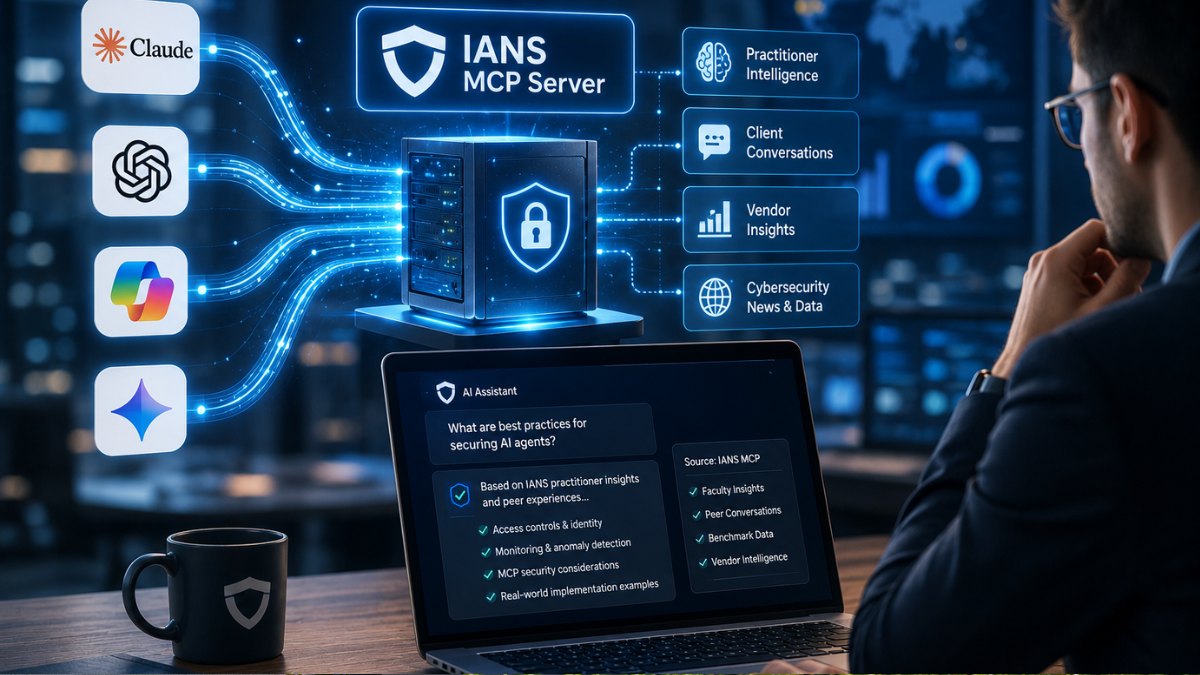
That's what makes the IANS Model Context Protocol server launch genuinely significant. It's the first cybersecurity MCP server deployment for native AI tools that gives security teams access to practitioner-validated intelligence directly inside their existing workflows - specifically Claude, with more platforms coming later in 2026. No switching tabs. No waiting for a research analyst to respond. Just answers grounded in what real security teams have actually done.
Why Standard AI Tools Keep Giving You Mediocre Cybersecurity Answers
Here's something vendors don't usually say out loud: public AI models are trained on public data. And public data in cybersecurity is mostly vendor marketing, press coverage, and SEO-optimized blog posts from three years ago.
Ask about phishing-resistant authentication. Ask which vendor handled an enterprise deployment well. Ask what your peers are doing about AI governance right now. You'll get polished, plausible-sounding answers that have no grounding in actual practitioner experience.
Practitioner-validated cybersecurity intelligence AI integration is the missing piece. And it's what IANS has spent two decades building - a private knowledge base that's now accessible through the MCP.
If you follow Security coverage or track Ai developments on Www.Globalbyte.News, you've probably noticed how wide the gap between "what public AI knows" and "what CISOs actually need" has become. This integration is a direct response to that gap.
What's Actually Inside the IANS Knowledge Base
This is where it gets concrete.
IANS has a faculty network of 170+ active cybersecurity practitioners - people currently working in security, not just writing about it. Their expertise, recommendations, and thousands of client interactions are all searchable through the MCP. That includes anonymized peer discussions, vendor-agnostic research, and real decision logs from CISOs at organizations that faced the same choices you're facing now.
Wolf Goerlich, CISO of Oakland County, Michigan and an IANS Faculty Member, said it directly: "CISOs don't need another plan; we need to understand what our peers at similar organizations actually did, what the trade-offs were, and the outcomes."
That's the Claude AI tools integration cybersecurity private knowledge base difference. Not theory. Not vendor positioning. Actual decisions, with actual trade-offs and actual outcomes, from peers who've been in your shoes.
Unbiased cybersecurity vendor intelligence research databases are almost nonexistent in public AI. Everything a standard LLM tells you about a vendor has been filtered through that vendor's own marketing content. The IANS MCP pulls from vendor-neutral research, so when you're evaluating tools or justifying a budget to your board, the answer you get is grounded in something real - not PR copy.
The Areas Where This Is Seeing Strongest Demand
Early usage data shows security teams aren't using the MCP for casual browsing. They're using it for the hard stuff - the topics where traditional research cycles have completely broken down.
Securing AI agents and cybersecurity MCP server deployment, native AI tools is the top use case right now. Phishing-resistant authentication deployment peer benchmarks is close behind. And cyber risk quantification data models and native workflows is the third major area showing strong traction.
These topics aren't stable. They're changing week to week. Enterprise CISO strategy adjustments, real-time peer data is exactly what you need when your board is asking about AI agent governance, and you need a defensible answer by Thursday, not next quarter.
Paul Henderson, Chief Product Officer at IANS, put the value simply: "It doesn't just tell you what an expert would advise; it shows you what security teams like yours have actually done."
That's a different kind of useful. And it's hard to overstate how much that distinction matters when the stakes are high.
AI Is Being Deployed Everywhere - But Domain Depth Still Decides Quality
It's worth stepping back briefly here, because this MCP launch fits into a much bigger pattern.
AI is now embedded in enterprise operations across every vertical. From how Samsung Yongin Semiconductor Wafer Fab C is reshaping chip production timelines, to how the Shanghai Meteorological Bureau Ai Ty handles real-time typhoon forecasting, to what Tianwen 2 Quasi Moon Kamo Oalewa Image 1 tells us about deep-space navigation data - the pattern is consistent. Generic AI gets you started. Domain-specific data is what makes it actually work.
Cybersecurity is no different. Arguably, it's the highest-stakes version of that pattern.
Whether you're a Webdev team building secure application pipelines or a Startup building out a security function from scratch, the Science of how AI retrieves and weights information matters enormously. And so does what that information actually is. Even the Gadgets side of enterprise technology eventually hits the same question: does this tool have access to the right data? In security, that question has real consequences.
Data Privacy and Anonymization - Not an Afterthought Here
One important thing to cover: if thousands of CISO conversations live in this knowledge base, how does IANS handle privacy?
Strict anonymization and consent standards apply to everything in the system. Peer discussions and client conversations are governed before they're accessible through the MCP. Anonymized cyber threat intelligence network integration solutions are what this approach is built to produce - so you get the intelligence without any identifying details attached.
Securing AI agents enterprise security infrastructure 2026 is one of the most scrutinized areas in enterprise tech right now. Data handling practices around AI integrations are under a microscope. Model Context Protocol security architectural framework compliance isn't a checkbox IANS ticked after the fact - it's baked into how the system was designed. That matters. And frankly, for any enterprise evaluating this kind of integration, the privacy architecture should be the first question you ask.
What This Changes for How You Actually Work
Cybersecurity MCP server deployment native AI tools isn't a concept on a roadmap anymore. It's live, it's working inside Claude, and early adopters are already using it to get better answers on the hardest security topics in play right now.
The core shift is straightforward. Your AI tool is only as useful as what you feed it. When you're feeding it 20+ years of practitioner-built intelligence - thousands of real CISO conversations, faculty-authored research, peer-validated recommendations, and anonymized peer community data - the quality of what comes back changes fundamentally.
The rate of change in enterprise security doesn't leave room for slow research cycles. You need to know what's happening now, what your peers decided, and whether it held up. That's what cybersecurity MCP server deployment for native AI tools, done right, actually delivers.