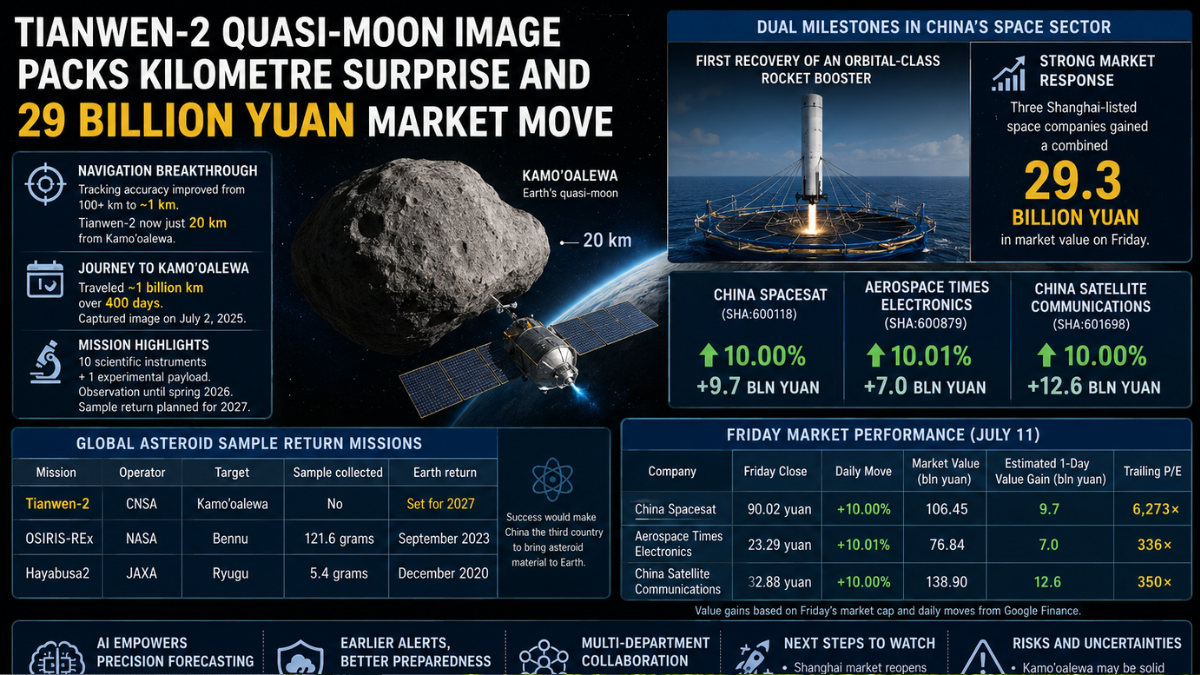
The first photo of Kamo'oalewa wasn't dramatic. Grainy. Distant. Small. But the number buried underneath the image was striking: China's Tianwen-2 probe had cut its asteroid position tracking error from over 100 kilometers down to roughly one kilometer, with the spacecraft now sitting just 20 km from the surface. That's what the China National Space Administration confirmed, and it's the technical core behind the Tianwen-2 quasi-moon Kamo’oalewa image space stocks market move that added 29.3 billion yuan in a single Friday session. Two milestones. One week. So what actually happened here, and is the market pricing it correctly?
What Kamo'oalewa Actually Is - and Why the Science Matters
Kamo'oalewa is a quasi-moon. Not a moon in the gravitational sense - it doesn't orbit Earth. Instead, it traces a path around the Sun that keeps it near our orbital track, like a companion that shadows us at a distance on its own slightly different loop.
Tianwen-2 spent about 400 days and roughly 1 billion kilometers getting there. The spacecraft arrived, captured its first image on July 2, and is now midway through a mission carrying 10 science instruments plus an experimental payload. The plan is months of close observation and surface mapping, then a sampling attempt, then an Earth return in 2027. If it succeeds, China becomes the third country to return asteroid material - after Japan's Hayabusa2 (5.4 grams from Ryugu in 2020) and NASA's OSIRIS-REx (121.6 grams from Bennu in 2023).
Han Siyuan, the Tianwen-2 spokesman, told Scientific American the asteroid is "highly likely to contain primordial information" from the early Solar System. Patrick Michel, who leads ESA's Hera mission, was blunter: "Every new image of an asteroid has been a surprise. We have everything to learn."
That's not hype. That's genuinely the state of the science right now. Nobody knows whether Kamo'oalewa is a fragment blasted off the Moon in an ancient impact or a primitive body from the asteroid belt. Its orbital behavior and spectral properties fit the lunar ejecta hypothesis, but the Kamo’oalewa quasi-moon sample return mission timeline exists specifically because scientists need the material in a lab to answer that question properly.
How Tianwen 2 Cut the Quasi Moon Tracking Margin of Error to One Kilometer
When you track China space industry moves across the sector, autonomous deep space navigation is one of the quieter but more consequential capabilities to watch.
The China National Space Administration optical navigation accuracy data confirms Tianwen-2's optical guidance systems are working. Getting the tracking margin of error from over 100 km down to around 1 km at 20 km range is the level of accuracy the next mission phases require. From here, the Tianwen-2 probe’s autonomous navigation asteroid margin of error reduction feeds into a structured close-approach sequence: the spacecraft will drop to 3 km, then 600 meters, then 300 meters, building a three-dimensional model of Kamo'oalewa before engineers select a sampling site.
And there's a longer play here. The Tianwen-2 mission paper explicitly frames these navigation capabilities as foundational tech for future Chinese deep space programs - Mars sample return, Jupiter exploration. The accuracy result released this week is both an immediate milestone and a proof point on a decade-long roadmap.
That framing matters when you're trying to understand why institutional investors track autonomous deep space navigation results so closely.
The Space Stocks Market Move: What Drove 29 Billion Yuan in Friday Gains
Here's where the timing gets interesting.
Two things happened in the same week. The Tianwen-2 navigation result was one. The other was a Long March-10B booster landing in a net stretched across an offshore barge at the Wenchang Commercial Space Launch Site, about six minutes after stage separation from a successful satellite deployment. The Long March rocket engineering story got a significant new chapter. Chen Mu, from the Chinese rocket developer, told Reuters the net recovery method "reduces vehicle mass and increases payload capacity" compared to landing-leg approaches used by competitors.
Markets didn't wait. Three Shanghai-listed names hit their daily limit up simultaneously:
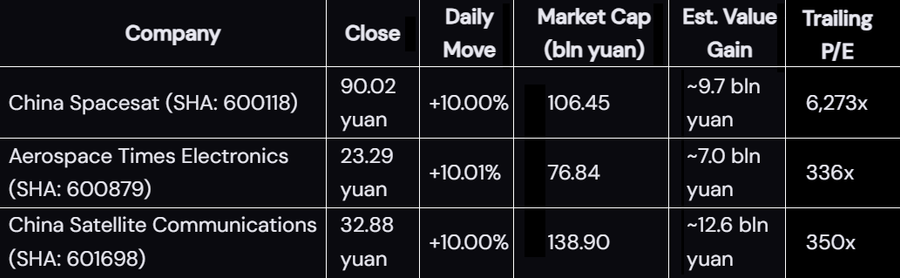
Friday market close, daily limit-up percentage moves, and trailing Price-to-Earnings (P/E) ratios tracking the 29.3-billion-yuan surge across Shanghai-listed space equities
The Shanghai space stocks’ twenty-nine billion yuan value gain is real. But those trailing P/E ratios - 336x at the low end, 6,273x at the top - mean investors are pricing in years of commercial execution that hasn't materialized in revenue yet. Li Kunlun at UBS Securities told CGTN that China's commercial space sector is nearing a "commercialization inflection point," with trillion-parameter capital flows following the sector narrative. And the broader China stocks tech rally has been adding sustained tailwind to names like these throughout 2026. China stocks rise broadly on data, and this week's dual space milestones landed on an already bullish macro backdrop.
The mission paper doesn't list a budget or name contracts tied to public companies. Friday's move is pricing the sector story, not Tianwen-2 cash flows.
The Risks That Aren't Hard to Name
Honestly, none of this risk is hidden. It's just inconvenient to say out loud.
Kamo'oalewa rotates every 27 to 30.5 minutes and could be a loose rubble pile rather than solid rock. Asteroid sample return capsule heat shield reentry parameters are the straightforward engineering problem - it's the touch-and-go sampling on a spinning, unpredictable surface where the real unknowns pile up. JAXA and NASA both hit surprises during their respective missions. Assuming Tianwen-2 won't is probably overconfident.
One booster recovery isn't a reuse program. The SpaceX Falcon 9 vs China reusable launch infrastructure comparison still favors SpaceX by a wide margin - Falcon 9 stages get reused dozens of times per booster across roughly 150 flights a year. China's orbital-class rocket booster dynamic net recovery method is impressive as a first demonstration. That's all it is. The scheduled reflight of the same recovered hardware before year-end is where proof actually starts.
A reusable rocket engine test from CAS Space earlier this year - Kinecore-2 burning for 620 seconds - added encouraging data. Signals, though, don't pay dividends. China A-share market resilience is real as a macro theme, but it doesn't neutralize execution risk in individual names trading at 6,273x trailing earnings. The updated capital market tech listing rules from 2025 also changed what's required to sustain premium valuations in this sector - worth reading if you're following these stocks seriously.
At 336x to 6,273x trailing earnings, there's essentially no cushion for a slow commercial ramp.
The Bigger Infrastructure Story Behind the Move
The Tianwen 2 quasi moon Kamo oalewa image space stocks market move didn't arrive in isolation. It landed in a week - and a broader period - where multiple China space infrastructure signals converged.
China's satellite constellation milestone crossed 238 satellites in orbit. The Beijing space computing center launched with explicit AI-in-orbit ambitions. China's orbital computing push is now investment-grade infrastructure. A marine satellite launch success completed the ocean monitoring constellation. And an atmospheric research aircraft flight filled another scientific data-collection gap in the same window.
That convergence - across deep space science, commercial launch, and orbital computing - is what Li Kunlun's "inflection point" comment was pointing at. Not one mission image. A cluster of milestones that hit investors all at once.
Wrapping Up
The Tianwen 2 quasi-moon Kamo’oalewa image space stocks market move is two different stories running in parallel.
The technical story is genuinely impressive: a probe that traveled 1 billion km over 400 days is now 20 km from a quasi-moon it can track to one kilometer accuracy, setting up to do something no spacecraft has previously attempted. That progress is real.
The market story is something else entirely. Twenty-nine billion yuan in a single Friday, sitting atop P/E ratios ranging from 336x to 6,273x, isn't a measured assessment of mission cash flows. It's a sector-level bet. Both can be true simultaneously: the technology is advancing, and the stocks are expensive.
Watch Monday's open on July 13 to see if the China Spacesat SHA 600118 limit-up gains hold. Watch the Long March-10B reflight, not the first recovery, for real proof of reuse. And watch what Tianwen-2's 3 km mapping orbit actually shows when the probe closes in.