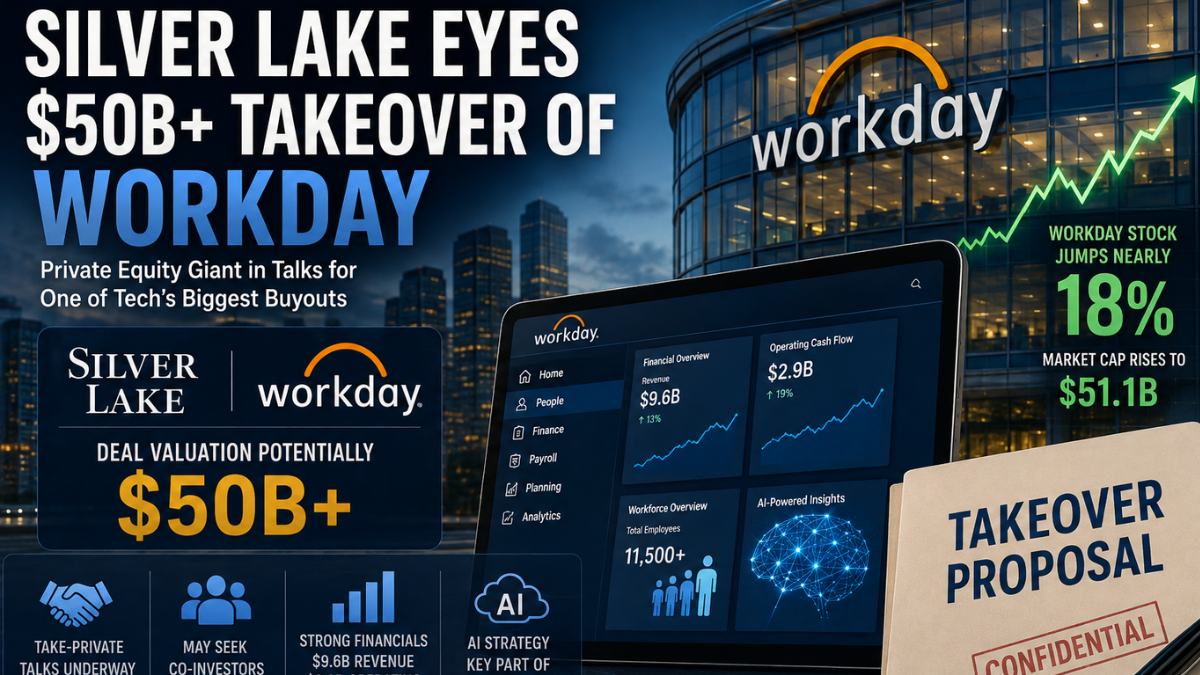
The Silver Lake acquisition Workday software buyout valuation story has put one of enterprise software's biggest names back in the spotlight. Reports indicate the private equity firm is discussing a potential takeover of Workday, though negotiations remain ongoing and no agreement is guaranteed.
That uncertainty matters. But so does the market reaction.
Workday shares jumped nearly 18% after the report, lifting the company's market value from roughly $43 billion to about $51.1 billion. For investors watching the Workday WDAY stock price surge takeover rumor, that move signals genuine interest, even if a signed deal is still some distance away.
Key Points
- Silver Lake's reported interest puts Workday's valuation back in focus, with the potential deal potentially exceeding $50 billion.
- Workday isn't a distressed company. It has a large enterprise customer base, recurring revenue, and significant operating cash flow.
- The stock's sharp jump shows how seriously investors took the report, even though discussions do not guarantee that a deal will happen.
- Slower growth is part of the reason Workday has become interesting to private equity. A lower public-market valuation can create an opportunity for buyers who believe the market has become too pessimistic.
- AI is the biggest long-term question. Workday needs to show that AI will strengthen its HR, finance, payroll, and planning products rather than make parts of traditional enterprise software less important.
- A $50 billion-plus transaction would be enormous for the software buyout market, and Silver Lake may need co-investors to help finance a deal of that size.
- Workday's customer relationships are one of its biggest assets. Large organizations depend on its software for critical business operations, making the platform harder to replace than many smaller software products.
- Private ownership could give Workday more flexibility. A new owner could focus on product changes and AI investment without having to respond to public-market pressure every quarter.
- The valuation still has to make sense. Paying a large premium only works if Workday can continue generating strong cash flow and find new sources of growth.
- The deal could become a broader signal for enterprise software. If Silver Lake moves forward, other mature software companies with strong customers but slower growth could become acquisition targets.
- Investors should watch Workday's AI progress closely. The important question isn't whether the company uses AI, but whether those features create enough additional value to support future growth.
- The talks also highlight a wider shift in software investing: companies are increasingly being judged on how well they can adapt to AI, not simply on their existing subscription revenue.
Silver Lake acquisition Workday software buyout valuation: where things stand
Silver Lake and Workday have reportedly held discussions in recent months about taking the cloud software company private. The firm may seek co-investors to help finance the transaction, a familiar move when a target carries a valuation above $50 billion.
The reported Silver Lake in talks to buy Workday 50 billion scenario would place the transaction among the most significant private equity technology deals ever attempted. Silver Lake has the experience, too. It previously partnered with Saudi Arabia's Public Investment Fund and Affinity Partners on the roughly $55 billion Electronic Arts take-private deal.
Still, talks are talks. They can change quickly over price, financing terms, regulatory review, or Workday's own view of its future as a public company.
Why Workday's valuation suddenly matters so much
Before the report, Workday had been under pressure. Its shares were down about 15% for the year and more than 40% below their 2024 high. That gap created an opening for a buyer willing to bet that the market has become too pessimistic.
The Workday market cap valuation acquisition talks are especially interesting because the company remains profitable and deeply embedded in large organizations. Workday reported fiscal 2025 revenue of $9.6 billion, up 13%, alongside $2.9 billion in operating cash flow, up 19%.
Those are not distressed-company numbers.
But revenue growth slowed from 16% in the prior year. And that slowdown helps explain why the Traditional software growth concerns AI disruption narrative has weighed on the sector. Investors are asking whether established subscription software can keep pricing power when AI tools begin changing how businesses build, buy, and use software.
You can see similar pressure in the broader market conversation around the AI capex squeeze, even though Workday's business model differs from a hyperscaler's.
Workday's AI strategy is now part of the price
A potential buyer isn't simply purchasing recurring revenue. It is buying Workday's customer relationships, data, cloud platform, and ability to adapt its products for AI-driven work.
Workday provides human resources, payroll, finance, spending, and planning tools to more than 11,500 customers worldwide. Netflix, U.S. Bank, Johns Hopkins University, and Thomson Reuters are among the organizations using its platform. That makes the enterprise HR cloud software buyout Workday angle far more than a stock-market story.
The company was founded in 2005 by former PeopleSoft executives Aneel Bhusri and David Duffield. Bhusri returned as chief executive in February, replacing Carl Eschenbach, at a delicate moment for the business.
Workday's revenue growth and AI strategy are under spotlight during Silver Lake buyout talks. Can its AI features help customers automate routine finance and HR tasks without weakening the value of its existing software? That's the question buyers, boards, and shareholders will all be pricing in.
How large could a Silver Lake deal become?
The Silver Lake acquisition Workday software buyout valuation could exceed $50 billion once a buyer adds a premium to Workday's unaffected share price and assumes debt or other obligations. That would make it much larger than Hg Capital's roughly $6.4 billion agreement to take OneStream private this year.
It would also dwarf Thoma Bravo's approximately $12.3 billion Dayforce transaction.
That comparison matters because the potential Silver Lake Workday deal could become one of the largest software buyouts in history. Silver Lake's likely need for partners also reflects the reality of modern dealmaking: a single private equity firm rarely funds an acquisition of this size alone.
The reported Silver Lake considers co-investors for historic private equity acquisition of Workday approach fits its earlier Electronic Arts playbook. Possible partners have not been confirmed publicly.
Private equity mega deals software sector 2026 activity has been selective rather than constant. Buyers want dependable cash flow, sticky customers, and an asset that can withstand technological change. Workday offers much of that, but the AI risk isn't imaginary.
Why private equity is looking again at enterprise software
After a quieter stretch for large software takeovers, a deal for Workday could suggest that private equity firms believe public-market valuations have fallen far enough to make quality assets attractive again.
This is part of how rising AI adoption is driving private equity consolidation in enterprise software. The market has punished companies seen as slow to adapt, while buyers may see an opportunity to invest outside the pressure of quarterly earnings calls.
The potential deal also arrives as businesses prepare for an enterprise IT boom. If organizations spend more on modernizing their financial and workforce systems, Workday could benefit. If AI-native competitors move faster, however, a buyout premium could look expensive.
And that tension is exactly why the Silver Lake acquisition Workday software buyout valuation is so closely watched.
For a broader sense of how acquisition pricing is being tested across industries, compare the reported PayPal buyout offer, the Tamron acquisition proposal, and the Samsung Biologics bid. Different sectors, same hard question: what is a durable business worth when expectations are moving fast?
What investors should watch next
First, watch for confirmation that formal due diligence has started or that a consortium has formed. The identity of co-investors could reveal how the deal is structured and how much leverage Silver Lake plans to use.
Second, monitor Workday's operating results. A strong earnings report could raise the price Silver Lake needs to pay. A weaker outlook could complicate financing.
Finally, follow AI-related guidance. Big-tech enthusiasm has already produced dramatic moves, from the Microsoft value gain to investor focus on Azure AI cash flow. Yet not every AI market moves in one direction, as recent volatility in China AI stocks shows.
Workday won't be judged on hype alone. It needs to show that AI can support its subscription business rather than chip away at it.
What the Workday buyout talks could mean
The Silver Lake acquisition Workday software buyout valuation is a test of whether private equity sees opportunity where public investors see risk. Workday has slowing growth, legitimate AI questions, and a share price that had already taken a hit.
It also has sticky customers, substantial cash flow, and a central role in how large organizations manage people and money.
If Silver Lake proceeds, the deal would signal renewed confidence in mature enterprise software. If it falls apart, the conversation still tells you something useful: investors are trying to decide which established software companies can thrive in an AI-heavy market, and which ones need a new owner to make the next chapter work.
GlobalByte Perspective
The interesting part of the reported Silver Lake–Workday talks isn't just the potential $50 billion-plus price tag. It's the question behind the deal: does a mature software company with slower growth still have enough value to attract a huge private-equity bet?
Workday has some qualities buyers usually want. It has thousands of large customers, recurring revenue, strong cash generation, and software that sits at the center of how businesses manage employees, payroll, finance, and planning. Those relationships are difficult for competitors to replace overnight.
But the company is also facing a very different software market than it did a few years ago. Growth has slowed, while AI is forcing enterprise software companies to rethink what their products should actually do. Investors aren't only asking how much revenue Workday can generate anymore. They're asking whether AI will make its existing software more valuable—or eventually make parts of it easier to replace.
That makes Silver Lake's reported interest particularly interesting.
In our view, the potential deal is as much a bet on Workday's next chapter as it is on its existing business. A private owner could give the company more room to invest in AI, reshape products, and make longer-term decisions without the same pressure that comes with being a public company.
But paying more than $50 billion would also raise the stakes considerably. Workday would need to show that its customer base, cash flow, and AI strategy can justify that valuation over time.
The bigger message for the software industry is clear: AI isn't only creating new winners. It's also forcing investors to reconsider what established software companies are worth.