Summary
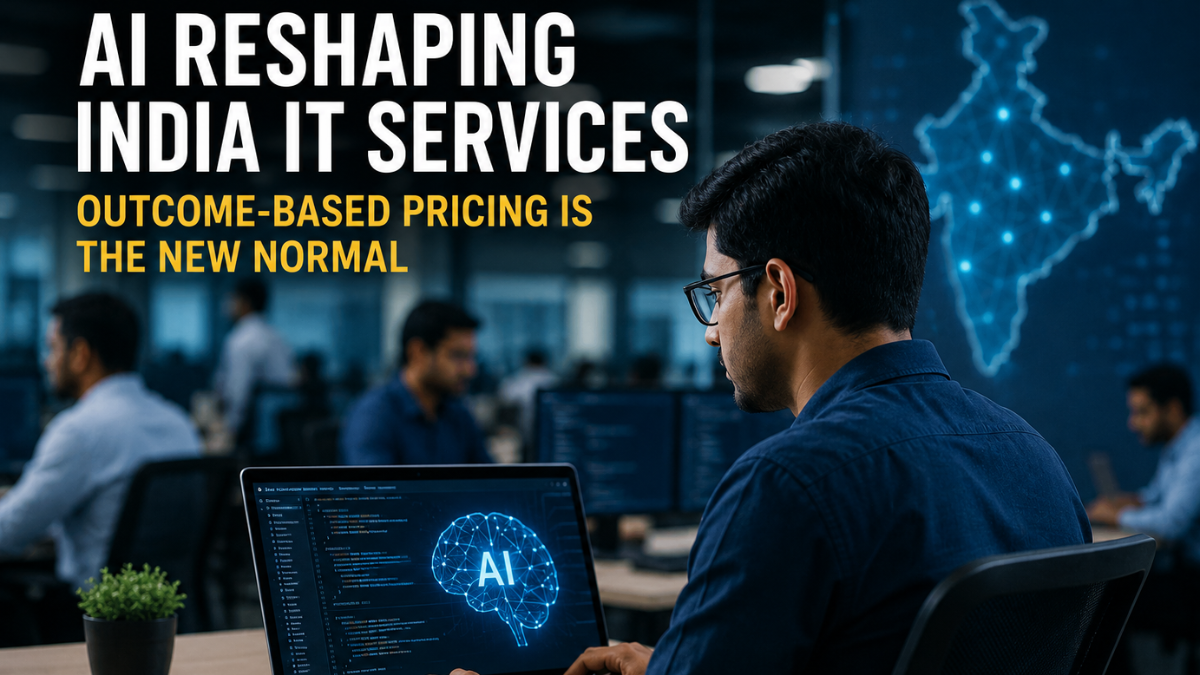
AI reshaping India IT services contracts outcome based pricing is no longer a future trend. It is already changing how clients buy technology work, how vendors calculate revenue, and which firms can win the next deal.
For decades, Indian outsourcing thrived on a familiar formula: add skilled people, bill for their time, and scale delivery across large teams. AI coding agents have made that formula harder to defend. If a task that once took ten engineers two weeks can be completed faster with a smaller, senior-heavy team, clients naturally ask why they should keep paying the old rate.
That question is rattling a $315 billion industry.
Key Points
- Outcome is replacing effort: Clients increasingly care about what a technology project achieves, not simply how many engineers are assigned to it.
- AI is weakening the billable-hours model: Faster development means traditional staffing-based pricing is becoming harder to justify.
- Margins are becoming a bigger battleground: IT firms cannot keep cutting prices indefinitely while maintaining delivery quality.
- Mid-tier firms have an opening: Faster decision-making and specialised AI capabilities can help smaller providers compete for enterprise work.
- Entry-level hiring could change: Routine coding, testing and documentation are increasingly exposed to AI automation, raising demand for higher-value technical skills.
- AI productivity needs measurement: Vendors will need clear baselines and measurable KPIs before claiming that AI has created savings.
- Clients also carry risk: Outcome-based contracts can become complicated when results depend on factors outside the technology vendor's control.
- The next competitive advantage is commercial discipline: The strongest IT providers may be those that know when to use AI, how to price its impact, and when to walk away from an uneconomical contract.
AI reshaping India IT services contracts outcome based pricing is putting clients in control
The India IT services sector AI contract disruption comes down to leverage. Clients can automate routine work internally, compare more vendors, and demand proof that AI is producing real savings before they commit to long contracts.
Some are also asking suppliers to cut prices by 25% to 30% while delivering more, faster. That's a hard bargain, especially when vendors still carry delivery, talent, infrastructure, and compliance costs.
And clients aren't impressed by AI demos alone. They want AI margin outcomes, not vague promises about productivity. The wider enterprise AI spending debate shows why buyers have become more demanding.
Shorter contracts are one result. More pilot projects are another.
Why AI reshaping India IT services contracts outcome based pricing favors measurable results
What is outcome-based pricing in IT outsourcing? Instead of charging for the number of people or hours assigned, a provider is paid for an agreed business result, such as lower processing costs, faster claims handling, improved uptime, or a defined revenue target.
That is the outcome based pricing model Indian IT companies are being pushed toward. It can work well when both sides agree on clean baseline data and controllable metrics. But it can get messy fast if the client changes systems, delays decisions, or expects savings that AI cannot realistically create.
TCS outcome performance contracts 80 percent share is a striking signal of the shift. In its business-services segment, roughly 80% of contracts reportedly use outcome measures, about double the level seen before generative AI became mainstream.
Cognizant and HCLTech have also structured cloud and automation deals around AI savings and efficiency gains. That approach connects naturally to AWS cloud growth and Azure AI cash flow, because cloud platforms are where much of this automation gets built and measured.
The end of billable hours IT outsourcing model
The end of billable hours IT outsourcing model won't happen overnight. Large transformation projects still need people, specialist judgment, and steady operational support.
But billing for effort alone is losing its appeal. Clients now ask: if AI reduces your delivery time, why doesn't my price fall too?
That pressure explains TCS Infosys Wipro AI productivity price cuts. Vendors must choose between accepting lower rates, sharing savings, expanding the project scope, or walking away. Infosys has indicated that it has declined work where the economics no longer made sense, while Tech Mahindra has warned about rivals offering unrealistic long-term pricing assumptions.
Tech Mahindra Infosys non viable AI contracts are not just corporate talking points. They reveal a genuine risk: providers can win a logo today and lock themselves into a loss-making commitment tomorrow.
Mid-tier IT firms are moving faster
Mid-tier IT firms vs Tier 1 Indian IT AI race is becoming one of the industry's more interesting contests. Scale still matters for global delivery, security, and massive enterprise accounts. Yet it no longer guarantees success for Tier 1 Indian IT giants in the AI era.
Smaller firms can often put senior decision-makers in front of a client quickly, test an AI use case, and adjust commercial terms without layers of approval. That agility matters when customers want a working pilot next month, not a transformation roadmap next year.
Persistent Systems Coforge double digit revenue growth AI illustrates the point. Both companies have recorded sustained double-digit dollar revenue growth, while several larger peers have posted much slower expansion.
There is a catch, though. Fast growth can turn into thin margins if firms chase every deal at any price.
The same demand is visible beyond traditional outsourcing, from Indian fintech deployment to digital transformation demand. Buyers want practical implementations, not theatre.
Markets and hiring are feeling the AI impact
Nifty IT index market value loss AI impact has become a visible measure of investor anxiety. The index's constituents have lost tens of billions of dollars in market value as investors weigh lower pricing, in-house automation, and uncertain demand.
The fear isn't that IT services vanish. It's that the old staffing-heavy growth engine weakens.
Indian IT entry level hiring decline coding AI agents may be the more lasting change. Traditional firms hired large groups of fresh graduates, trained them, and built a pyramid with many junior engineers at the base. AI can handle more basic coding, testing, documentation, and support work now, so companies may need fewer entry-level roles and more people who can design, validate, and govern AI systems.
That's uncomfortable. It's also why reskilling has to become more than a slide in an earnings presentation.
Global supply and policy shifts will shape the opportunity too, including the AI computing supply chain, the India-Japan AI pact, and the broader AI industry empowerment push across sectors.
What clients and vendors should watch now
AI reshaping India's IT services contracts through outcome based pricing rewards firms that can quantify value without making reckless promises. If you're buying services, define the baseline, the shared risks, the data access, and what happens when outside factors affect the result.
If you're selling, don't confuse AI productivity with free delivery. Protect margin floors. Price the business outcome carefully. Be ready to say no.
The strongest providers will pair technical credibility with commercial discipline, then show clients where AI genuinely creates savings. That is more valuable than simply claiming an AI-led IT boom.
GlobalByte Perspective
AI is not killing India’s IT services industry. It is changing what clients are willing to pay for.
For years, the basic outsourcing model was simple: more people, more hours, more billing. AI has started breaking that equation. If a smaller team can deliver the same software faster with coding agents and automation, clients have a legitimate reason to question traditional staffing-based contracts.
That is why outcome-based pricing is becoming more important. Clients increasingly want vendors to connect their fees with measurable results—lower costs, faster processes, better uptime, or higher productivity.
But there is another side to this shift. Lower prices do not automatically create better IT services. If vendors accept aggressive pricing without understanding the actual cost of delivery, AI could improve productivity while simultaneously damaging margins.
The bigger opportunity may be for companies that can do both: use AI to reduce delivery effort while becoming more accountable for the business result. That could give agile mid-sized firms an opening against much larger IT providers.
For GlobalByte News, the real story isn't simply that AI is reducing IT jobs or forcing price cuts. It is changing the economics of the entire outsourcing relationship. The winners will likely be the companies that can prove exactly how their technology creates value, and price that value without making promises they cannot deliver.