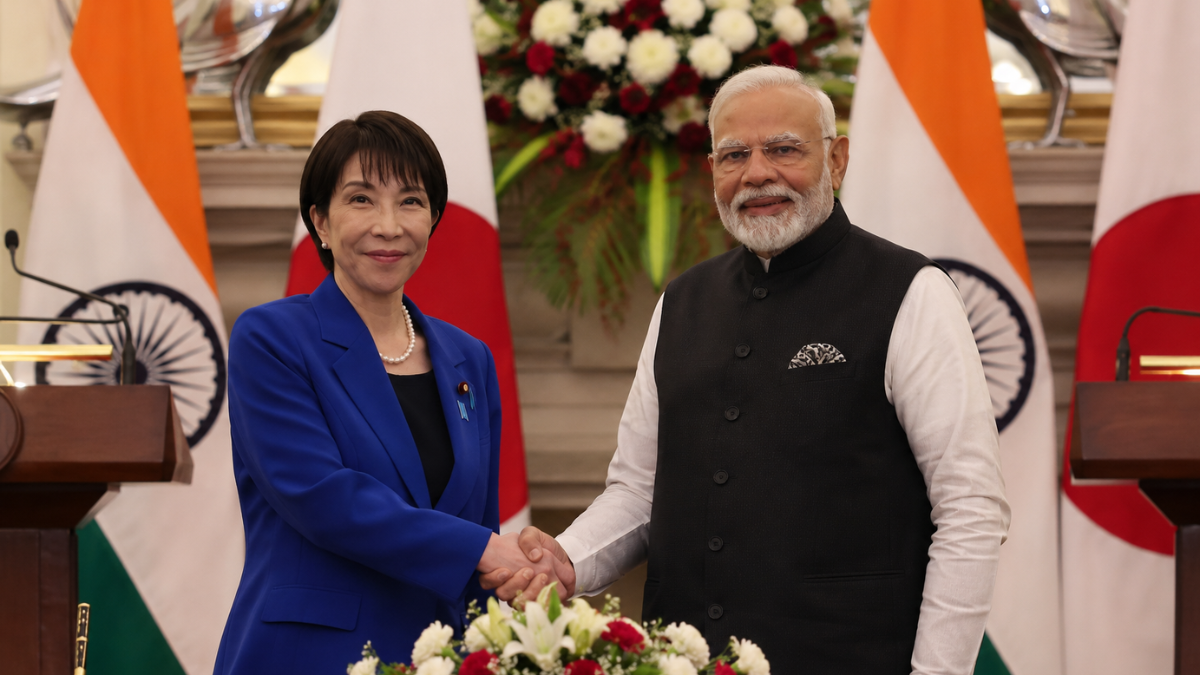
Something shifted in New Delhi this week. Japanese Prime Minister Sanae Takaichi flew in with a business delegation big enough to fill a conference hall, sat down with Narendra Modi, and walked out having signed the India-Japan AI and Economic Security Pact along with two other landmark agreements. It's not every day two Asian powers rewrite their playbook on artificial intelligence, defence, and critical metals in the same afternoon. But that's exactly what happened.
If you're trying to make sense of what got signed and why it matters beyond the diplomatic photo-ops, here's the breakdown.
Key Takeaways from PM Modi and Japanese PM Sanae Takaichi Talks
Let's start with the basics. Modi and Takaichi held what officials called "wide-ranging talks" covering trade, economic security, energy, emerging tech, defence, and people-to-people ties. Three documents came out of it: one on economic security, one on energy resilience, and one on AI cooperation.
Takaichi didn't mince words. "Japan and India will leverage each other's strengths to grow strong and prosperous together," she told reporters. She added that in a turbulent international landscape, this mutually complementary relationship "has become increasingly important." Neither leader took questions afterward, which is fairly typical for these state visits, but the substance of what got signed speaks louder than any press conference would have anyway.
Here's a quick rundown of what changed:
- Three landmark documents adopted covering AI, energy, and economic security
- First-ever defence co-development project between the two countries
- Reaffirmation of Japan's pledge to invest over $61 billion in India over the next decade
- Fresh commitments on critical metals supply chains and energy resilience
How India Software and Japan Precision Tech Boost Global AI Development
This is the part that probably matters most for the tech world. Modi put it plainly: "The convergence of Japan's precision technology and India's software capabilities will give a new momentum and strength to global AI development." That's not just diplomatic filler. Japan brings hardware precision, chip manufacturing know-how, and robotics expertise. India brings software talent at a scale few countries can match.
Think about it this way. Japan has been pouring resources into Japan's semiconductor fab expansion, while simultaneously making moves through Tokyo's push into physical AI. Pair that hardware muscle with India's software and AI talent pool, and you get a partnership that could genuinely reshape parts of the global AI computing power supply chain. It's an India-Japan AI co-development agreement in every sense but name, even though the official documents use more cautious diplomatic language.
Will this translate into actual joint products within a year or two? Probably not that fast. These things take time. But the direction is set.
Details of India Japan First Defence Co-Development Agreement
Now here's something genuinely new. Modi confirmed the two countries signed their first-ever co-development project in the defence sector. This is a big deal because India and Japan have cooperated on defence before, but never actually co-developed equipment together from the ground up.
Neither side released granular specifics on what the equipment involves. That's normal for early-stage defence pacts. What is clear, though, is the broader context: both India and Japan are Quad members, alongside Australia and the United States, and the Quad grouping is widely understood as a counterweight to China's expanding footprint across the Indo-Pacific. As countries look to build a more sovereign military AI platform approach rather than relying on a single supplier nation, this India-Japan defence co-development project fits a pattern playing out globally right now.
Critical Metals and Energy Resilience Pact
Supply chains for critical metals have become a genuine anxiety for governments everywhere, and this critical metals and energy resilience pact tackles that head-on. Rare earths, battery materials, semiconductor inputs. All of it flows through a handful of chokepoints, and both India and Japan clearly want to diversify away from overexposure to any single source.
This isn't happening in a vacuum either. Countries have been scrambling to respond to shifting rules on overseas tech transfers, and the pressure on chip-adjacent supply chains has already forced moves like South Korea's AI chip hub infrastructure buildout and TSMC's Arizona investment expansion. India and Japan securing their own critical metals and energy resilience roadmap together is really just catching up to a trend the rest of the industry already started chasing.
Japan's $61 Billion Investment and the India-Japan Trade Corridor
Numbers help ground all this. Bilateral trade between India and Japan hit $27.5 billion in fiscal year 2025/26. Japanese investment into India ran $3.2 billion between April and December 2025 alone. And Takaichi's visit reaffirms a pledge Modi secured last year in Tokyo: Japan more than doubling its investment target to over $61 billion over the coming decade.
Where's that money actually going? Infrastructure, mostly. Japan has long backed the Mumbai-Ahmedabad high-speed rail corridor, and Japanese firms keep expanding their footprint in Indian banking and manufacturing. There's also that recent $1.6 billion deal for a 20% stake in Yes Bank, which shows Japanese capital isn't just flowing into big government-to-government infrastructure projects anymore. It's reaching into Indian financial markets directly.
That's a meaningful shift. Japanese investment in Indian infrastructure and technology used to be dominated by a few marquee rail and highway projects. Now it's spreading across sectors.
Quad Economic Security Roadmap 2026 and the Bigger Indo-Pacific Picture
Zoom out and this India-Japan AI and Economic Security Pact sits inside a much larger Quad economic security roadmap for 2026. India and Japan aren't acting alone here. The broader Indo-Pacific economic security strategy involves coordination with Australia and the US too, even if this particular round of agreements was bilateral.
It's worth watching how this fits against the backdrop of other multilateral AI efforts happening elsewhere. There's been a joint statement on AI accessibility at the UN signed by dozens of countries, plus momentum building around the World AI Cooperation Organization forum. Meanwhile, broader debates over global governance on artificial intelligence keep intensifying. India and Japan's pact is one thread in a much bigger tapestry of countries trying to figure out how AI development, security, and trade all fit together.