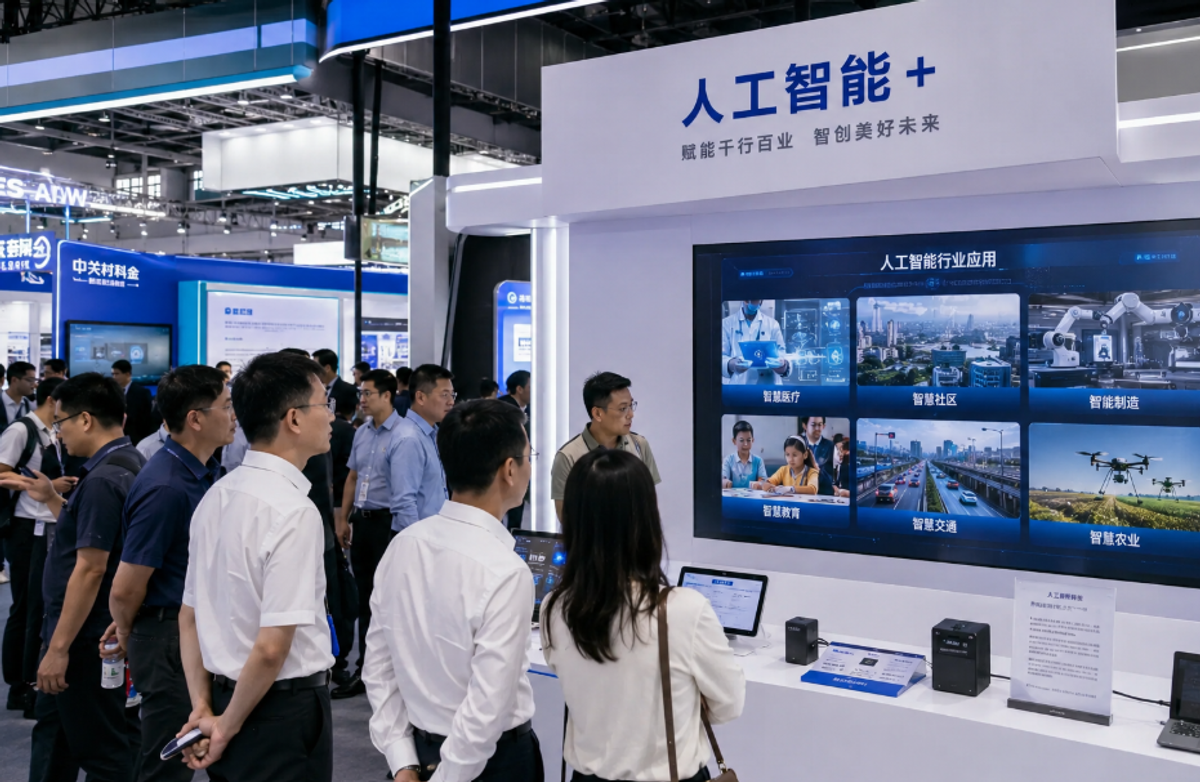
Something significant is shifting in China's economy right now. Over the past few weeks, central and local governments have issued a coordinated series of AI policy packages - and the data coming out of that push is striking. Artificial intelligence accelerates empowerment of industries at a pace most analysts weren't projecting for this year, from tourism platforms tripling their AI usage to solo founders replacing 72 yuan of human development costs with a single yuan of AI investment. Here's what's actually moving, and why it matters.
When AI Stops Talking and Starts Executing
There's a phrase circulating in Chinese tech circles right now: "from intelligent interaction to intelligent execution." It sounds like marketing language. But it's describing something concrete.
Fliggy's data from the summer travel season makes it tangible. AI interactions surged threefold in just two weeks, with travelers using AI-powered intelligent services to coordinate complex multi-person, multi-day itineraries in real time. That's not searching for flights. That's full trip orchestration.
E-commerce shows the same pattern. During the 618 shopping festival, Qianwen App handled the full process of filtering, comparing, and ordering on Taobao. Doubao went further - integrating with Douyin Mall for intelligent shopping suggestions and direct ordering, collapsing the steps between intent and purchase down to almost nothing.
This shift is exactly why China's AI sector growth is drawing serious attention from analysts globally. When AI handles execution rather than just advice, the value equation changes entirely.
The Yiwu Case: What Happens When Language Stops Being a Wall
Yiwu - the city that supplies the world with everything from artificial flowers to holiday decorations - has quietly become one of the clearest case studies in AI's impact on small exporters.
Chen Jinbao runs Yiwu Duofu Artificial Flower Co., Ltd., targeting overseas markets. For years, connecting with foreign clients meant fighting two problems simultaneously: time zone gaps and language barriers, with slow human translators stuck in the middle. Missed messages. Delayed responses. Lost deals.
Now the company runs AI-powered real-time translation with 24/7 intelligent reception. No time zone problem. Conversations happen when the client is ready, not when a translator is available. Communication efficiency and conversion rates have both improved measurably.
It's one company. But multiply it across thousands of similar exporters, and you see how AI supply chain integration is reshaping cross-border trade economics at the small-business level - structurally, not just operationally.
How Artificial Intelligence Accelerates Empowerment of One-Person Companies
Here's a number worth pausing on. A survey by CCID Consulting and MYbank found that every one yuan invested in AI effectively replaces 72 yuan in human development costs. For a solo founder with no team, that's not a productivity metric. That's the entire business model.
75% of One Person Company (OPC) entrepreneurs in the survey have non-technical backgrounds. Over 57% spend more than 8 hours a day working alongside AI. The OPC is being reshaped from a niche structure into a scalable startup model - and the barrier to entry has never been lower.
Suzhou has read that signal clearly. It's positioning itself as the preferred city for OPC startups, with 80 specific measures covering innovation support, application scenario rollout, industry cultivation, and resource access. That's what this kind of innovation-led economic strategy looks like when a city gets serious about it. Other cities are watching.
Industrial Investment: The Hard Numbers Behind the Story
Set the startup stories aside for a moment. The industrial data from January to May doesn't need any spin.
National investment in high-tech industries grew 4.5% year-on-year. Integrated circuit manufacturing investment climbed 11%. Information services investment rose 13.8%. And electronics industry profits - driven by explosive demand for computing power and memory chips tied to global AI deployment - grew 103.9% year-on-year in just five months, contributing 43.1% of total profit growth among large industrial enterprises.
That last figure is the one to sit with. A single sector driving 43% of industrial profit growth in five months reflects a structural shift, not a cyclical bounce.
Lu Zhe, chief economist at Soochow Securities, points to smart terminal iteration as a central driver. With edge computing making large-scale AI models lighter, devices can now run sophisticated AI locally. AI smartphones, AI glasses, and AI PCs are crossing into mainstream use fast. JD.com's 618 festival saw AI glasses and AI PCs more than double in transaction volume, while AI mini workstations and intelligent sensing devices grew by over 20 times year-on-year.
Physical AI for business is clearly crossing from novelty into normal. On the factory floor, intelligent manufacturing AI agents are beginning to touch every part of production - from R&D design through supply chain management - in ways that keep improving total factor productivity over time.
Policy Is Building the Foundation
None of this is accidental. China's state AI policy got a formal mandate when the June 29th State Council meeting clarified that the "AI+" action plan would be implemented in depth - leveraging China's complete industrial system and rich application scenarios to push large-scale commercialization of intelligent products and services.
Transportation got its own framework: the "Action Plan for Innovating Typical Application Scenarios of Artificial Intelligence + Transportation," targeting ten major areas - intelligent driving, smart highways, intelligent shipping, intelligent construction and maintenance - with over 100 pilot projects and thousands of participating entities already in motion. That's not a pilot. That's national-scale deployment.
On the consumer side, eight ministries jointly issued implementation opinions to accelerate AI-powered phones, smart home appliances, and smart homes into mainstream adoption.
Chinese AI companies are benefiting from city-level support that goes far beyond broad incentives - specific, implementation-focused packages designed to close gaps in funding, talent, and market access simultaneously. And the industrial internet transition that's been building for years is now accelerating under this policy architecture. Together, these layers show how central and local governments join forces to drive AI innovation - and why artificial intelligence accelerates empowerment of industries at a national scale when policy coordinates with real adoption.
Artificial Intelligence Accelerates Empowerment of Industries - But the Work Isn't Done
Luo Zhiheng, chief economist at Yuekai Securities, puts the challenge plainly: expand effective investment in AI and deepen "AI+" integration across all fields. China's strength is already in the application layer. The work now is maturing the business models sitting on top of it - and proving those models out in real-world conditions, not just pilot environments.
That's not trivial. But when central government mandates meet local government execution, the compounding effect is real. Artificial intelligence accelerates empowerment of industries not just within sectors, but through spillovers between them - each successful application generates data and capability that adjacent industries can use immediately.
The digital economy AI innovations already visible give a credible preview of what comes next. The billion-yuan AI agent investment flowing into major platforms signals institutional confidence the returns will justify the scale. And for context on how China is positioning itself internationally alongside all this, China's open-source AI rise and China's AI governance role are both worth reading next.
Business models still need to prove out fully. But the policy momentum, the capital flows, and the adoption data are all running in the same direction.