Summary
Google buys Spirit Airlines business data 10 million AI training assets in a bankruptcy auction, a deal that has sparked obvious questions about privacy, corporate communications, and what AI companies actually want from a failed business.
The purchase is not about passenger profiles, according to the bankruptcy filings and Google's statement. Instead, Google is seeking a large de-identified enterprise dataset: operational records, internal emails and collaboration data, marketing material, software code, pricing information, and other business documents from the defunct carrier.
It’s a strange sentence to read. An airline shuts down, then its internal work history becomes valuable fuel for AI development.
But that’s where the market is heading.
Key Points
- Google has offered $10 million for a large collection of Spirit Airlines’ internal business and technology data.
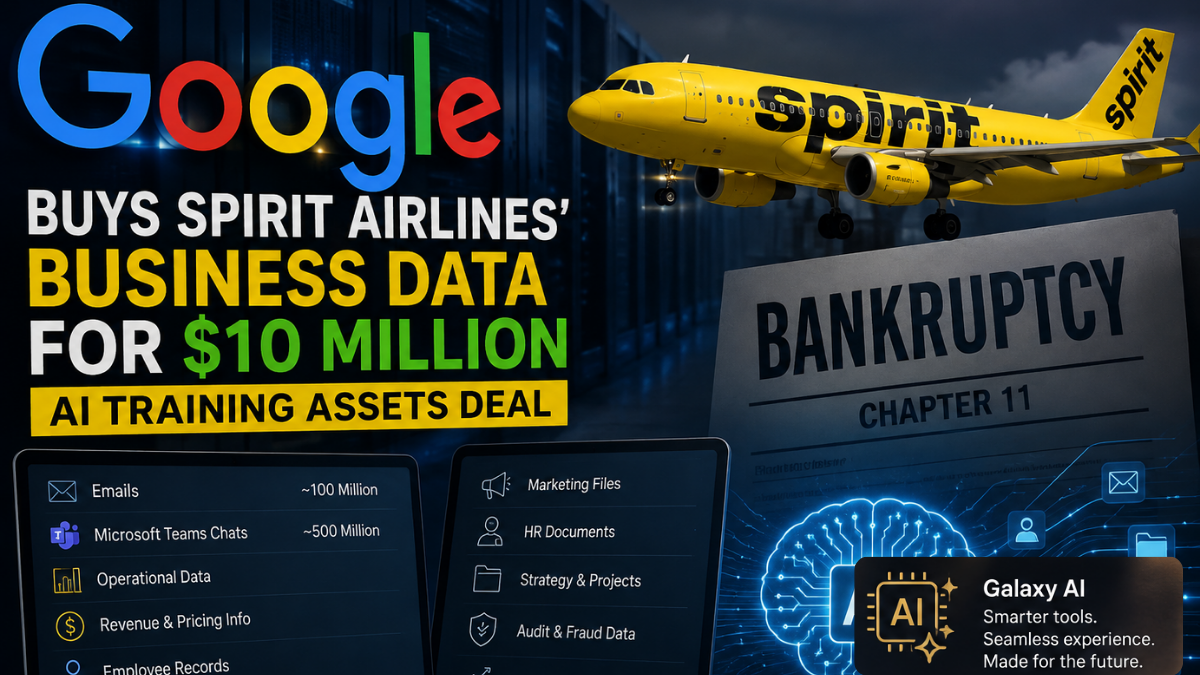
- The deal reportedly includes emails, Microsoft Teams records, operational data, pricing information, software code, models and internal business documents.
- Spirit’s passenger profiles and Free Spirit loyalty records are excluded from the transaction.
- Google says the acquired information will undergo third-party removal of personally identifiable information before transfer.
- Mercor offered $7.5 million, but Google submitted the higher $10 million bid.
- The bankruptcy court was scheduled to review the Google deal on August 19, so the transaction still requires approval.
- Spirit’s collapse left around $8.1 billion in debt and about 17,000 employees without jobs, making the data sale part of a much larger asset liquidation.
- The deal could become an early example of bankrupt companies’ internal data being treated as valuable AI-training material.
Google buys Spirit Airlines business data 10 million AI training assets
Google’s winning $10 million offer covers a significant collection of Spirit Airlines corporate records and technology assets. The reported material includes roughly 100 million emails, 500 million Microsoft Teams chats and collaboration records, operational data, revenue information, audit and fraud-related materials, and employee productivity records.
The Google buys Spirit Airlines business data 10 million AI training transaction also includes internal business records tied to marketing campaigns, human resources, strategy, project management, and airline operations.
And there’s more.
Court documents reportedly list about 30 million lines of code, development metadata, software models, and algorithms. Google is also acquiring historical pricing and transaction-related datasets, including competitor flight-price data and pricing curve information. For a company building business-focused AI tools, that mix is unusually useful because it reflects how a real organization communicated, planned, built systems, priced services, and handled routine work over time.
This is not just another public web-data purchase. It’s a Google product development internal corporate data purchase, built around the messier reality of enterprise operations.
What types of Spirit Airlines data is Google acquiring?
The broad answer is corporate data, not customer identity data.
Google acquires bankrupt Spirit Airlines internal business data for 10 million dollars to train AI, but the asset list is varied enough that the label “business data” can sound too vague. Here’s what the reported dataset includes:
- Internal emails, Microsoft Teams messages, and collaboration records
- Marketing, human resources, strategy, and project-management files
- Revenue, aircraft operations, employee productivity, audit, and fraud data
- Competitor-flight pricing and pricing-curve data
- Passenger transaction datasets in de-identified or otherwise protected form
- Software code, development metadata, models, and algorithms
- Historical employee records and internal spreadsheets, calendars, and workflow data
That variety matters. AI systems built for work need to understand more than polished documents. They need exposure to requests, meeting conversations, status updates, spreadsheets, technical handoffs, policy discussions, and the occasional confused thread that should probably have been a phone call.
That’s one reason real-world corporate material carries value. It may help AI developers build models that are better at tasks people actually perform in offices and operations teams.
Spirit Airlines de-identified employee emails Microsoft Teams data and privacy
Does Spirit Airlines data sale to Google contain customer personal information? Based on the reported court records and Google’s public statement, it should not.
The sale excludes Spirit’s estimated 97.5 million passenger profiles and roughly 50.2 million Free Spirit loyalty-program records. Privileged materials are also excluded. Google said the assets it receives will be rigorously scrubbed of personally identifiable information by an independent third party before transfer.
That protection is central to the deal. Without it, the transaction would raise a much more serious set of privacy and legal concerns.
Still, de-identification is not a magic word. Data can be difficult to anonymize properly, particularly when many fields can be combined to infer identity. That’s why the controls, third-party review process, permitted-use terms, and handling restrictions matter as much as the initial promise to remove names and email addresses. Businesses watching this case will likely look for more detail on the methodology.
The sale also lands during a period of wider AI safety concerns, where questions about data provenance and responsible model development are no longer side issues.
Why did Spirit Airlines file for bankruptcy and sell its assets?
Spirit Airlines shutdown debt fuel costs bankruptcy assets are the backdrop to the whole transaction.
Florida-based Spirit reportedly ceased operations on May 2 after its second Chapter 11 case in two years. Surging fuel costs and failed financing talks contributed to the company’s collapse, with filings citing approximately $8.1 billion in debt. Around 17,000 employees were laid off when operations ended.
A bankruptcy process is designed to recover value for creditors from whatever assets remain. In an airline, that can include aircraft-related rights, airport slots, equipment, contracts, intellectual property, and now, increasingly, data.
Spirit has already received approval to sell 22 takeoff and landing slots at New York’s LaGuardia Airport to JetBlue for $58.5 million. The proposed Google sale is another piece of the broader liquidation. Spirit Airlines asset liquidation continues with 10 million dollar Google data transaction, but the numbers also show why data has become a genuine bankruptcy asset rather than an afterthought.
For a business that generated years of operational records, internal communications, and software work, the dataset may be worth more than outsiders expect.
Why is Google buying Spirit Airlines business data for $10 million?
Google’s stated reason is straightforward: the dataset may help improve its products and AI models.
Why Alphabet is expanding AI training sets with real world corporate communication data is less mysterious when you consider where AI demand is moving. Consumer chatbots attract attention, but businesses spend money on systems that can search internal knowledge, support customer teams, prepare analyses, draft documents, help developers, and automate repetitive work.
That race affects enterprise AI spending, because companies want evidence that expensive AI deployments can solve real operating problems rather than produce impressive demos.
An airline’s data offers a dense cross-section of business behavior. You have pricing decisions, customer-service workflows, scheduling pressures, operational constraints, marketing activity, technical systems, and thousands of employees coordinating across departments. Cleaned properly, those materials can offer context that generic public data often lacks.
Of course, the flaw in any acquired dataset is that it reflects one company’s systems, habits, and failures. Spirit’s records won’t represent every industry, and they certainly shouldn’t be treated as a universal template. But for training and evaluating enterprise-oriented AI, diversity of real operational examples has obvious appeal.
The bigger picture includes AI industry growth, AI-powered industries, and the costly infrastructure behind them, from the AI computing supply chain to AI data center economics. Good training data is one piece of a much larger, very expensive puzzle.
Google buys Spirit Airlines business data 10 million AI training deal faces court review
The Spirit Airlines bankruptcy judge court approval Google data deal is scheduled for review on August 19 before U.S. Bankruptcy Judge Sean Lane in the Southern District of New York.
Google’s $10 million bid beat a $7.5 million offer from Mercor.io, an AI talent recruiting company. Mercor remains the backup bidder if the Google deal does not close. So, did Mercor bid against Google for Spirit Airlines internal business data? Yes. The Mercor 7.5 million bid Spirit Airlines internal data was the competing offer, though Google outbid it.
The hearing will determine whether the sale can proceed under the proposed terms. Bankruptcy judges generally consider whether a sale process was fair, whether the price is appropriate, and whether the transaction serves creditors’ interests. With a data asset, privacy safeguards and excluded material are likely to receive added attention.
Alphabet Google AI data acquisition bankruptcy hearing cases like this could become more common. As companies fail, merge, or restructure, their internal datasets may attract bidders that see value beyond physical assets and customer lists.
What this could mean for AI data deals
Google buys Spirit Airlines business data 10 million AI training material at a moment when the origin of AI training data is under scrutiny. The deal illustrates a new market: corporate data from bankrupt firms, packaged with legal restrictions and de-identification requirements, becoming a potential input for AI development.
There are legitimate upsides. Better enterprise AI could help organizations manage complex workflows, improve software tools, and reduce repetitive administrative work. That potential feeds AI market competition, where access to useful data can shape who builds the most capable systems.
But there are risks, too. Internal records can contain sensitive business context even after personal information is removed. And if an AI system is trained on real workplace communication, buyers need clear boundaries around consent, confidentiality, governance, and misuse. An AI cyber incident is a reminder that AI risks are not limited to training practices. Security and access controls matter after deployment as well.
That’s why AI governance action will need to keep pace with these transactions. The technology is moving quickly. Bankruptcy law, privacy expectations, and corporate policy are trying to catch up.
A new kind of bankruptcy asset
Google buys Spirit Airlines business data 10 million AI training assets, but the story is bigger than one airline and one buyer. It shows how internal company records, once treated mainly as a compliance burden or an IT storage problem, can become valuable assets in a liquidation.
For you, the practical lesson is simple: treat business data as valuable long before a crisis arrives. Know what you hold, separate sensitive information from ordinary records, define retention rules, and understand whether your contracts permit any future transfer or reuse.
Because when corporate data has value, someone will eventually want to buy it.
GlobalByte Perspective
Google’s $10 million purchase of Spirit Airlines’ business data is interesting for one reason: the valuable asset in a bankruptcy is no longer limited to planes, airport slots, or physical equipment. Corporate data itself can now attract serious buyers.
Google is not buying Spirit’s passenger database. The deal is focused on de-identified business material, including emails, Microsoft Teams records, operational information, pricing data, software code, internal documents, and other records built up during years of running an airline.
From Google’s perspective, the appeal is understandable. Real companies generate messy, complicated information every day. Employees communicate across departments, pricing changes with market conditions, software teams leave behind code and documentation, and operations teams deal with problems that rarely appear in polished public datasets. That kind of material could be useful for developing AI systems designed for actual business work.
But the privacy question shouldn't be brushed aside. Google says passenger profiles and loyalty-program records are excluded and that the purchased material will be scrubbed of personally identifiable information by an independent third party. Even so, removing names doesn't automatically make every piece of corporate information harmless.
The bigger story is what happens next. If this transaction receives court approval, it could encourage more buyers to look at the data held by bankrupt companies as an AI asset. That would create a completely new layer in corporate restructuring, where years of emails, workflows, code, pricing records and operational knowledge could become part of the sale.
For GlobalByte News, this is less a story about Spirit Airlines and more a sign of where the AI data market is heading.