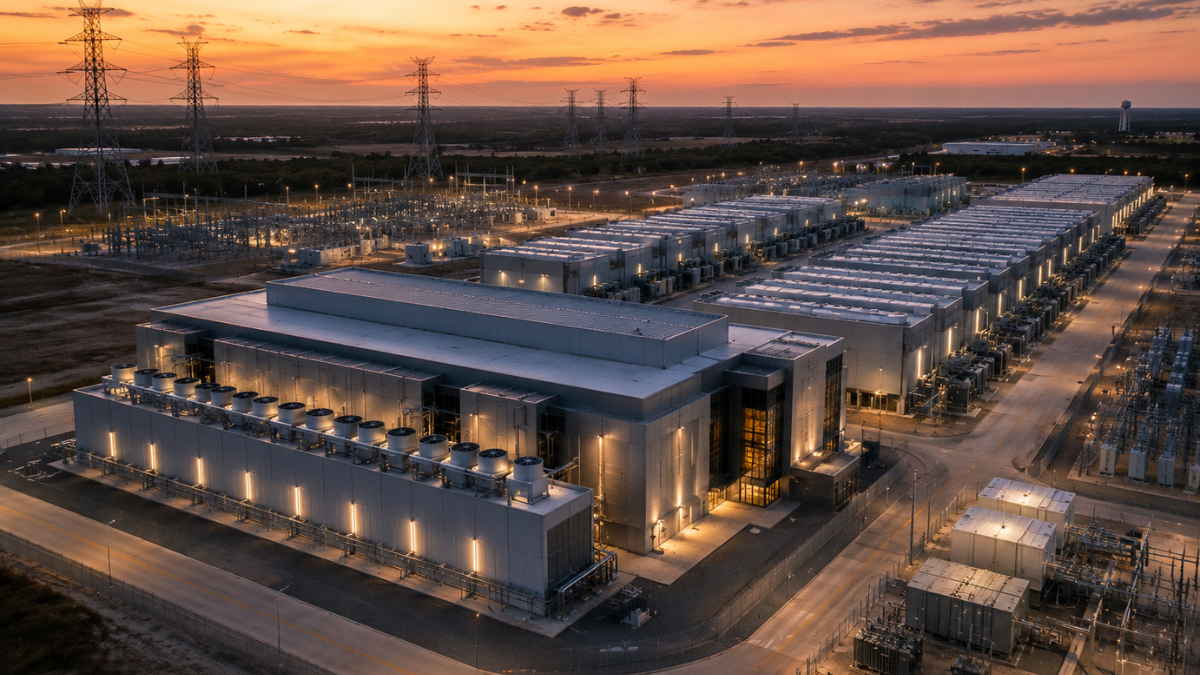
Hut 8 just made the biggest move in its post-crypto history. On July 20, the company announced a second 15-year lease worth $9.8 billion, fully commercializing its one-gigawatt Beacon Point campus in Texas. For anyone who's been tracking the Hut 8 billion-dollar AI data center lease Texas campus story, this second deal closes the loop on a transformation that's been years in the making.
HUT shares jumped about 5% in premarket trading. They've nearly doubled already this year.
What's in the Hut 8 $9.8 Billion Texas AI Data Center Lease
The new agreement covers 352 megawatts of IT capacity, doubling the existing tenant's contracted footprint at Beacon Point to 704 MW total. Who is the tenant? Hut 8 hasn't said. But the company describes them as an investment-grade counterparty - the kind of tenant that doesn't walk away from multi-decade contracts.
With both leases in place, the Beacon Point campus now carries a base-term contract value of $19.6 billion over 15 years. Renewal options could push that number to $50.2 billion.
Fifty billion dollars. From a single campus.
Across Hut 8's full portfolio, contracted AI data center capacity has reached 949 MW, backed by 1,330 MW of utility capacity. Aggregate base-term contract value stands at $26.6 billion - all of it backed by investment-grade tenants.
How Nvidia Architecture Unlocked 57% More Capacity
Here's something the headline missed. Before signing the second lease, Hut 8 redesigned the first data hall at Beacon Point around Nvidia's architecture. That redesign increased capacity by 57% within the same land and utility footprint. No new land. No new power agreements. Just a better design.
The Nvidia architecture optimized data center infrastructure approach signals something important: this isn't retrofitted mining hardware rebranded for AI. It's purpose-built space designed around what major GPU buyers actually need.
After the redesign, the existing tenant doubled its contracted capacity at the site. Make of that what you will.
Phase 2 data hall delivery is set to begin in Q2 2028. Second quarter twenty twenty eight infrastructure delivery timelines are a common benchmark across the AI sector right now, and Hut 8 is tracking in line with where serious operators are landing.
From Bitcoin Mining to Billion-Dollar AI Hosting
Hut 8 used to mine Bitcoin. Now it's signing multi-billion dollar leases with unnamed tech giants. That's not an accident.
The Hut 8 cryptocurrency mining to AI infrastructure pivot has worked, partly because the underlying assets transfer better than most people expected. Power infrastructure. Industrial cooling. Large-footprint facilities. Experience managing megawatt-scale operations at tight margins. Among bitcoin miners transitioning to generative AI compute hosting, Hut 8 has arguably executed the most complete pivot at the largest scale.
CEO Asher Genoot has positioned the company around using crypto-era capital discipline to build AI compute capacity at a lower cost basis than hyperscalers now racing to catch up. A fully commercialized gigawatt campus and $26.6 billion in portfolio contract value suggest that approach is paying off.
That transition also tracked precisely with how surging AI chip demand reshaped what enterprise buyers actually need - not just chips, but the physical space and power to run them at scale.
Power Is the Bottleneck Nobody Wanted to Talk About
Ask any hyperscale operator what's slowing down new capacity additions, and they'll probably say power. Not chips, not construction labor, not real estate. Power.
High-performance computing data center power constraints in Texas and across the U.S. have become one of the industry's defining competitive pressures. Transmission access and utility interconnection timelines are now strategic assets, not logistics details. The Hut 8 billion-dollar AI data center lease Texas campus deal is partly valuable because Beacon Point's 1,330 MW of utility capacity was already locked in. One gigawatt utility capacity data center infrastructure investment takes years to develop - and Hut 8 did that work during the mining era, when no one in AI was watching.
That's the overlooked part of this story. The data center battleground has moved well past real estate and cooling into upstream fights for grid access. And the rise of the green AI data center as an operating model shows that operators are trying to solve the power problem from both ends - securing supply while making workloads more efficient.
The Global Race to Build AI Infrastructure at Scale
Hut 8's deal doesn't exist in isolation. The AI industry growth forecast across major markets is pushing capital into data center infrastructure at a pace that was hard to imagine just a few years ago. Companies that can actually deliver at scale - with secured power, Nvidia-optimized design, and investment-grade lease structures - are capturing that capital disproportionately.
The AI energy infrastructure challenge is one reason the field of credible operators stays small. Sourcing gigawatt-scale power on AI customer timelines is genuinely hard. Most would-be operators can't do it.
Beyond U.S. borders, the global AI competition has intensified sharply. Countries and companies are scaling up AI computing infrastructure on multiple continents. Projects like a massive AI supercluster represent very different building models to compute capacity at national scale, while targeted billion-dollar AI investment programs are accelerating timelines on multiple fronts simultaneously.
Anyway, the point is that physical AI infrastructure - the actual buildings, power systems, cooling, and networking that run AI workloads - is where durable long-term value is being created. Hut 8's Beacon Point campus is a working example of what that looks like at scale.
What Hut 8's Billion-Dollar AI Data Center Lease in Texas Means Going Forward
The Hut 8 billion-dollar AI data center lease Texas campus story is ultimately about timing and asset conversion. A company that built power-dense infrastructure for one purpose found itself holding exactly what the AI boom needed - and built on it methodically rather than scrambling.
That's not luck. Signing a second $9.8 billion lease with an investment-grade tenant, at a campus redesigned around Nvidia architecture and backed by 1,330 MW of secured utility capacity, takes years of operational groundwork. Sovereign enterprise compute asset capital allocation infrastructure commitments at this scale don't happen without a track record to stand on.
Phase 2 is coming. The demand isn't slowing down. And Hut 8 now has a fully commercialized gigawatt campus to prove what the pivot was always meant to become.