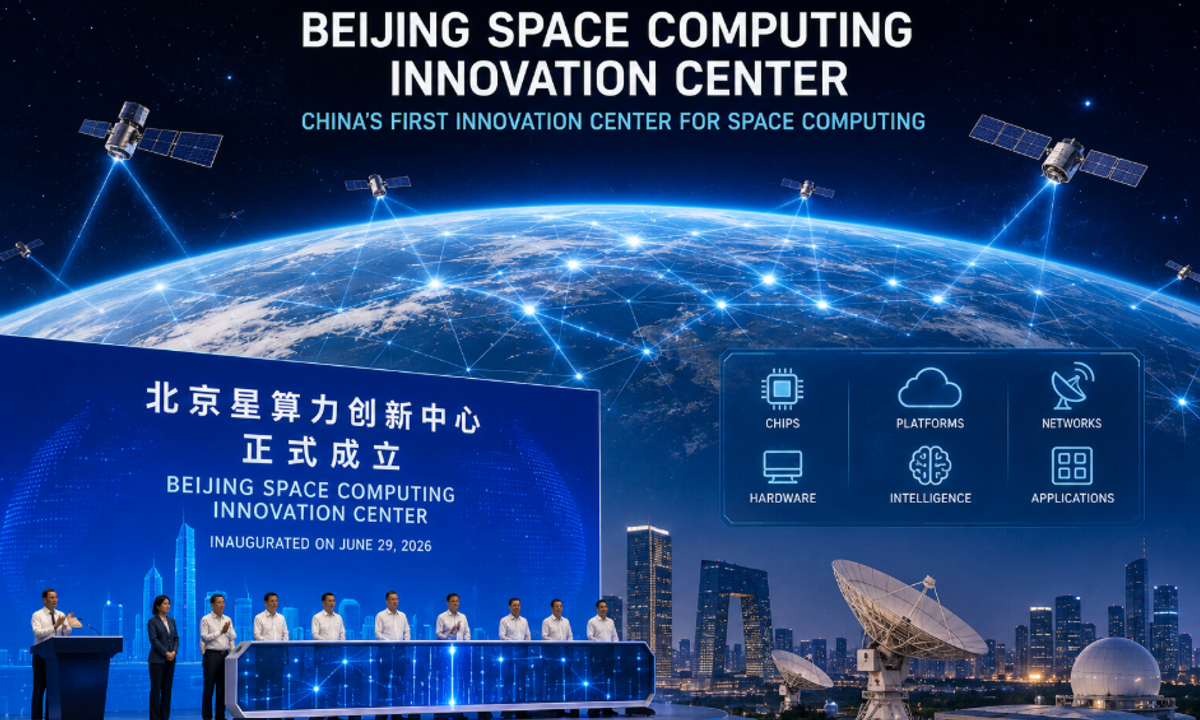
China just made a move worth watching. On June 29, at the Global Digital Economy Conference Space Computing Forum in Zhongguancun, Haidian District, the Beijing Space Computing Innovation Center launch became official - the country's first dedicated platform for computing in orbit. Experts called it a milestone for space-based computing as a new class of digital infrastructure.
So what is it, and why should you care?
Inside the Beijing Space Computing Innovation Center Launch
This isn't a typical government research lab. It's China's first innovation platform built specifically to eliminate bottlenecks across the entire space computing industrial chain - from chips to applications, every layer under one coordinated roof.
The official framework, confirmed by Zhongguancun Science City, targets a fully vertically integrated space computing capability architecture covering "chips, hardware, platforms, intelligence, networks, and applications." That's the whole stack. And if you've been tracking 2026 digital economy innovations, this center fits a clear pattern: China formalizing institutional support for emerging tech categories before they fully mature.
What the Beijing Space Computing Innovation Center Is Building
Space-based computing means putting real processing power directly into low Earth orbit. Instead of beaming raw satellite data down to Earth for analysis, satellites process it onboard - using onboard AI chips and high-performance computing payloads. A constellation of these satellites becomes a distributed intelligent network, or what the center formally calls an integrated space-ground intelligent computing network, designed for global coverage with seamless coordination.
Six major research areas have been approved by the Beijing Economic Bureau:
- Onboard AI chips and high-performance computing payloads
- Intelligent satellite systems
- Space-based large models under power consumption constraints
- Integrated space-ground cloud platforms
- Shared ground verification facilities, open to the full value chain
- National standardization and ecosystem development
That third item deserves more than a glance. Running large AI models in space means working with solar power and zero convection cooling - vacuum doesn't conduct heat. Developing highly reliable, heat-resistant space native computing chips that survive radiation and temperature extremes while staying within strict watt budgets is one of the genuinely hard engineering problems here. This center is tasked with cracking it.
Shared infrastructure matters too. Those integrated ground verification facilities will be open across the value chain, giving the broader tech startup ecosystem in Zhongguancun access to tools that used to be reserved for state aerospace giants.
The People Behind It
Three names stood out at the event.
Tang Chao, deputy head of the administrative committee of Zhongguancun Science City, called space-based computing a "new avenue for developing new productive forces." In Chinese policy language, that signals strategic national priority - not a pilot.
Fu Yunhao, CEO of Tiansuan Xinglian Technology, brought the commercial perspective. Tiansuan Xinglian's space computing operations are among the more active in China's emerging orbital sector, and their presence signals real commercial intent behind the launch.
Professor Wang Shangguang, dean of the computer school at Beijing University of Posts and Telecommunications, also participated. BUPT has been building satellite IoT expertise for years, and the university's research feeds directly into the center's agenda.
One number that cut through the announcements: 108 founding member organizations. That breadth is what separates a real industrial coalition from a ribbon-cutting ceremony.
Why Orbit? Why Now?
China's AI computing push has been accelerating across sectors simultaneously. Ground-based AI infrastructure is hitting real constraints - power costs, physical space, cooling overhead. Low Earth orbit offers some genuinely interesting alternatives that are only now becoming commercially viable.
No cooling infrastructure. Direct solar power. And unlike geosynchronous satellites, low Earth orbit constellations deliver low latency with global coverage. For AI industry developments in disaster response, ocean monitoring, and smart agriculture, processing data directly in orbit - rather than routing it through ground stations - cuts response times from minutes to seconds. That's not a marginal improvement. That's a different category of capability.
China's space launch program already has hardware in orbit supporting this vision. The world's first space computing satellite constellation was launched via Long March 2D. The center announced in June is the institutional ground-layer that supports what's already up there.
The space computing market is projected to reach tens of billions of dollars by 2030. Whether that figure lands precisely or not, the direction is consistent with what the latest science and space coverage has been pointing toward.
The Bigger Picture
China's open-source AI rise already shifted global expectations about what Chinese tech companies can produce at scale. Space computing could follow a similar arc - coordinated, nationally backed, and built to cover every layer domestically rather than rely on imports.
China's AI ecosystem expansion has moved aggressively into sectors with long-term strategic value. Orbital AI is now firmly on that list. The center's roadmap explicitly includes tokenized AI-driven services deployed through widespread space-based computing applications - meaning this isn't just infrastructure for governments. It's intended as a commercial platform.
Internationally, China's global trade strategy increasingly treats technology standards as a key lever. A domestically developed, vertically integrated space computing stack positions China to define this sector's rules rather than just participate in them. Even bilateral conversations like China-UK economic cooperation will increasingly have to account for what Chinese orbital AI infrastructure means as a technology export.
Eliminating production chain bottlenecks in space native computing isn't just engineering. It's strategic positioning.
What Comes Next
The Beijing Space Computing Innovation Center launch is a starting line, not a finish line. Building the full vertically integrated stack - from space native chips to orbital AI models to commercial tokenized services - will take years and face hard engineering obstacles. The power constraints alone aren't trivial.
But the alliance is formed. Six research tracks are funded. The framework is in place.
And for a sector moving this fast, institutional coordination is often exactly the bottleneck that needed solving first.