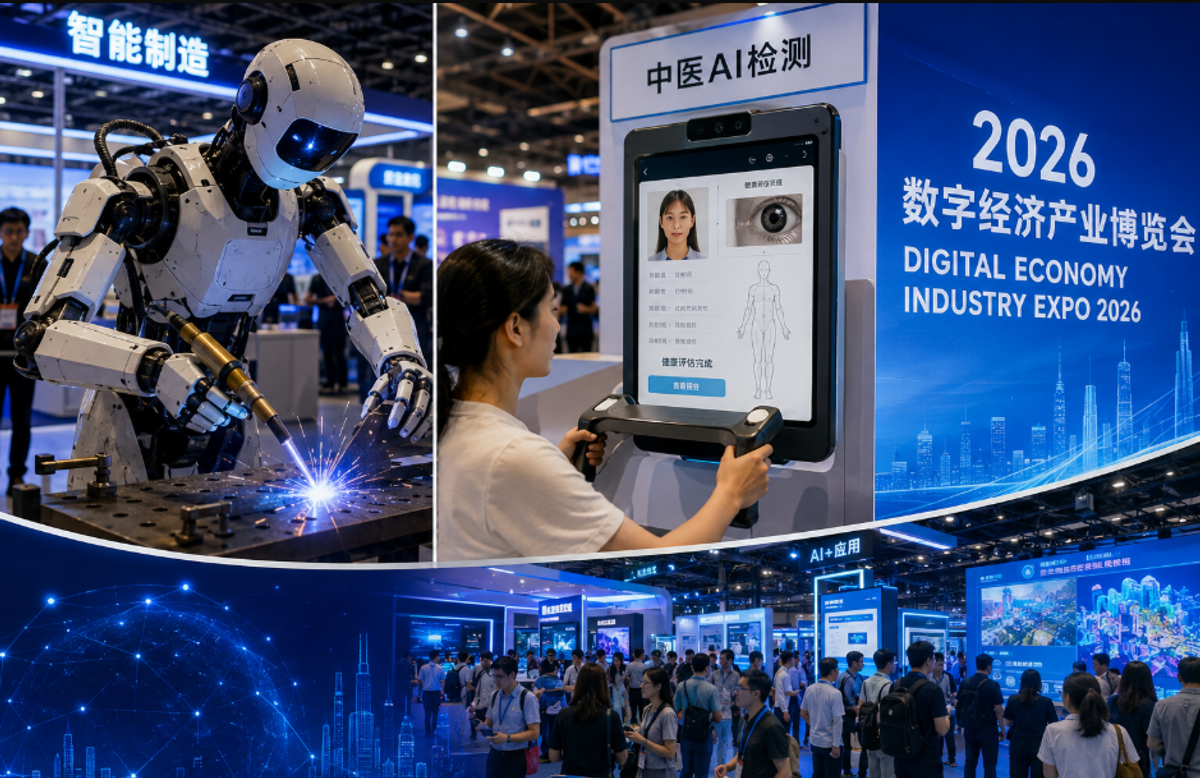
Welding robots with the precision of a master craftsman. A health device that reads your meridians, face, and eyes in under two minutes. Solo founders shipping hardware products that used to require entire teams. If you want to see where AI tech innovations are actually landing in the physical world, the 2026 Digital Economy Industry Expo is one of the clearest examples available.
Held July 2-4 at Hall E of the China National Convention Center in Beijing, the event runs alongside the Global Digital Economy Conference exhibition in Beijing. Six themed zones, hundreds of exhibitors, and a handful of demos that genuinely stopped foot traffic cold.
Inside the Dual-Hall Layout
The expo splits by design - one hall for innovation, one for application. Six zones cover the full pipeline: Global OPC Co-creation Festival, International Exhibition Area, Urban Development, First Launch and Debut, AI+ Application, and Digital Cultural and Entertainment Consumption.
That application hall is what sets this apart from a standard tech conference. Exhibitors can't just show prototypes. They have to show real deployed systems - products already running in clinics, factory floors, and people's bedrooms. That's a meaningful filter.
Xiaoyu Intelligent Manufacturing: Welding Robots That Carry a Craftsman's Expertise
Xiaoyu Intelligent Manufacturing ran a 231-square-meter booth with a 1:1 replica of an actual industrial production line. Right at the front: a humanoid welding robot that drew crowds from the first hour.
Xiaoyu Future Robot Zero stands 175 centimeters tall, weighs 75 kilograms, has 52 degrees of freedom, and lifts 30 kilograms with both arms. Eight-hour battery life. That last spec matters more than it sounds - a robot that can't hold a full industrial shift isn't a real solution.
"Hands are arms, eyes are 3D cameras, and the brain is a self-developed embodied model," a staff member explained. The humanoid welding robot Xiaoyu Future Robot Zero operates on hand-eye-brain coordination and is already deployed across two demanding real-world environments: shipbuilding and steel structure assembly. In the narrow, confined spaces of ship cabins where traditional industrial robots simply can't maneuver, Xiaoyu's spatial perception and "one brain, multiple forms" architecture handles the adaptation. Through Xiaoyu Intelligent Manufacturing's strategic partnership with CSCEC - China Construction Science & Industry Corporation - decades of field expertise have been integrated directly into how the robot operates.
Current welding precision: within ±0.5 millimeters. Sub-millimeter level.
Wei Fanli, special assistant to the CEO, put the labor problem plainly. The average welder is 45-46 years old. Younger workers aren't entering the trade at scale, and wages above 10,000 yuan monthly haven't solved the recruitment gap. But that's not even the deeper problem. When this generation of skilled craftsmen retires, their expertise goes with them unless something captures it first.
"Embodied intelligence is the best solution," he said.
Xiaoyu's positioning pen takes about 3 minutes to learn, letting experienced welders shift into robot operators without losing their relevance. Next targets include heavy machinery, aerospace, grinding, polishing, and spraying. That expansion connects directly to the manufacturing and digital growth reshaping China's industrial base - and helps explain why tech stocks and factory activity have tracked each other as automation pushes into sectors that resisted it for years.
The Xuanhuang Identifier Instrument: AI-Powered TCM Diagnostics in 90 Seconds
A different kind of crowd formed on the other side of the floor. Not around a robot. Around something roughly the size of a consumer handheld device.
The Xuanhuang Identifier Instrument multimodal detector is the work of the Beijing Digital TCM Industry Development Research Institute - China's first national innovation consortium dedicated to digital traditional Chinese medicine. Its AI-powered Traditional Chinese Medicine diagnostic assessment takes about two minutes: scan a QR code, enter basic details, hold the device for meridian testing, and take facial and eye examination photos. Ninety seconds of interaction. Thirty seconds of processing. One health report.
The digital health checkup device meridian eye diagnosis capability runs on the Xuanhuang TCM nutrition model, built with clinical data from the China Academy of Chinese Medical Sciences. It pulls together multispectral imaging, meridian sign sensing, digital human consultation, and facial diagnosis - then links outputs to personalized nutrition and meridian regulation programs through a multilingual AI Q&A engine.
Visitor Ms. Li read her results on the spot: "There is indeed a problem with my gallbladder, and the unstable heart rate is consistent with my daily feelings. These problems have also been reflected in my previous physical examination reports. The AI consultation is of reference value."
That reaction is worth noting. When a device's outputs line up with someone's existing medical history, trust builds quickly. Right now, the instrument runs in high-end private hospitals and wellness institutions across northern China. English and German versions are in development for international markets. The booth also showed "Xiao Zhi" - an AI-embodied intelligent robot - alongside a palm-shaped TCM meridian detector and a medical infrared thermal tomography system.
As health devices collect biometric data at this scale, cybersecurity in the digital age becomes a legitimate and growing concern, especially for products entering international healthcare markets where data protection standards vary significantly.
The Global OPC Co-creation Festival: One Person, One Computer, One Company
Thirty-five live projects. Twenty-four concurrent AI workshops. The Global OPC Co-creation Festival runs on three principles: openness, partnership, creation. It combines hackathons, keynote speeches, workshops, and startup roadshows in a format that's more structured than a meetup and less corporate than a trade show.
Feng Huanyuan, head of Beijing Lingzhou Technology, previously worked across core Xiaomi business segments - MiTalk, Xiaomi Cloud, Ecosystem Chain, and Youpin. Now he's building a one-person company model AI native hardware venture through the AI Origin Community. His first product is a sleep companion.
It doesn't loop pre-recorded audio. That's the whole point. The AI generates sleep-inducing music and natural sounds in real time, shifting based on environmental variables like weather. Sensors track heart rate and breathing, cut audio automatically when you fall asleep, and wake you during light sleep with natural sounds in the morning. Birdsong. Rain. Insect chirps.
"These are the most natural ways for humans to wake up during evolution," Feng said. Hard to argue.
His take on the AI era: "In the past, 50 people might not have been enough to make a product. Now one person working with a set of efficient AI tools can do the work of ten." That's not a pitch - it's the actual operating model of the companies standing in this zone. The one-person working with efficient AI tools productivity shift is already visible across emerging tech startups globally, and the OPC festival puts it front and center.
Why the Digital Economy Industry Expo AI Tech Innovations Matter Beyond the Demo Floor
No product on this floor exists in isolation. Each one sits on an infrastructure that's been building quietly.
China's open-source AI development has strengthened the model layer that products like the Xuanhuang instrument and Xiaoyu's embodied systems are built on. The GPU chip deals reshaping AI provide the hardware capacity these systems need to operate at industrial scale. Quantum computing breakthroughs point toward what comes next in the underlying compute stack. And satellite and connectivity tech continues building the networked backbone that distributed AI systems depend on.
For anyone following the latest science and technology moving from research into real deployment, the Beijing expo this week is a useful marker of where things actually stand.
The 2026 Digital Economy Industry Expo AI Tech Innovations Are Already Here
A humanoid robot is welding in confined ship cabins right now. A health device is generating full TCM assessments in 90 seconds. A solo founder is shipping AI hardware that used to need an entire department behind it.
These aren't previews. The Digital Economy Industry Expo AI tech innovations on display in Beijing this week show you what the deployment gap looks like when it actually closes - not all industries, not all at once, but at a pace that's harder to dismiss than it was even two years ago.