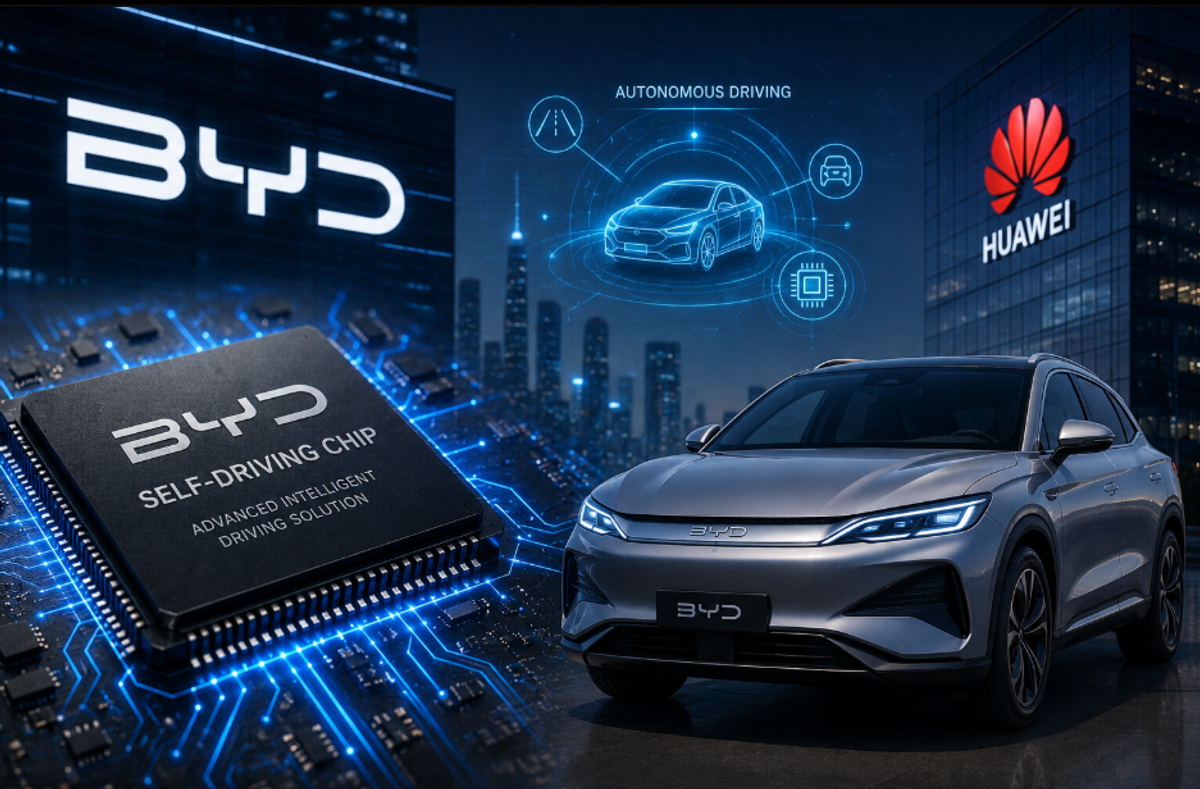
BYD just made a move worth paying attention to. China's dominant electric vehicle maker announced a new semiconductor processor for autonomous vehicles - one it's calling the most powerful domestic self-driving chip in the country. When BYD unveils an advanced self-driving chip into territory Huawei has spent years carefully building, you pay attention. This isn't just a product launch. It's a declaration of intent - and if you follow China's EV market, the automotive chip race, or the growing rivalry between automakers and tech giants, this one matters.
BYD Unveils an Advanced Self-Driving Chip: What We Actually Know
Details are still sparse. BYD hasn't published a full technical datasheet, and the "most powerful domestic chip" label is, for now, a claim rather than a verified benchmark. That's worth keeping in mind before drawing firm conclusions.
What we do know: the chip is designed to power advanced driver assistance systems and eventually enable higher levels of vehicle autonomy. That's the core job of any advanced driver assistance systems processor - real-time sensor fusion, split-second decision-making, and reliability good enough that a car trusted with human lives won't fail under pressure.
The Straits Times BYD autonomous driving report that broke the news didn't include granular technical specs either. Independent verification of BYD's autonomous driver assistance tech specs will matter a great deal before this chip means anything commercially. So anyone drawing firm conclusions about processing power right now is getting ahead of the data.
That said, the strategic logic is undeniable. BYD already manufactures its own batteries and its own vehicles. Adding a BYD in-house autonomous vehicle semiconductor to that list isn't a surprise. It's the logical next step in something the company has been building toward for years.
How BYD's Self-Driving Chip Directly Challenges Huawei
Here's the thing: this is where the story gets genuinely interesting.
Huawei's Intelligent Automotive Solutions business has quietly become one of the more powerful forces in China's autonomous driving market. Its Huawei Ascend series self-driving chips already power multiple production vehicles on Chinese roads. Automakers like AITO and AVATR have built deep partnerships around Huawei's hardware and software stack - so deep that some vehicles are effectively Huawei products wearing another brand's badge.
BYD's entry into chip design is a direct challenge to that arrangement. When BYD unveils an advanced self-driving chip Huawei has spent years positioning as indispensable, the message is blunt: we don't need you. We'll build it ourselves. And unlike a startup making the same claim, BYD has the manufacturing scale, distribution network, and capital to actually back that up.
The BYD vs Huawei intelligent automotive solutions rivalry has been simmering quietly for a while. Now it's out in the open. Horizon Robotics and Black Sesame Technologies will feel the pressure too - this doesn't just squeeze Huawei; it complicates the entire competitive landscape for domestic chip players.
Honestly, it's a pattern you see echoed across China's tech sector. From AI chip innovations reshaping Beijing's GPU supply chain to the rise of China's open-source AI ecosystem - domestic challengers keep appearing, and they keep getting more serious.
Vertical Integration: From Batteries to Autonomous Driving Silicon
BYD's vertical integration electric vehicle strategy isn't new. But it keeps going deeper.
Most carmakers rely on a web of suppliers for core components. Chips from Nvidia or Mobileye. Batteries from CATL or LG. Sensors from Bosch. That model works fine until it doesn't - and the global semiconductor shortage of 2021 and 2022 showed exactly how badly the whole system can seize up. Automakers sat on nearly-finished vehicles that couldn't ship because of chips that cost a few dollars each. BYD, already controlling its battery supply chain, was better insulated than most at the time.
The logic of extending that control to autonomous driving chips is straightforward. There's a financial angle too: BYD's chip could eventually be sold to other automakers, turning a cost-saving initiative into a new revenue stream (which would fundamentally change how analysts think about BYD's long-term business model). That hasn't been confirmed - but the possibility alone is significant.
Automakers becoming semiconductor designers is already a global industry trend, accelerated by Tesla's FSD chip strategy. BYD is bringing that logic home to China. And it's happening in a broader context where fields like space computing and AI show that China's appetite for indigenous technology development isn't limited to one sector - it runs across the entire economy.
Supply Chain Independence and the Politics Behind It
Reducing automotive supply chain risk is both a business priority and a political one in China right now.
U.S. export controls on advanced semiconductors have turned import dependency into a strategic vulnerability. Beijing has consistently pushed for China automotive tech self-sufficiency - and an automaker designing its own processor fits directly into that policy goal. If BYD can deploy a domestically built self-driving chip at scale, that's one fewer chokepoint that foreign governments can use as leverage.
But the other side of that equation is real too. Dual-use applications scrutiny for Chinese smart vehicle technology is already a concern in Western markets. Governments in Europe and the U.S. are increasingly wary of connected vehicles built on Chinese silicon - not just for trade reasons, but for data security concerns. A BYD chip that ends up in globally sold vehicles will face regulatory questions that don't apply to purely domestic deployments. Bypassing third-party hardware restrictions in Chinese EV manufacturing is the benefit. Navigating international scrutiny is the cost.
The geopolitical currents shaping China-UK trade cooperation and the upcoming China-EU trade consultations will inevitably filter into how this technology is received beyond China's borders. That's a layer of complexity that doesn't apply when a U.S. or European company makes the same announcement.
What the Market Should Watch Next
Three things matter here. None of them are resolved yet.
Mass production timeline is the first. Advanced vehicle autonomy processors don't ship on announcement schedules - they ship when they've cleared safety testing, regulatory approval, and production ramp-ups. Real-world testing validation for BYD's intelligent vehicle processor is a long process. A chip that's announced is not a chip that's in vehicles. The gap between those two things matters enormously, and BYD hasn't given a clear deployment timeline yet.
Global comparison is the second. Comparing BYD's self-driving processor performance with Tesla's FSD computer or Nvidia's Drive platform will become critical if BYD ever pushes autonomous features into markets outside China. Right now, nobody outside BYD can make that comparison. That needs to change before the "China's most powerful chip" claim can be evaluated on a global scale.
Third are the second-order effects on other players. If BYD succeeds at this, other well-capitalized Chinese EV makers may follow. That puts third-party chip suppliers in a tighter spot. Korean chipmakers targeting China are already repositioning for this market - and BYD's chip rollout will shape how attractive the Chinese automotive semiconductor space looks to outside vendors. The broader AI tech innovations to know from China's 2026 Digital Economy Expo reinforce that this is part of a coordinated national push moving faster than many outside observers expected.
BYD's Chip Is a Signal, Not Just a Product
When BYD unveils advanced self-driving chip capability into territory Huawei once had largely to itself, the whole EV tech landscape shifts a little. Not because the chip is proven yet - it isn't, not fully - but because of what the move signals.
BYD isn't content to be an automaker that buys intelligence from outside suppliers. It wants to own the full stack: the battery, the vehicle, and now the autonomous driving silicon inside it. Strengthening competitive moat via proprietary silicon is a long-term bet, and for a company that already pulled off vertical integration in batteries better than almost anyone expected, that bet carries some real credibility.
The chip still needs real-world validation. Mass production timelines remain unconfirmed. International reception will be shaped by geopolitical headwinds that won't disappear on their own. But the direction BYD is moving in is clear - and the pressure it puts on Huawei's automotive division, on smaller chip designers, and on the broader autonomous driving ecosystem is real.
This is one to keep watching. For the latest AI developments and technology news shaping the future of mobility, keep this story on your radar.