Summary
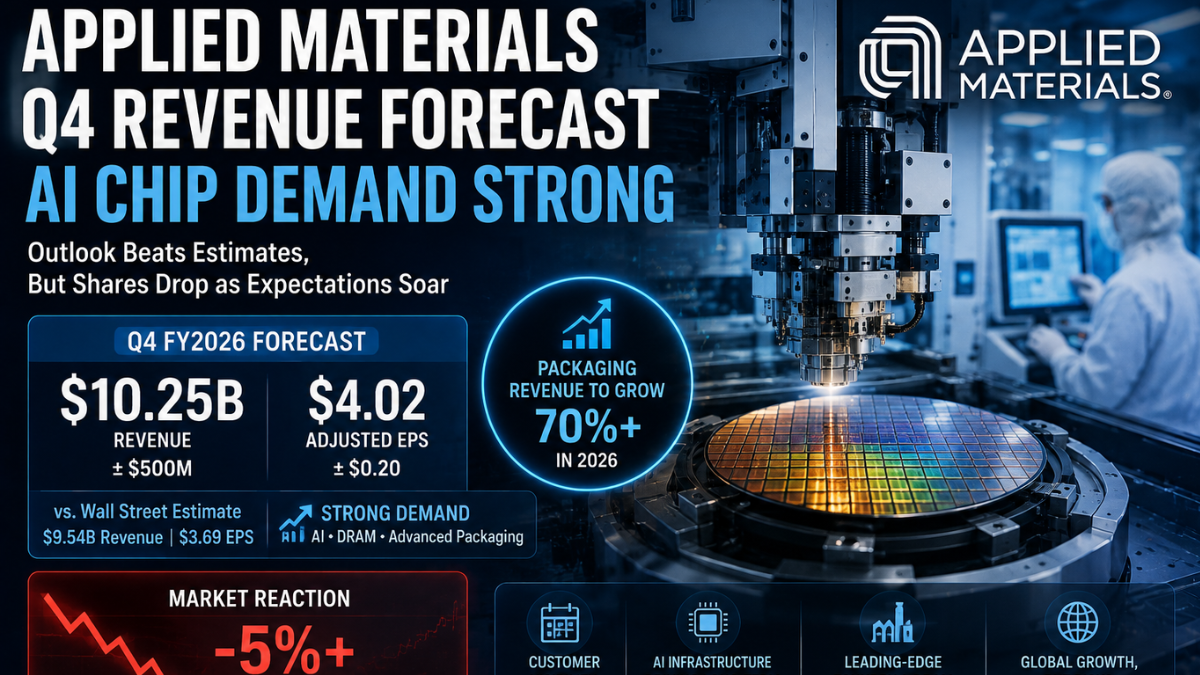
The Applied Materials Q4 revenue forecast and AI chip equipment demand story has a twist investors know well: strong numbers didn't produce a strong immediate market reaction. Applied Materials expects roughly $10.25 billion in fourth-quarter revenue, well above Wall Street's $9.54 billion estimate, yet shares dropped more than 5% in extended trading.
Why? Expectations had already become enormous.
With AMAT stock more than doubling in 2026 and peers reporting healthy results, investors were looking for an outright blowout. The company delivered a solid forecast. The market wanted something even bigger.
Key Points
- Q4 guidance came in well above expectations: Applied Materials expects about $10.25 billion in revenue versus the roughly $9.54 billion Wall Street estimate mentioned in the article.
- The market wanted more: Despite the strong forecast, AMAT shares fell more than 5% after hours, showing how high investor expectations had become.
- AI remains the main demand driver: Chipmakers are spending heavily on advanced manufacturing, memory, and packaging to support expanding AI infrastructure.
- Advanced packaging is becoming increasingly important: Applied expects packaging revenue to grow more than 70% in calendar 2026, according to the article.
- DRAM is another major opportunity: Strong memory demand could translate into additional equipment spending as manufacturers expand capacity.
- Customer visibility is unusually long: Management said some customer discussions now extend toward 2030, suggesting that AI-related semiconductor investment is being planned well beyond the current cycle.
- AMAT's fundamentals remain strong: Q3 revenue reached about $9.12 billion, up 25% year over year and ahead of the cited analyst estimate.
- The semiconductor equipment market still has risks: Export restrictions, changes in memory demand, regional spending shifts, and delays in fab construction could affect equipment orders.
- AMAT is being judged against strong competitors: Results from Lam Research and KLA have raised the bar for what investors expect from semiconductor equipment companies.
- The bigger question is valuation: A strong outlook doesn't automatically mean the stock is attractive if much of that future growth is already reflected in its price.
- The next numbers to watch: DRAM spending, advanced packaging growth, foundry investment, margins, and whether customer commitments continue to stretch toward 2030.
Applied Materials Q4 revenue forecast: AI chip equipment demand remains strong
Applied Materials forecasts fourth quarter revenue above estimates at 10.25 billion, plus or minus $500 million. It also expects adjusted earnings per share of $4.02, plus or minus 20 cents, versus the $3.69 analyst consensus.
That forecast points to continued demand across the equipment used to make advanced semiconductors. Applied sells deposition, chemical mechanical planarization, inspection, and other systems that chipmakers need before a wafer becomes a finished chip.
The broader semiconductor equipment demand AI infrastructure spending cycle is doing most of the heavy lifting. Foundries and memory producers aren't simply adding capacity for ordinary devices. They're preparing for bigger AI clusters, more complex chips, and packaging steps that used to be less central to the production process.
You can see the investment pattern in projects such as TSMC’s Arizona expansion and Samsung’s Yongin fab buildout. Both help explain why long-cycle capital spending is back in focus.
What were Applied Materials' Q3 financial results?
In the Applied Materials earnings report, Q3 revenue was $ 9.12 billion, up 25% from a year earlier for the quarter ended July 26. That beat the $8.99 billion Wall Street estimate.
Adjusted gross margin came in line with the company's Q4 guidance of 50.4%, slightly ahead of the 50.15% analysts expected. These aren't weak results. Far from it.
Still, when a stock has already surged, a beat can feel ordinary. That's the uncomfortable math behind the Applied Materials share price drop in extended trading.
Why did Applied Materials stock drop after beating earnings estimates?
AMAT's results landed after positive updates from Lam Research and KLA, which raised the comparison bar. The Applied Materials vs Lam Research KLA stock comparison matters because investors often treat all three as a read-through on the same AI manufacturing cycle.
A high share price creates a high hurdle.
Investors may have expected faster near-term upside, firmer margins, or a larger revenue guide. That doesn't mean the operating outlook suddenly turned negative. It means the market had already priced in a great deal of good news.
This is also why chip equipment maker stocks AI hardware rally can be volatile. Strong demand supports the group, but valuations can still pull back when forecasts merely beat estimates instead of crushing them.
Advanced packaging and DRAM are the real growth engines
Applied expects overall packaging revenue to grow more than 70% in calendar 2026, above its previous projection of more than 50%. That answers a key investor question: How much is Applied Materials' advanced packaging revenue expected to grow?
AI accelerators increasingly rely on advanced packaging to connect compute, memory, and interconnect components efficiently. The company is benefiting as customers invest in denser, more complicated chip designs.
The AMAT advanced packaging revenue growth DRAM chip equipment opportunity also includes memory. Management expects strength in DRAM, leading-edge foundry logic, and packaging during the second half of the calendar year.
That lines up with AI-driven DRAM demand and growing concerns about Samsung’s chip supply constraints. More memory capacity usually means more equipment orders. Simple.
Applied Materials sees customer visibility reaching 2030
Management said customers are giving it longer planning visibility than ever, with some discussions extending to 2030. That is a meaningful signal for Applied Materials’ long-term customer visibility 2030 outlook.
Chipmakers don't normally commit to distant capacity plans without confidence in demand. AI infrastructure spending has created a different planning horizon, especially for high-end logic, memory, and packaging tools.
Technology shifts beyond standard GPU production also influence the leading-edge foundry logic equipment demand picture. Watch AI chip equipment demand, silicon photonics expansion, and near-memory AI computing. Each trend can increase manufacturing complexity, which is where equipment suppliers make their money.
What the wafer fabrication equipment market outlook 2026 means for AMAT
The wafer fabrication equipment market outlook 2026 remains favorable, but it isn't risk-free. Spending can shift sharply by region, customer, and chip category. Export restrictions, oversupply in parts of memory, or delayed fab construction could all affect order timing.
Then there's China. Developments such as China’s 3D AI chips and CXMT’s chip investment show why global equipment demand isn't a one-company story.
Applied's forecast suggests its customers are still spending. But investors should separate that operating fact from the question of whether AMAT shares already reflect too much future growth.
Applied Materials Q4 revenue forecast AI chip equipment demand: what matters next
The Applied Materials Q4 revenue forecast AI chip equipment demand outlook confirm that the AI buildout is still feeding semiconductor capital spending. Revenue guidance beat expectations, Q3 growth was strong, and management sees unusually long customer planning cycles.
But AMAT's after-hours decline is a reminder that great businesses can disappoint when investors expect perfection. Watch DRAM orders, packaging growth, foundry spending, and margin performance in the next report. Those details will show whether the current momentum has more room to run.
GlobalByte Perspective
The interesting part of Applied Materials’ latest update isn’t simply that the company expects $10.25 billion in Q4 revenue. It’s that even a forecast comfortably above Wall Street expectations wasn’t enough to satisfy investors.
That tells us something about where expectations have moved in the semiconductor equipment market.
AI demand is still pushing chipmakers to spend heavily on advanced logic, DRAM, and packaging. Applied Materials is benefiting from that investment, and its comments about customer planning extending toward 2030 suggest that the current spending cycle may have more depth than a short-term AI boom.
But the stock reaction is a useful reminder that strong business performance and strong stock performance are not always the same thing. AMAT had already more than doubled in 2026, so investors were looking for exceptional numbers, not merely good ones.
From our perspective, the bigger story is what happens next. If advanced packaging, DRAM and leading-edge foundry spending continue accelerating, Applied Materials could have a long runway ahead. But if growth simply meets expectations while the valuation remains demanding, the stock may continue to struggle even as the underlying business stays healthy.
In other words, the AI semiconductor boom is still creating demand for Applied Materials. The question now is whether that demand can grow fast enough to keep up with what investors are already expecting from the company.