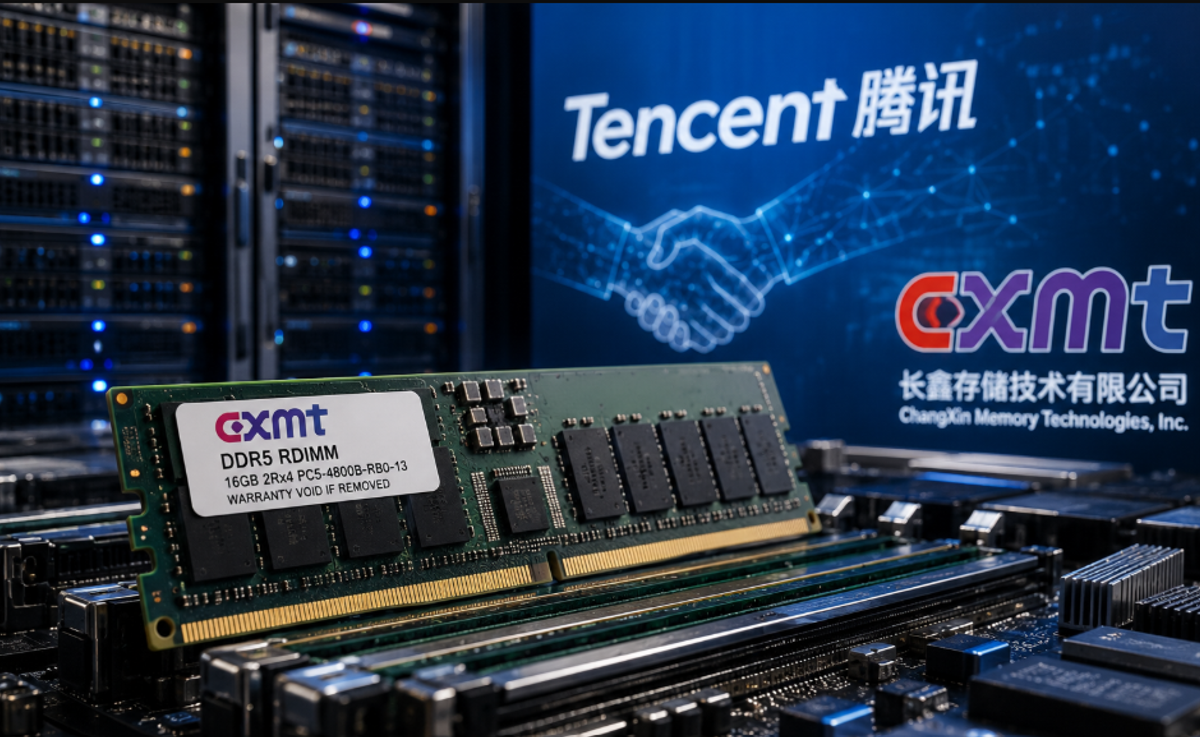
On June 29, Reuters reported that ChangXin Memory Technologies (CXMT) and Tencent had signed a long-term supply agreement worth more than 20 billion yuan - roughly $2.94 billion USD. Three sources familiar with the deal confirmed it. The CXMT Tencent server DRAM supply deal is significant on its own terms. But what makes it genuinely interesting is what it signals about how China's biggest cloud companies are rethinking where their memory chips come from.
That shift is happening fast.
Why Conventional Server DRAM Is Running Short
DRAM - dynamic random-access memory - is what every server uses to process data in real time. Software tasks, AI inference, database queries: they all depend on it. When supply tightens, everything running in the cloud either slows down or gets more expensive.
Right now, supply is tight.
The AI boom is the core reason. As demand for AI data centers surged, memory manufacturers responded by shifting production toward high bandwidth memory (HBM) - the premium variant used inside AI accelerators like Nvidia's H100 and AMD's MI300X. Higher prices, higher margins. Of course they chased it.
But that reallocation of HBM production capacity came with a side effect: conventional server DRAM capacity is shrinking. Samsung and SK Hynix are prioritizing premium DRAM allocation for US technology companies. That leaves Chinese cloud providers in a tough spot. They need enormous volumes of conventional server DRAM to keep their platforms running, and global memory makers' supply chain tightening is making that harder to secure.
This is exactly the gap CXMT is stepping into. And Tencent just bet $2.94 billion on it.
Inside the CXMT Tencent Server DRAM Supply Deal
This isn't a spot purchase. It's a long-term supply agreement, and that distinction matters.
Tencent isn't just buying chips off the shelf - it's locking in a domestic supplier to ensure continuity over an extended period. The 20 billion yuan server DRAM agreement is one of the largest publicly known contracts of its kind between a Chinese cloud giant and a domestic memory producer. It also arrives at a pointed moment: CXMT is preparing a 29.5 billion yuan IPO on Shanghai's Star Market, the exchange designed to back China's most innovation-driven technology companies.
A signed deal with Tencent worth nearly $3 billion changes the story around that IPO considerably. It's proof of commercial demand. It's revenue visibility. It's the kind of anchor institutional investors look for before committing to a listing of that size.
The broader Chinese AI infrastructure push - backed by state-level policy and massive cloud investment - is generating hardware demand that CXMT now has a direct line into. That's not an accident. It's a strategic position.
Chinese Big Tech's Wider Pivot to Domestic Memory
Tencent isn't alone here. That's the part that elevates this from a single deal story to something more structural.
According to reporting from The Information, Alibaba and ByteDance are also securing supply from CXMT and Yangtze Memory Technologies - China's other significant domestic memory producer. As Samsung and SK Hynix direct their capacity toward HBM for US customers, China's hyperscalers are building alternative pipelines closer to home.
China's AI market momentum has been compounding for years. At the scale these companies operate, supply chain risk isn't an abstract concern - it's existential. You can't build AI infrastructure on a supplier relationship that might get squeezed by market forces or geopolitical pressure at any moment.
Honestly, this pivot was probably coming regardless of the HBM shortage. The shortage just compressed the timeline and made the business case obvious.
There's also a strategic layer worth naming plainly: relying on foreign memory suppliers whose biggest customers are US tech giants creates real vulnerability for Chinese cloud companies. The Alibaba, ByteDance, and Tencent move toward domestic memory producers is rational procurement and strategic risk management at the same time.
What CXMT's IPO Says About Domestic Semiconductor Confidence
CXMT's planned 29.5 billion yuan Star Market listing is a meaningful moment for China's semiconductor ambitions more broadly. The Star Market exists precisely to back companies like this - technologically serious, strategically important, not yet at the global frontier but closing the gap.
CXMT produces competitive DDR4 and DDR5 chips. Its yield rates have been improving. But it's not at Samsung or SK Hynix's scale yet, and no serious analyst would claim otherwise.
That said - Tencent just committed nearly $3 billion to it.
That says something about where CXMT actually sits. The Chinese big tech domestic semiconductor pivot isn't aspirational language anymore. It's showing up in balance sheets and supply contracts. Events like NVIDIA and Qualcomm at CISCE show just how intensely the global chip ecosystem is competing for position in China's market - which makes CXMT's domestic advantage increasingly valuable.
The CXMT-Tencent Deal and What It Means If You're Watching This Market
Let's be direct about the implications.
For procurement teams at Chinese cloud companies: if you don't already have a domestic DRAM sourcing strategy, your competitors probably do. This agreement should be a prompt to revisit your own supply roadmap.
For investors: CXMT's IPO now has a major commercial anchor. Watch how the Star Market receives it - and watch whether Alibaba and ByteDance deals surface in the prospectus disclosures.
For anyone tracking semiconductor geopolitics, the CXMT-Tencent agreement is a live case study in how supply chain localization actually happens. Not through mandates. Through companies making rational decisions when global supply tightens, and domestic alternatives improve enough to be credible.
The open-source AI adoption trends reshaping markets globally and the next-gen mobile AI signals coming out of recent industry events share a common thread: memory demand is accelerating across every layer of the stack. CXMT's timing looks strategic, not lucky.
The AI startup ecosystem in China adds yet another demand vector - every new AI company that scales needs infrastructure, and memory sits at the foundation. Meanwhile, deep tech and science breakthroughs across hard-tech sectors reinforce that China's ambitions in semiconductors aren't isolated - they're part of a much wider pattern of technical advancement.
Conclusion: A Deal That Marks the Beginning of Something
The CXMT Tencent server DRAM supply deal isn't a procurement story with a tidy ending. It's more like a starting gun.
Conventional server DRAM supplies are shrinking because AI is pulling manufacturing capacity toward HBM. China's biggest cloud companies can't wait around for Samsung and SK Hynix to free up capacity - so they're turning to domestic suppliers who can deliver now. CXMT, with its improving production, growing customer base, and upcoming Star Market IPO, is positioned to absorb a significant share of that demand.
The 20 billion yuan agreement with Tencent is a milestone. And given that Alibaba and ByteDance are reportedly moving in the same direction, this looks less like an outlier and more like the opening chapter of a durable trend in how Chinese cloud infrastructure gets built and supplied.
Whether you track semiconductor markets, Chinese big tech, or the global AI infrastructure race - this one's worth understanding now, before the next chapter gets written.