Summary
The DJI Osmo 360 II launch specs 8K video replaceable lens story is one of the more interesting camera announcements of August 2026. Reportedly launching in China on August 13 after pre-orders opened on August 7, the camera appears aimed at a few annoyances every 360 creator knows too well: fragile lenses, short shooting sessions, and fussy phone connections. On paper, it looks promising. Really promising.
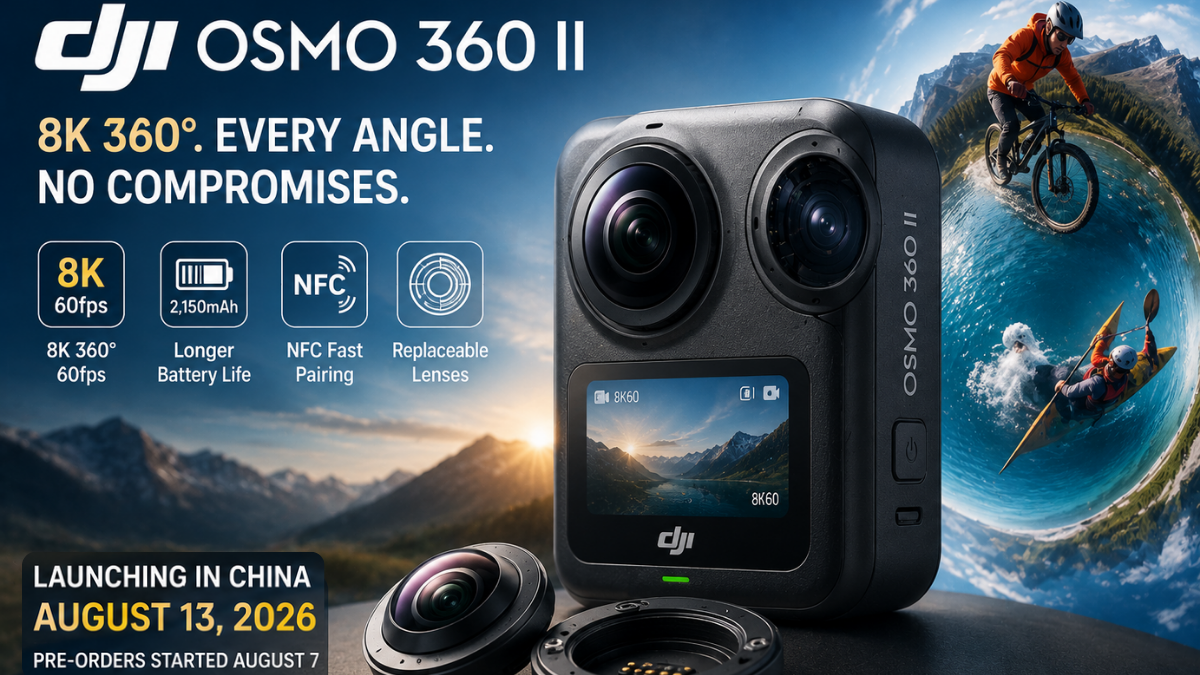
You may get 8K 360-degree footage at 60fps, a 2,150mAh battery, quick NFC pairing, and a lens design that can be repaired instead of forcing you to replace the whole camera after one unlucky drop.
Key Points
- 8K at 60fps is the headline feature, giving creators more flexibility when cropping and reframing 360 footage.
- The 2,150mAh battery could make longer shooting sessions more practical, although real-world battery life still needs testing.
- Replaceable lenses may be the most practical upgrade, particularly for travel and action creators who regularly expose their cameras to drops and scratches.
- NFC pairing is a small but useful improvement, reducing the friction between taking the camera out and actually starting a shoot.
- 8K video also has some drawbacks, including larger file sizes, higher storage requirements, greater heat generation, and a greater workload for editing.
- DJI still needs to test the camera's performance under real-world conditions, particularly in terms of image stabilization, low-light quality, overheating, and sustained 8K recording.
- Insta360 remains a strong competitor, especially given its well-established editing software and creator ecosystem.
- Price and availability of replacement parts can determine its value proposition. Expensive or difficult-to-source lenses would weaken one of the camera's biggest selling points.
- The bigger industry trend is toward practical creator hardware, where durability and convenience are becoming nearly as important as raw specifications.
- The real test isn't the spec sheet: it is whether the Osmo 360 II can deliver reliable footage while being easier and less stressful to own.
DJI Osmo 360 II launch specs 8K video replaceable lens: Confirmed highlights
The headline DJI Osmo 360 II launch specs 8K video replaceable lens package focuses on the frustrations creators actually run into: limited shooting time, slow setup, and exposed 360-camera lenses.
Here’s what has been announced or reported so far:
- 8K 360-degree video recording at up to 60fps
- A 2,150mAh battery
- NFC pairing for quicker phone connection
- A modular 360 camera replaceable lens system
- China launch scheduled for August 13, 2026
- Pre-orders reported to have started on August 7
For creators asking, “Can the DJI Osmo 360 II record video in 8K at 60fps?” the answer appears to be yes. That capability puts it among the most ambitious consumer 360 cameras available, especially for users who want room to crop, reframe, and export sharper footage.
Why 8K at 60fps could change 360-degree vlogging
Why DJI Osmo 360 II 8K 60fps recording changes 360 degree vlogging comes down to flexibility. With a 360 camera, you often decide your framing after you’ve filmed. More resolution means you can crop into the shot without turning it into a blurry mess.
And 60fps gives you cleaner motion for cycling, skiing, running, or handheld walk-and-talk footage.
The DJI Osmo 360 2 8K 60fps camera specs could be especially appealing if you shoot travel videos, action clips, or social-first content where one captured scene needs to become several edits. You might record a wide 360 view, then pull a forward-facing vlog angle, a vertical short, and a detail shot from the same clip.
Still, 8K files are heavy. Expect more storage use, more heat, and longer editing times on older phones or laptops. High resolution is great, but it isn’t magic.
DJI Osmo 360 II launch specs 8K video replaceable lens: Battery and setup upgrades
The reported DJI Osmo 360 II replaceable lenses 2150mAh battery combination addresses two practical issues in one go. A larger battery should mean fewer interruptions when you’re out filming, while replaceable lenses could reduce the cost and stress of a damaged optic.
The DJI Osmo 360 2 battery life shoot time has not yet been confirmed in minutes. Battery capacity alone doesn’t tell the whole story because 8K recording, screen brightness, temperature, and stabilization all affect endurance. But 2,150mAh is a notable step up from the original model’s capacity.
NFC pairing is less glamorous, yet it may be one of the features you notice most. A DJI 360 action camera NFC pairing price hasn’t been revealed, but quick tap-to-connect setup is useful when your phone is buried in a bag and the light is disappearing fast.
Simple. Effective. Free to start, assuming you already own the phone.
Replaceable lenses are a practical creator feature
Does the DJI Osmo 360 II have replaceable lenses? DJI says the new design supports them, and that’s a big deal for outdoor shooters.
Traditional 360 cameras place delicate, bulging lenses directly in harm’s way. One drop on gravel can ruin a shoot, or worse, leave a permanent scratch in every clip afterward. A next gen DJI 360 camera brings replaceable lenses for professional creators because replacement is far more sensible than replacing an entire camera after a minor accident.
Of course, the real test will be price and availability. Replacement parts that are hard to find or expensive enough to hurt won’t feel very creator-friendly.
DJI Osmo 360 II vs Insta360 X6 comparison
The DJI Osmo 360 II vs Insta360 X6 comparison will heat up quickly because Insta360’s X6 is expected to debut on August 12, one day before DJI’s China event.
That timing is no accident.
DJI Osmo 360 II vs Insta360 X6 360 degree action camera battle discussions will likely focus on video quality, stabilization, mobile editing tools, battery life, lens durability, and accessory support. DJI’s reported 8K 60fps mode, NFC connection, larger battery, and serviceable lens design give it a strong feature list. Insta360, meanwhile, has a deep reputation for creator software and 360-degree workflows.
If you’re choosing between them, don’t buy purely from a specs chart. Check real-world low-light samples and how each app handles reframing. That’s where the annoying differences usually appear.
Release date, global availability, and expected price
When is the DJI Osmo 360 II launch date? The official China debut is scheduled for August 13, 2026. The DJI Osmo 360 II pre order release date began earlier, with pre-orders reportedly opening August 7.
A DJI Osmo 360 II global rollout expected following China official release could arrive later in August or in September, though DJI has not confirmed regional timing. The DJI Osmo 360 2 global release price is also still unknown.
For context, the previous Osmo 360 has sold in the Philippines for ₱24,490. That isn’t a guarantee of the new model’s local cost. Better hardware usually means a higher price, and taxes, bundles, and regional stock can shift the number considerably.
What this launch says about the wider camera market
The best 8K 360 action camera for vlogging 2026 won’t be decided by resolution alone. Creators increasingly expect products to be repairable, quick to connect, and capable of lasting through a full day outdoors.
That trend sits alongside broader consumer device trends, smartphone camera innovation, and demand for AI smart headphones. Hardware companies are competing on convenience as much as raw performance.
Lens technology is moving too, as Sony’s Tamron bid illustrates. Behind the scenes, AI-powered device demand, advanced chip manufacturing, and high-performance computing are also shaping what smaller creator devices can do. Even Apple hardware strategy, Sony’s PS5 outlook, and digital future innovations point to the same thing: people expect more from the gear they carry.
Final thoughts
The DJI Osmo 360 II brings a more creator-minded mix of high-resolution capture, longer potential shooting time, faster setup, and a lens system designed for real-world mishaps. If the global pricing is reasonable and replacement lenses are easy to buy, this could become a serious option for anyone who wants 8K 360 footage without treating their camera like glass.
GlobalByte News Perspective
The DJI Osmo 360 II looks less like a routine spec upgrade and more like DJI is paying attention to the small frustrations that come with using a 360 camera every day.
8K at 60fps will get most of the attention, and understandably so. It gives creators more freedom to crop and reframe footage after shooting. But the more interesting changes may be the ones that don't look impressive on a product box. A larger battery, quicker phone pairing, and especially replaceable lenses could make the camera easier to live with.
That last part could be important. 360 cameras have always had an awkward weakness: their lenses need to stick out, leaving them exposed when the camera is dropped or placed on a rough surface. Making those lenses replaceable doesn't make the camera indestructible, but it could make an expensive accident much less painful.
There are still plenty of unanswered questions. We don't yet know how long the camera can actually record in 8K before heat becomes an issue, how well it performs in low light, or how much replacement lenses will cost. Those details will matter more to serious creators than another number on a specification sheet.
DJI is also entering a market where Insta360 has a strong creator following and a mature editing ecosystem. So the Osmo 360 II doesn't need to simply match its rival on specifications. It needs to make the entire process, from shooting to editing to repairing the camera, feel easier.
Our view: the Osmo 360 II could be a meaningful upgrade if DJI gets the everyday experience right. The 8K mode will attract attention, but the combination of durability, battery life, connectivity, and repairability may ultimately be what makes the camera worth buying.