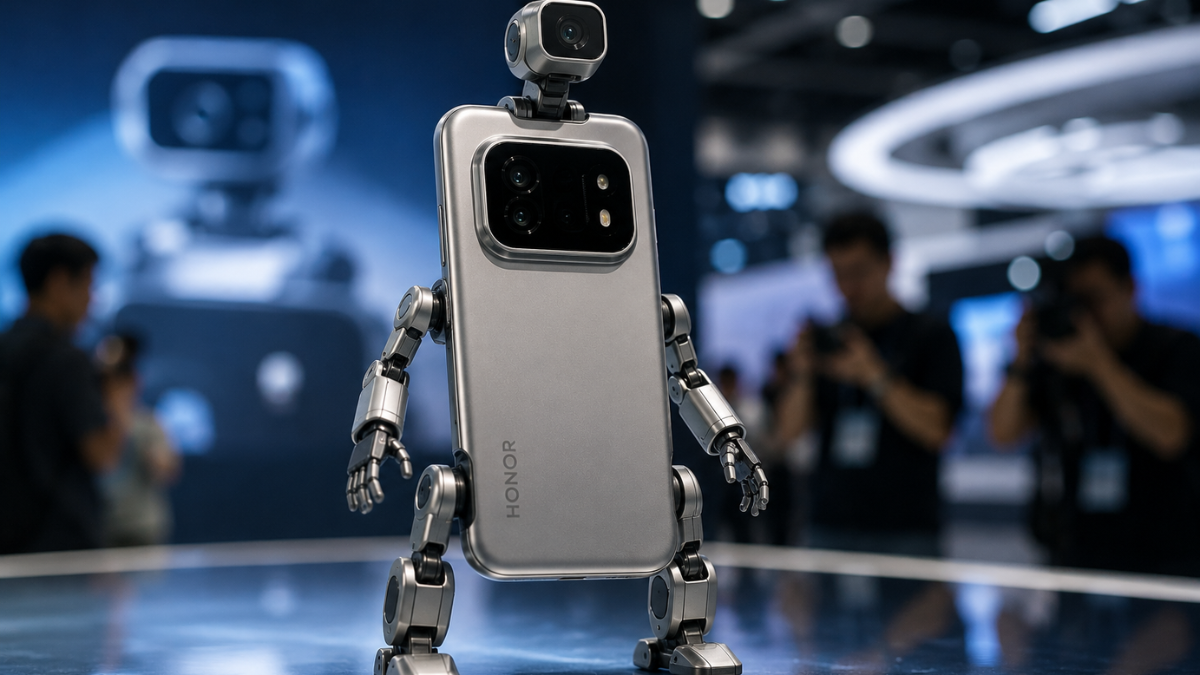
Your phone is about to grow hands - and feet, apparently. At the 2026 World Artificial Intelligence Conference (WAIC 2026), Honor officially unveiled the Honor Robot Phone, the device the company is calling the world's first robot phone. Pre-orders opened right there at the event. And if you've been keeping up with future mobile AI tech trends over the past year, this one hits differently than the usual product launch.
It can dance. The device responds to your mood. A tiny titanium alloy mechanical arm physically extends from the top in under a second - and that's not software. That's hardware moving in the real world, which shifts something fundamental about what a phone is actually supposed to do.
What Exactly Is the Honor Robot Phone?
The name does most of the work. This is a smartphone with mechanical parts that physically move, something no mainstream device has attempted at this scale before. The design centers on a miniature titanium alloy mechanical gimbal fitted into the top of the phone.
Think of it as a tiny robotic arm sitting at the crown of your device. Activate it, and it pops out with a single click and fully unfolds in just 0.8 seconds. That's the titanium alloy pop-out gimbal design in action - fast, precise, and reportedly quiet in person (which, if you've seen clunky pop-up camera mechanisms before, is not something you'd take for granted).
Why titanium? It's light and incredibly strong, which matters for a moving component that could get activated hundreds of times a day. Engineers here clearly weren't cutting corners on materials.
And the gimbal isn't just decorative. It functions as an autonomous mobile camera gimbal - stabilizing footage, tracking subjects, and rotating independently without you touching anything.
What This Robot Phone Can Actually Do
Can it actually dance? Sort of. The device moves its gimbal expressively in response to the user's mood or specific task context, so it's not quite a choreographed performance. But the phone physically reacts to you in ways no standard smartphone does. That's a genuinely unusual thing to encounter in a pocket device.
This connects directly to the larger wave of physical AI solutions that companies across the industry are racing to develop. Instead of AI living purely in software - sorting photos, autocompleting texts, answering questions on a screen - physical AI operates through hardware that moves and acts in the real world. Sensors. Motors. Actuators.
Pocket-sized, but mechanically alive in a way your current phone definitely isn't.
Why Smart Terminals Are Moving Beyond the Screen
Here's the bigger context. Competition in next-gen smart terminal robotics has stopped being about screen resolution or chip speed. The real shift is from devices that manage digital content to devices that can drive action in the physical world.
That pivot's been building. You can see it in how Chinese AI companies reshaping competition are prioritizing hardware embodiment over pure software capabilities. You can see it in how AI across China’s industries has pushed into physical environments, not just cloud infrastructure. The MWC26 AI economy signals from earlier this year pointed directly at this convergence - robotics thinking colliding with consumer mobile hardware in products people would actually carry around every day.
Honor's physical AI smartphone sits right at that intersection. It's not just running a smarter assistant - it uses hardware automation to physically interact with the world around it, which is a meaningfully different thing.
Where This Fits in a Much Bigger Robotics Push
Worth zooming out for a second. The robotics industry isn't quietly iterating in labs anymore. The China robot race goes public with Unitree's recent IPO approval. Zhiyuan's embodied robot mass production has hit 15,000 units. Governments are rolling out humanoid robot ID rules to govern an expanding population of robotic hardware.
This device is the consumer-facing edge of all that momentum. It brings robotics integration down from factory floors and research labs into something you'd actually carry every day. That's genuinely new territory for the smartphone category.
Honor Robot Phone: Pre-Order, Price, and What We Know
If you've been watching consumer digital device trends, the pre-order window for this device opened at WAIC 2026. Full pricing and detailed specifications hadn't been publicly confirmed at the time of writing - honestly, a bit frustrating when you're deciding whether to jump on early access.
There are also fair engineering questions here. Moving mechanical parts on a phone you'll drop, stuff in pockets, and use in the rain is a different challenge than building a solid-state device. How the titanium gimbal holds up after thousands of activations, whether dust or moisture affect the mechanism over time, what repairs actually look like - none of that has been answered yet.
That said, if build quality matches what early demos suggest, this is worth watching closely.
The AI gadgets category is moving faster in 2026 than almost any other consumer electronics segment, and this launch marks a real milestone. For anyone following AI innovation coverage this year, it's one of the most structurally interesting consumer releases in recent memory. It's also a strong signal that companies committed to people-centered AI priorities are choosing to make AI physical and tactile, not just conversational.
A Genuinely New Kind of Phone
The Honor Robot Phone doesn't just run better software than its competitors. It moves. That's what makes this genuinely new - not a spec bump or a camera upgrade, but hardware that physically responds to you and the world around it. How well the mechanical parts hold up in daily use, and what the final pricing turns out to be, will determine whether the world's first robot phone becomes a category-defining product or a very compelling proof of concept.
But the direction it's pointing toward is hard to ignore.