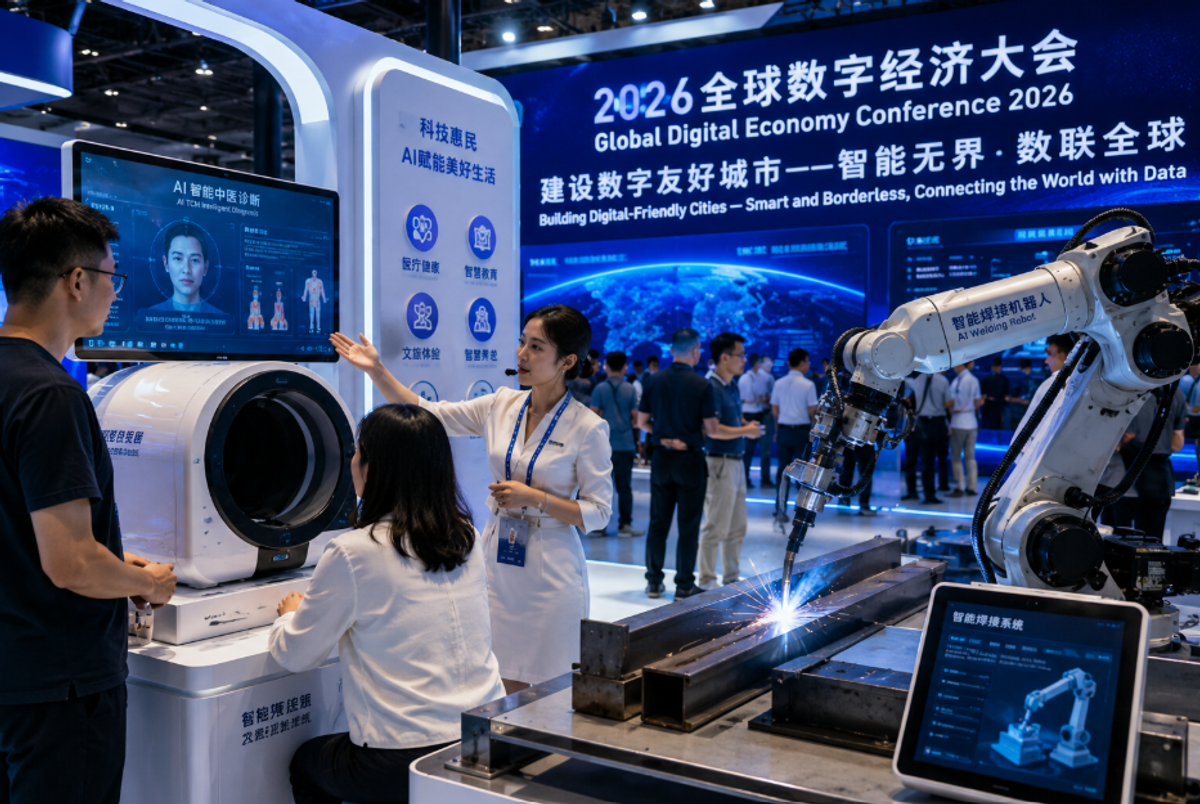
Walk up to a machine. Let it scan your face and eyes. A few minutes later, you've got a personalized health report that would have required an in-person consultation with a traditional Chinese medicine practitioner not long ago.
That's what China people centered digital future AI innovations look like when you strip away the abstract language. Real tools. Actual human problems getting solved. It was the clearest through-line across the entire 2026 Global Digital Economy Conference in Beijing - and it tells a more interesting story than the usual tech expo headlines suggest.
How AI Is Modernizing Traditional Chinese Medicine
Guanwei Intelligent Technology, based in Beijing, developed the AI-powered TCM diagnostic device that drew consistent crowds at the conference. If you want the full scope of everything shown across four days, the Digital Economy Conference highlights are worth a look. But Guanwei's device is a useful entry point because it captures the broader logic so clearly.
Zhou Chao, the company's business manager, explained that the technology uses AI to digitize and standardize TCM diagnosis - a discipline that has historically depended on highly trained practitioners, years of study, and hands-on experience that can't easily scale. The device changes that. It's already available in over a dozen languages - English, Korean, Russian, Thai, and more - and it's actively entering overseas markets.
Why Guanwei's AI diagnostic device digitizes traditional Chinese medicine diagnosis comes down to one blunt fact: most of the world doesn't have access to qualified TCM practitioners. That's not a flaw in TCM. It's a supply problem. And this device is actually addressing it.
Honestly, it's the kind of specific application that gets buried in broader conversations about China's AI sector growth. Aggregate numbers are impressive. But a product that brings TCM diagnostics to a rural clinic in Thailand tells a sharper story.
The Robotic Welder That New Operators Learn in Three Minutes
Xiaoyubot, founded in 2023, brought something different to the conference floor. But the underlying principle was the same.
A staff member marked a path across steel structures with a positioning pen, selected a welding procedure, and a robotic arm started working immediately. That's it. The Xiaoyubot smart welding system can be deployed across shipyards, steel-structure workshops, and construction-component manufacturing - and new operators are up and running in about three minutes.
That matters because industrial welding is genuinely brutal work. Extreme heat. Blinding light. Heavy toxic fumes. Workers deal with all of it because someone has to. But with embodied intelligence handling the operation, they don't have to anymore.
"The ultimate value of embodied intelligence lies in serving the real economy," said Qiao Zhongliang, the company's founder and CEO.
That line is doing real work. Physical AI for business is increasingly defined by exactly this - AI systems that operate in physical industrial spaces, not just software optimizing a dashboard. The Embodied Intelligence Innovation Industrial Park in Zhongguancun Haidian is one of several hubs supporting this expansion. And China's innovation industrial transition depends heavily on demand-driven artificial intelligence innovations like Xiaoyubot's - built for the factory floor, not the boardroom.
Why China’s People-Centered Digital Future AI Innovations Are Already Crossing Borders
Here's something that doesn't always get framed clearly enough. This isn't a domestic story.
TikTok operates in over 100 countries. Doubao's overseas version - Dola - has become a widely discussed topic on international social media platforms. Zhipu AI has launched large-model infrastructure projects in Singapore, the UAE, and Saudi Arabia, helping new markets access AI-powered digital services that weren't previously available at scale.
China people centered digital future: AI innovations are being deployed globally, often with a specific focus on markets that have been underserved by traditional tech investment. Joe Weinman, founder of the International Institute for Future Industries, summed it up: "China, in general, and Beijing in particular, is leading the world in many of these technologies through a powerful combination of government support, academic excellence, entrepreneurial innovation and highly talented individuals."
His point about affordability keeps coming back in discussions of innovation-led economic resilience: capable AI at lower cost doesn't only benefit Chinese users - it benefits anyone who previously couldn't afford the alternative. There's also an often-overlooked parallel story in how AI and green energy integration is being woven into China's global deployment strategy, a dimension of this picture that rarely gets the column inches it deserves.
Open Source AI and Why the Cost Gap Is Closing Faster Than Expected
Professor Jiang Xiaojuan from the University of Chinese Academy of Social Sciences made a point worth sitting with: unlike the manufacturing era, large AI models are global from the start. No domestic scaling phase required.
That fundamentally shifts the competitive dynamic. Open-source AI models can close capability gaps between companies in different countries quickly. They cut the cost of cross-border innovation and collaboration in ways that simply weren't possible before - creating real opportunities for economic growth in markets that used to be spectators.
Open-source AI reshaping competition is already visible across sectors. And open-source AI adoption in Africa shows how fast that spread can happen in markets that traditional tech investment has consistently skipped. Openness and sharing aren't just stated principles in China's AI innovation model. They're structural advantages.
The 15th Five-Year Plan: People-Centered AI Innovation at a National Scale
China's 15th Five-Year Plan (2026-2030) makes the direction explicit. It calls for building internationally competitive digital industrial clusters and strengthening core digital economy industries. But it does something else, something less common in national planning documents - it ties technology development directly to human welfare.
The plan specifically targets integration of digital and intelligent technologies into healthcare, elderly care, education, culture, tourism, employment, and consumption. Not as secondary features. As primary goals. This is the China 15th Five-Year Plan digital industrial clusters vision made tangible: infrastructure and human benefit developing together.
With AI supply chain and daily life already converging - robot dogs popular with kids in Beijing parks, AI-powered travel photography spreading among young tourists - the integration the plan describes isn't theoretical. It's already happening.
AI accessibility at the UN offers useful context here: 65 countries have already aligned on AI accessibility principles. China's domestic planning reflects similar thinking, just operationalized through specific policy instruments and five-year investment cycles.
Building the Trust Layer - The Hard Part Nobody Wants to Talk About
None of this is frictionless. Experts at the conference didn't pretend otherwise.
Data security, cross-border data flows, and increasingly blurred technological boundaries create real complications that products and policies alone can't resolve. The 2026 Global Digital Economy Cities Report - released during the conference - identified people-centered digitalization, data openness, mutual recognition of standards, cybersecurity, and alliance-based cooperation as the key priorities for digital economy partnerships going forward.
Global AI governance is still being worked out. That's not a criticism - it's just where things are. The call from multiple participants was for regular multilateral dialogue mechanisms and structured industrial cooperation channels that persist beyond individual events. Because a trustworthy, inclusive, and sustainable environment for global digital development doesn't emerge on its own.
Gong Ke, executive president of the Chinese Institute of New Generation Artificial Intelligence Development Strategies, put the whole conversation in its proper frame: "Whether it is the digital economy or AI, neither is an end in itself - they are all agents for promoting the sustainable development of humanity."
What This Moment Actually Signals
The pattern across everything at GDEC 2026 - the TCM device, the welding robot, the open-source infrastructure reaching new markets, the national plan tying AI to human welfare - points somewhere specific.
China people centered digital future AI innovations are built on a clear premise: the measure of AI isn't the technology itself, but what it enables for the people using it. Patients who can't access TCM. Workers who shouldn't be breathing fumes. Communities in developing markets that can now run AI tools previously locked behind expensive proprietary systems.
That's the framework. And what the 2026 GDEC made visible is that the direction of China's AI development is increasingly outward - built for the world, not just for home. Whether that shapes global norms around what AI is actually for remains to be seen. But the argument is coherent, the products are real, and the infrastructure is already in place.