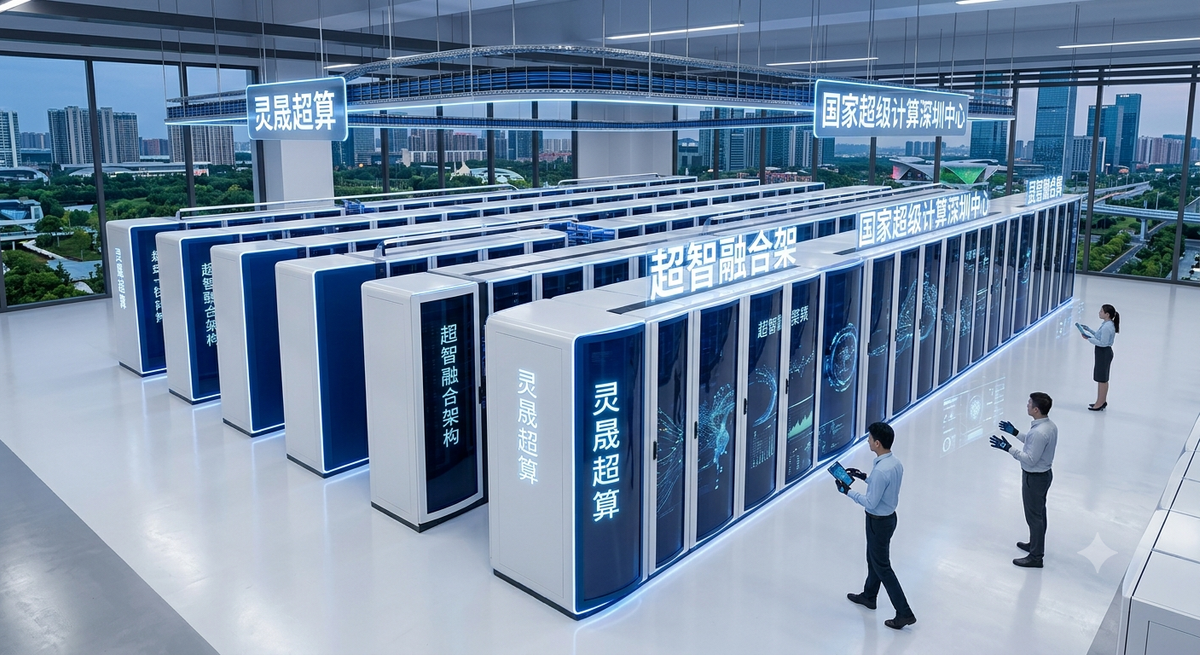
For the first time since 2017, a Chinese system sits at the top. The LingSheng supercomputer’s top 500 fastest world ranking for 2026 was officially announced in Hamburg, Germany, at the ISC High Performance conference - and it's a bigger story than a simple title swap suggests. This isn't just a faster version of the same machine. It's a different kind of architecture entirely.
Lu Yutong, chief designer of the LingSheng system and director of the National Supercomputing Center in Shenzhen, attended the ceremony in person. What she described in her interview afterward points to something more significant than raw speed: a systematic capability, built entirely from domestic Chinese technology, that now leads the world.
So what actually makes it #1? And why does that matter to anyone outside supercomputing?
What Made LingSheng #1 on the Top500 List
The benchmark number is 2.198 quadrillion floating-point operations per second. Lu Yutong put it this way: if every person on Earth performed one calculation per second, it would still take nearly 10 years to match what LingSheng does in a single second.
That's not a marginal improvement.
But raw speed alone doesn't explain the LingSheng supercomputer’s top 500 fastest world ranking 2026 result. The real story is the design approach. Lu Yutong called it "super-intelligent fusion architecture" - a framework that integrates traditional high-performance scientific computing with AI-style intelligent computing on the same hardware. That kind of supercomputing and intelligent computing convergence for the AI era hasn't been deployed at this scale before.
China's supercomputing, she said, has "moved from catching up and keeping pace to super-intelligent integrated architecture innovation." That's a significant shift in framing.
The LX2 CPU and the Full-Stack Architecture
Here's where the technical picture gets genuinely interesting, especially if you follow high-performance computing AI developments.
The system runs on a processor called the LX2 CPU - self-designed, built around matrix acceleration computing. The LX2 CPU multi-precision hybrid computing framework allows the same chip to shift between different levels of numerical precision depending on workload. That flexibility matters a lot for AI tasks, which often trade off precision against speed. It's not something you get from a general-purpose chip optimized only for one type of computation.
Paired with that: domestically produced high-bandwidth memory, a self-developed high-speed interconnect network, and full-stack system software. Every layer - from silicon to OS to application interface. The domestically developed full-stack supercomputer software and hardware approach was deliberate. It reduces dependency on foreign components and builds sovereign capability across the entire stack, which has obvious implications beyond just performance.
The other architectural innovation is the Online Acceleration software and hardware architecture. This isn't a minor optimization. It's a new approach to how parallel workloads are structured across the system, and it's part of what allows consistent exascale-level performance. For broader context on how hardware competition is playing out, the AI chip showcase 2026 gives a useful look at where different players are placing their bets.
What 2.198 Quadrillion Operations Actually Unlocks
Benchmarks are abstract. Applications aren't.
Lu Yutong was specific. In meteorology, LingSheng can run higher-resolution climate simulations - the kind that track typhoon development or extreme rainfall with better precision and longer lead times than existing systems. In drug discovery, it can screen billions of candidate molecules in time frames that were previously impossible, shortening R&D cycles meaningfully. For b2b tech infrastructure applications in materials science, energy research, and life sciences, the computational ceiling just moved dramatically higher.
"Its value lies in making problems that were previously impossible or slow to calculate - calculable, fast, and potentially more accurate," she said.
The deeper capability here is the combination. Traditional supercomputing handles precise simulation. AI handles pattern recognition, prediction, and optimization. LingSheng's intelligent computing convergence design puts them in the same loop: simulate a process, use machine learning to extract patterns, optimize the next round of experiments, repeat. Faster. Better. Without switching systems.
Lu Yutong called this the future scientific research paradigm. "The core value is not to replace scientific research with AI, but to improve research efficiency, expand exploration space, and accelerate the innovation process." That's a careful distinction, and it's an honest one.
For ongoing coverage of how this intersects with the broader tech landscape, both our science and computing coverage and AI technology news sections track these developments in detail.
The Global Race: Where China Fits Now
The US, Europe, and Japan haven't stopped moving. The exascale computing race has been intensifying for years, and the US China chip race continues to shape which capabilities each country can actually build domestically.
Lu Yutong was measured about all this. "International supercomputing competition is fierce," she said, "and alternating leadership is the norm." That's not false modesty - the US Frontier system held the top position for years, and other nations are building their own exascale machines. The Chinese AI global competition landscape is genuinely contested, and the LingSheng supercomputer top500 fastest world ranking 2026 milestone is a significant step, not a finish line.
What's different now is the nature of the capability gap China has closed. LingSheng didn't win by iterating faster on borrowed architecture. It won with a new design, on domestic chips, with domestic software. That's a harder thing to replicate quickly, and it signals a broader shift in technological self-sufficiency.
China's high-tech government funding has clearly supported the kind of long-horizon investment this requires - the global AI industry rankings 2026 show Chinese firms increasingly competitive across the full tech stack, not just in isolated categories. And the global AI economy innovation wave makes supercomputing infrastructure more strategically important, not less.
What the LingSheng Team Is Building Next
Topping the list isn't the endpoint. The next phase for Lu Yutong's team involves something harder: turning peak benchmarks into real-world utility at scale. That means expanding the application software environment around LingSheng, building the domestic supercomputing software ecosystem, and creating the service layer that makes the system genuinely accessible to researchers, engineers, and industrial users.
Honestly, that part is often where supercomputing projects stall. Raw performance is tractable - the engineering is hard, but the problem is well-defined. Ecosystem development is messier and slower. It's the difference between a record-setting machine and an institution.
"Only by mastering key technologies can we truly support the development of scientific computing and AI for the future," Lu Yutong said. The LingSheng supercomputer’s top 500 fastest world ranking in 2026 is proof of capability. What comes next determines how much of that capability actually reaches the people who can use it.