Summary
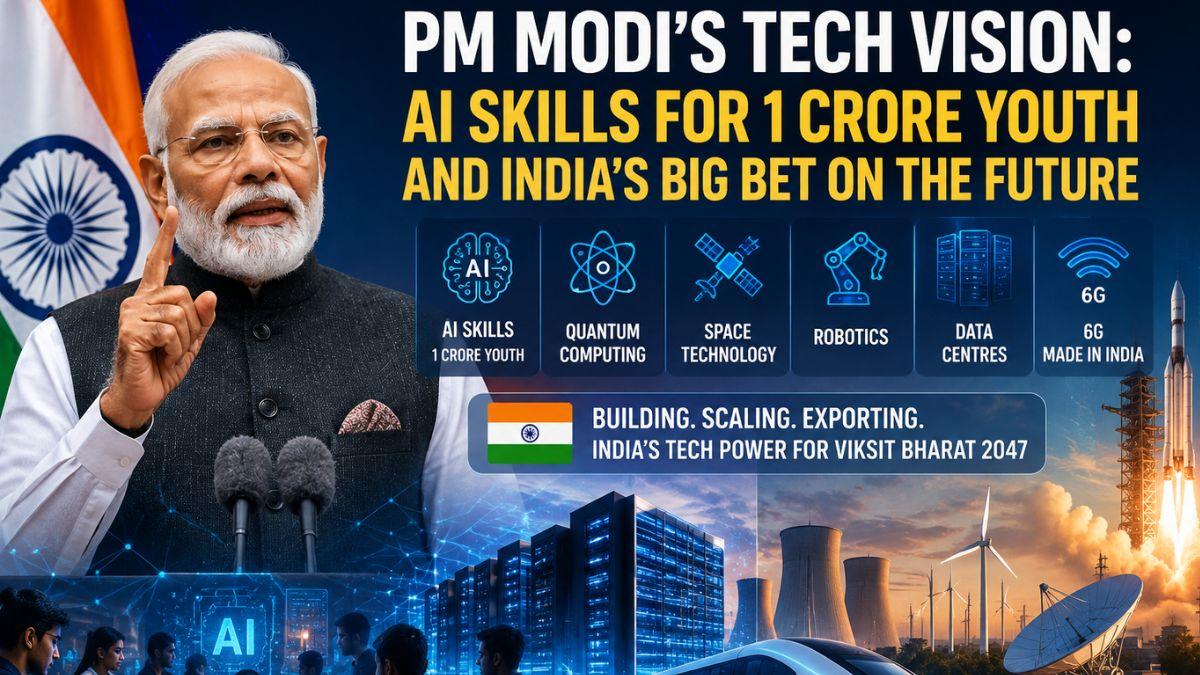
PM Modi AI skill training 1 crore youth tech ambitions became a central theme of his 80th Independence Day address, alongside plans for AI, quantum computing, space, robotics, data centres, and homegrown 6G. The message was direct: India shouldn’t only consume technology built elsewhere. It wants to build, scale, and export it.
That’s a large promise. And it comes with some very real pressure points, including electricity supply, cybersecurity, advanced-chip capacity, and whether training can translate into actual jobs.
Key Points
- 1 crore youth in AI training: The government plans to train one crore young people in AI within a year, making skills development one of the biggest parts of the technology agenda.
- Skills must lead to jobs: Training programmes will have greater impact if they provide practical experience, industry projects, and clear routes into employment rather than focusing mainly on certificates.
- India wants to build, not just consume: The broader message is a push toward homegrown AI, robotics, quantum technology, space systems, 6G, and other advanced technologies.
- Viksit Bharat 2047 gets a technology layer: AI, quantum computing, space, robotics, and digital infrastructure are being positioned as important parts of India's long-term development strategy.
- 6G is a long-term infrastructure bet: India's 6G ambitions will depend on standards, spectrum, network investment, compatible devices, and real-world applications.
- Power could become a major bottleneck: Expanding AI and data-centre infrastructure will require dependable electricity, making the proposed 100 GW nuclear capacity target by 2047 particularly important.
- Cybersecurity is becoming national infrastructure: As India's digital economy expands, protecting banks, payment systems, data centres, communications, and other critical systems becomes increasingly important.
- Private space is gaining importance: The reference to Skyroot Aerospace highlights how private companies and younger engineering teams could contribute to India's space ambitions.
- Defence technology is part of the same strategy: Growing defence exports will require not only higher production but also reliable technology, support systems, and global competitiveness.
- Digital public infrastructure gives India a foundation: The experience built around systems such as UPI provides a starting point for developing larger technology platforms and services.
- The global competition is getting tougher: India is competing for talent, chips, computing power, energy, investment, and technology leadership with major economies around the world.
- Execution will matter more than announcements: The biggest question is whether India's plans can translate into skilled workers, successful companies, useful products, stronger infrastructure, and technology that can compete globally.
PM Modi AI Skill Training 1 Crore Youth Tech Ambitions Put Skills First
The PM Modi Independence Day speech AI skilling 1 crore youth announcement commits the government to provide AI training to one crore young people within a year. It is an ambitious timeline, especially when AI literacy can mean anything from basic tool use to advanced model development.
For students, workers, and founders, the value will depend on what the programme teaches. Practical skills matter more than certificates. Data analysis, responsible AI use, coding, prompt design, model evaluation, and sector-specific applications could all make the difference.
The Government launches large scale AI skilling drive for Indian youth to lead global AI era, but the next question is unavoidable: where will those trained people work? India’s evolving AI job outlook suggests the opportunity is real, though roles will change quickly.
PM Modi AI Skill Training 1 Crore Youth Tech Ambitions and Viksit Bharat 2047
The PM Modi Viksit Bharat 2047 Sapta Dhara technology framework places innovation among the seven forces intended to support India’s developed-nation goal. AI, quantum technology, space systems, robotics, and data centres were presented as areas where India must compete globally.
That explains why India aims to become global innovation hub in AI quantum space and robotics rather than merely a large consumer market. The push also connects with the country’s India-Japan AI partnership, where technology cooperation increasingly overlaps with economic security.
PM Modi calls on Indian tech companies to build globally recognized homegrown brands. It’s a fair challenge. Scale alone isn’t enough if the most recognisable platforms, chips, models, and products are still built elsewhere.
Digital public technology, 6G, and the next infrastructure layer
India’s UPI and digital public infrastructure experience has given the country a credible starting point. Now, the India 6G roll out digital public infrastructure goals point toward a bigger role for open digital systems and next-generation connectivity.
Made in India 6G and digital public infrastructure push announced on Independence Day could affect everything from remote health services to industrial automation. But 6G is not a near-term consumer upgrade. Standards, devices, spectrum, network investment, and viable use cases all have to mature first.
India’s digital economy expansion will also be judged by whether the systems remain accessible. The global conversation around an AI accessibility agenda is relevant here. Technology that works only for well-connected urban users misses the point.
Nuclear power could decide how far AI and data centres can scale
Chips, AI workloads, and data centres consume serious amounts of electricity. PM Modi targets 100 GW nuclear energy capacity to power AI and data centers by 2047, while five reactors are expected to be commissioned this decade.
The India 100 GW nuclear energy target data centers AI plan is about more than clean power. It is about reliable baseload energy. Data centres cannot run on good intentions, and intermittent electricity is a genuine operational problem.
India semiconductor nuclear power expansion tech hub ambitions will need long-term policy consistency, faster project execution, and local supply chains. That’s the less glamorous bit. It’s also the bit that determines whether the headlines hold up.
Cybersecurity and defence are part of the technology story
Mission Sudarshan Chakra accelerated to protect critical digital infrastructure and banks reflects a changing view of national security. Modern attacks can target refineries, payment systems, hospitals, data centres, and communication networks.
Mission Sudarshan Chakra cybersecurity defense infrastructure efforts could create opportunities for skilled young professionals, but protection needs more than talent. It requires testing, incident response, secure procurement, public-private coordination, and clear accountability when systems fail.
India defense exports increase nearly 50 fold amid focus on modern technology, according to the address. That growth is significant, although export momentum must be supported by dependable production, support services, and technology that performs outside demonstrations.
Private space shows what young engineering teams can do
PM Modi highlights Skyroot Aerospace Vikram 1 milestone in private space innovation as an example of Indian ambition moving beyond government-led missions. Skyroot Aerospace Vikram 1 private rocket launch PM Modi references underscore the role private firms can play in launch services, satellite deployment, and commercial space infrastructure.
The broader lesson is simple. Younger teams can move fast when regulation, capital, testing facilities, and customers are available.
That logic also applies to AI entrepreneurship, Indian fintech AI growth, and physical AI solutions. India’s tech ambitions will be measured in products people use, not speeches they remember.
Why the global context matters
India global innovation hub emerging technologies 2026 ambitions are unfolding in a competitive environment. Countries are racing to secure chips, computing capacity, energy, skilled workers, and trusted AI systems.
India’s global AI governance role will matter alongside domestic innovation. So will its ability to sustain AI sector growth without losing sight of a people-centered digital future.
PM Modi address 80th Independence Day tech announcements offered a broad national direction. The hard work starts after the applause: training people well, keeping systems secure, powering infrastructure, and helping Indian companies compete globally.
From ambition to execution
PM Modi AI skill training 1 crore youth tech ambitions offer a connected vision: skilled people, digital infrastructure, secure systems, dependable power, and companies capable of competing across borders.
The PM Modi AI skilling initiative for one crore youth could become the most visible part of that agenda because it touches millions of careers directly. But skills need real projects, employers, and pathways into higher-value work. If those pieces move together, India’s technology push may have the depth to match its scale.
GlobalByte Perspective
PM Modi’s Independence Day technology push is ambitious, but the most important part of the announcement isn't any single number. It is the attempt to connect skills, infrastructure, energy, security, and technology manufacturing into one larger strategy.
Training 1 crore young people in AI within a year is easily the headline that will attract attention. But the real test will come after the training. If young people leave these programmes with certificates but without practical experience, projects, or access to employers, the scale of the initiative won't mean much. India needs people who can actually build products, work with data, deploy AI systems, and use these technologies inside real businesses.
The same principle applies to India's broader ambitions in quantum computing, robotics, space, 6G, and semiconductors. These sectors need more than skilled workers. They require reliable electricity, computing infrastructure, capital, research facilities, manufacturing capacity, and a regulatory environment that allows companies to move quickly.
The 100 GW nuclear power target is particularly interesting in that context. AI models and large data centres require enormous amounts of electricity, and India's technology ambitions will eventually run into an infrastructure question: where will all that power come from? Building reliable energy capacity could become just as important as building AI models.
Cybersecurity is another area that deserves more attention. As India's digital infrastructure grows, the consequences of attacks on payment systems, banks, government networks, data centres, and other critical infrastructure become much larger. A technology-first economy needs security built into the system rather than added after something goes wrong.
From GlobalByte News' perspective, India's biggest opportunity is not simply to become one of the world's largest technology markets. It is to build companies, platforms, infrastructure, and intellectual property that can compete outside India as well.
That is where the government's ambitions will ultimately be measured. A million more AI users is useful. A million skilled workers who go on to build products, start companies, and create high-value jobs would be far more significant.
India has the scale to make this work. The difficult part will be turning that scale into execution, productivity, and globally competitive technology.