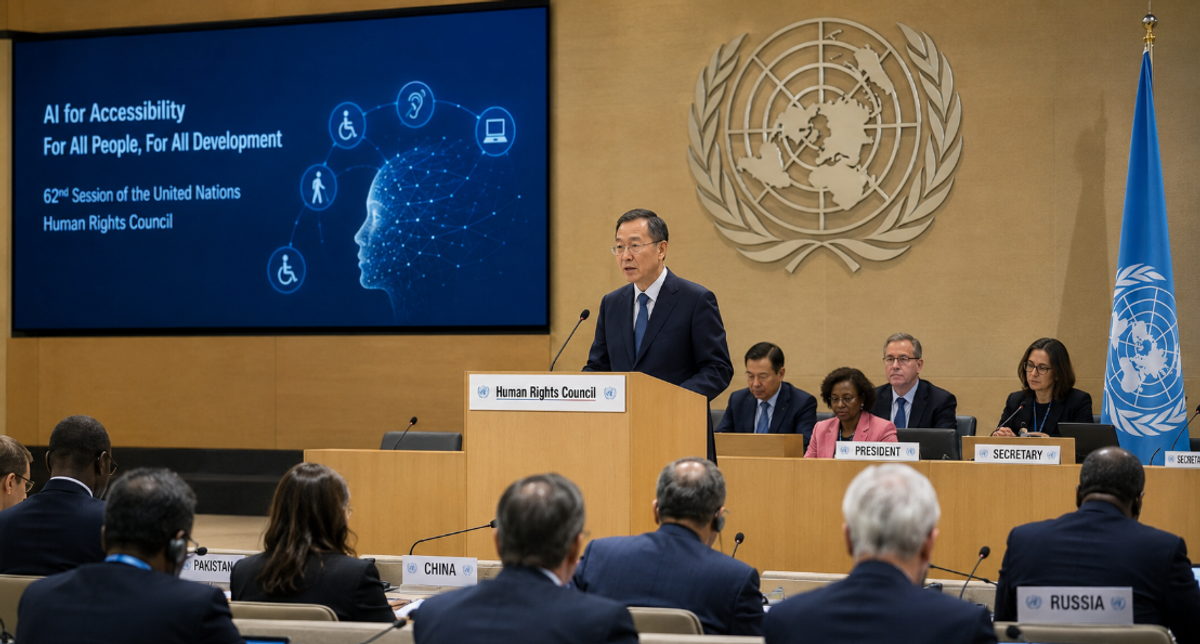
Something significant happened in Geneva on July 3, 2026, and it didn't get nearly the attention it deserved. The China joint statement on AI accessibility at the UN - delivered during the 62nd session of the United Nations Human Rights Council - outlined a four-point framework backed by 65 countries. That's not a fringe position. That's a substantial bloc of the international community pushing a specific vision for how AI should serve human rights.
So what did they actually propose? And why does the number 65 matter here?
Who Spoke and on Whose Behalf
Ambassador Jia Guide, China's permanent representative to the UN Office at Geneva, delivered the joint statement during the biennial panel on technical cooperation at the UNHRC 62nd session. He spoke on behalf of 65 nations, including Russia, Indonesia, Pakistan, Venezuela, Sudan, Cambodia, and dozens of developing countries that later echoed the position in their own national remarks.
The diversity of that coalition is the first thing worth noting. This wasn't China speaking alone in a room. It was a coordinated multilateral statement, and the breadth of signatories reflects something real: a shared concern that AI's benefits aren't being distributed evenly. Not even close.
The statement zeroed in on a persistent gap. Persons with disabilities, older persons, and people in vulnerable situations still face major barriers to digital access. AI, the document argued, could be one of the most powerful instruments for tearing those barriers down - but only if deployment is intentional and equitable.
The Four Proposals from China's Joint Statement on AI Accessibility at the UN
Here's what the document actually called for.
A development-oriented approach. The first proposal asks governments to treat accessibility not as a compliance checkbox, but as an active driver of growth. Using AI to expand access for vulnerable populations isn't charity - it's policy. This aligns closely with broader China AI ambitions that position technology as a lever for both economic and social progress rather than a narrowly national competitive tool.
AI for good and for all. This is arguably the most loaded of the four proposals. It insists AI must be people-centered - built around actual human needs, not profit motives. The Artificial Intelligence for good and for all framework has circulated in UN policy discussions for years, but this statement formally anchors a 65-country coalition to it, giving it renewed multilateral weight.
Fairness and impartiality. Third comes a direct critique of how AI has developed so far. Most accessibility tools were built in English, trained on Western datasets, and optimized for high-income users. That's a structural imbalance, and the statement names it explicitly. You can see this same tension playing out in the open-source AI rise, where non-Western developers are increasingly building tools designed from the ground up for their own populations rather than adapting products built elsewhere.
Universal benefits and bridging divides. The fourth proposal ties everything together. It calls for bridging the digital divide and development imbalances by actively promoting exchanges of good practices at regional and international levels. The point isn't just to develop best practices somewhere - it's to share them, particularly with nations that can't afford to develop them independently.
Why 65 Nations Behind This Statement Is Hard to Ignore
Sixty-five countries is not a small number.
And the composition matters as much as the count. You've got major powers alongside small developing nations. What holds this group together isn't geography or a simple ideological alignment - it's a shared frustration with who AI is currently being built for. Shifts in digital economy innovations and restructuring driven by semiconductor supply chain shifts are accelerating change in ways that structurally disadvantage countries without domestic tech capacity.
The joint statement is, at its core, a demand: stop and ask who AI is actually being built for.
That framing also shows up in broader diplomatic conversations, including discussions around China-UK economic cooperation where technology governance and trade policy increasingly overlap. Emerging tech policy is no longer a separate lane from geopolitics - they're running together, whether policymakers acknowledge it or not.
What This Means for Developing Countries
For developing nations, a statement with this level of backing creates real political leverage. It signals that a significant portion of UN membership considers the current AI development trajectory - skewed heavily toward wealthy markets - a problem the international community should address through inclusive global artificial intelligence governance structures.
Countries associating themselves with the China joint statement on AI accessibility at the UN are essentially demanding a seat at the table when AI standards get set. They want those standards to reflect their populations. That pressure is building across multiple forums simultaneously.
Breakthroughs in Chinese chipmaking advances tell part of this story. The broader global AI governance debate unfolding across multiple UN bodies tells the rest. The Geneva statement is one pressure point in a much larger conversation about who controls AI and who actually benefits from it.
A Political Signal Worth Watching
On the surface, July 3 in Geneva looked like routine UN diplomacy. A statement, some coordinated national remarks, a few countries associating themselves by name. Standard procedure.
But underneath that process, something more consequential was happening. Sixty-five nations formally aligned around a people-centered, equity-focused vision for AI governance - one that directly names structural imbalances in how AI tools are built and deployed, and demands corrective action. The United Nations Human Rights Council AI resolution framework gives this institutional backing that's hard to dismiss.
Will the China joint statement on AI accessibility at the UN translate into concrete policy change? Honestly, that's slow going. These processes move at a pace that frustrates everyone involved. But the political signal is unambiguous: a large, diverse coalition of developing and non-Western countries is refusing to let AI governance be decided without them.
That's worth paying attention to.