Summary
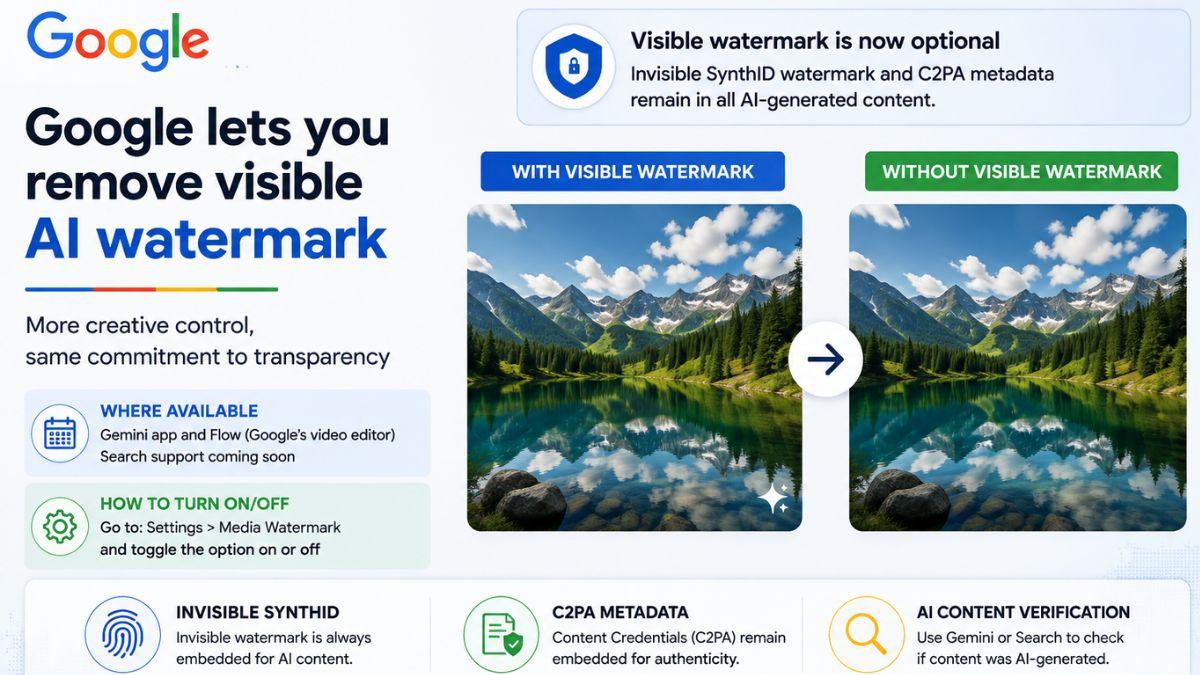
Google will let you remove the visible watermark from AI-generated images, video, and music created with select Gemini models. The Google remove visible watermark AI generations Gemini update gives creators cleaner exports, while invisible provenance markers remain in place.
That distinction matters.
A sparkle in the corner can make a polished campaign visual look unfinished. But removing it does not turn AI-made media into untraceable media. Google says SynthID and C2PA metadata will still identify eligible content as AI-generated.
Key Points
- Visible Gemini watermarks are becoming optional: Users will be able to remove the visible mark from supported AI-generated images, videos, and music.
- SynthID remains in place: Turning off the visible watermark does not remove Google's invisible AI-content identification system.
- C2PA metadata also remains: Supported media can still carry provenance information that compatible tools can inspect.
- The change covers major Gemini models: The setting applies to outputs from Nano Banana, Omni, and Lyria, according to the article.
- Gemini and Flow get the setting first: Users can manage the visible watermark through Settings > Media Watermark, with Search support expected later.
- Credentio is an important part of the update: Google's open-source C++ library is designed to let developers validate C2PA credentials locally instead of sending media to a remote server.
- Creators get cleaner exports: Removing the visible mark could make AI-generated assets more practical for advertising, presentations, design work, and other professional uses.
- AI provenance isn't disappearing: The key difference is between removing the visible label and removing the underlying verification signals.
- Regional rules still matter: Google says the option won't be available in locations where visible AI watermarks are legally required.
- Google and Anthropic are taking different approaches: Google is giving users more control over visible labeling, while Anthropic has taken a stricter approach to watermarking AI-generated text and files.
- The real challenge is verification: Invisible provenance only becomes useful at scale if platforms, publishers, and software can consistently detect and interpret it.
- The bigger takeaway: AI labeling is moving away from a simple visible badge toward a combination of metadata, invisible markers, and technical verification.
Google remove visible watermark AI generations Gemini: the new setting
The rollout introduces a Media Watermark control in Gemini and Flow, Google's video-editing tool. Once it reaches your account, you can go to Settings > Media Watermark and choose whether new media includes the visible mark.
The change applies to generations from Nano Banana, Omni, and Lyria. That means it covers images, videos, and songs, depending on the model and product you use.
Google allows users to remove visible watermarks from AI generated images and videos because visible labels can interfere with client-ready work, presentations, mockups, and social assets. Honestly, many people were already cropping the mark out anyway.
Google Search support is expected later. The company says the option will not be available in regions where a visible watermark is legally required.
What stays after you turn off the visible mark?
This is not a full removal of AI provenance.
Google SynthID invisible watermark C2PA metadata remain attached to supported media even when the visible indicator is disabled. SynthID embeds signals designed to survive many common edits, while C2PA Content Credentials carry provenance information that compatible tools can inspect.
So, does removing the visible watermark in Google Gemini delete SynthID? No. The visible layer and invisible verification systems are separate.
That approach feeds into the larger conversation around AI image accountability. Creators get more control over presentation, while viewers and platforms still have ways to assess where media came from.
How to remove visible AI watermark Google Gemini outputs
If the feature has rolled out to you, the process should be straightforward:
- Open Gemini or Flow.
- Go to Settings.
- Select Media Watermark.
- Turn the visible watermark setting off.
- Generate or export new content.
Existing files will not necessarily change retroactively. The setting affects future generations.
The Google Gemini turn off visible watermark AI images option is useful for professional exports, but you should still label work responsibly when your audience could mistake it for real photography, footage, or human-created audio. That isn't just good practice. It connects with evolving AI accessibility standards and public expectations around clear, usable information.
Why Google is making visible watermarks optional
Visible marks are blunt instruments. They signal that content came from AI, but they can also ruin the composition of an image or interrupt a video frame. For designers, agencies, and musicians, that limitation gets old fast.
Google's answer is a middle path: keep the machine-readable signals, make the obvious on-screen mark optional.
This is why Google is making visible watermarks optional for AI creators and professionals. You can produce cleaner media without losing the technical trail that supports verification. The policy also reflects wider global AI rules, where transparency requirements are becoming more specific and more varied by region.
There is a real flaw, though. Invisible labels only help if platforms, publishers, and viewers actually check them. A visible sparkle is harder to ignore.
Google Flow video editor remove watermark setting and Search support
The Google Flow video editor remove watermark setting will sit alongside Gemini's equivalent control. Google has said Search support is coming, which could make the setting available across another major AI-media surface.
Will Google Search allow removing visible watermarks from AI media? Google has indicated that support is planned, but availability may depend on local requirements and the pace of the product rollout.
That leaves a practical gap for now. If you use Search's AI tools, you may need to wait before the same choice appears there.
Meanwhile, the debate is not only about design preferences. AI safety concerns often focus on deceptive media, impersonation, and the speed at which convincing synthetic content spreads. A clean export is useful. A clean export used deceptively is something else entirely.
Credentio brings local C2PA validation to developers
Google also announced Credentio, an open-source library for validating C2PA Content Credentials locally on a device. In plain terms, developers can add media-authentication checks to their own apps without sending a user's files to a remote server.
The Google open source Credentio library AI verification effort could be especially useful for publishers, marketplaces, creative platforms, and moderation tools. It gives them a route to inspect supported provenance data closer to where the content is used.
What is Google’s new open-source Credentio validation library? It is a C++ library intended to validate C2PA credentials locally. That local-first design may help apps verify content while reducing the need to upload private media for inspection.
Google open sources Credentio library for local AI image authentication at a moment when generative AI adoption is moving beyond experimentation. Businesses need usable controls, not just policy statements.
Google vs Anthropic on AI labeling
Anthropic Claude AI watermark vs Google Gemini is becoming an interesting contrast. Google is making a visible mark optional while retaining invisible technical signals. Anthropic, according to the reported policy change, is taking a stricter route with watermarking for Claude-generated text and files to meet regulatory obligations.
Google vs Anthropic: Different approaches to AI content labeling and watermarking may lead to very different creator experiences. One prioritizes user control over visible presentation; the other leans harder into persistent labeling.
Neither model solves every problem. Labels can be stripped, metadata can be lost, and verification tools are not yet universal. Still, this work matters as open-source AI competition pushes more capable generation tools into more hands.
What this means for creators and businesses
You can now create professional-looking assets without a compulsory visible badge on each output. That is the practical win.
But keep your own disclosure standards. If an AI image appears in an editorial feature, commercial ad, customer support flow, or sensitive public communication, explain its origin where that context matters. AI generated content labeling transparency Google supports is only one piece of responsible publishing.
The update also arrives during rapid AI industry growth, where creators want flexibility and audiences want reassurance. Those goals can coexist, although the tools will need to keep improving.
Google remove visible watermark AI generations Gemini gives you more creative control without fully removing the evidence trail. Use the toggle when a clean file genuinely helps your work. Keep SynthID and C2PA in mind when you publish, verify, or share that work.
GlobalByte Perspective
Google’s decision to make visible AI watermarks optional is a sensible move, but it also creates a clear trade-off.
For creators, designers, agencies, and businesses, removing the visible sparkle makes Gemini-generated images, videos, and music much easier to use in polished work. A watermark can interfere with a campaign visual, presentation, product mockup, or social media asset. Giving users control over that visible mark makes the tool more practical.
The important part is that Google isn't removing AI provenance altogether. SynthID and C2PA metadata remain in supported content, giving platforms and verification tools a way to identify AI-generated media even when the visible watermark is gone.
From GlobalByte News’ perspective, that is probably the right direction. Visible labels are easy for people to see, but they are also easy to crop, edit, or remove. Technical provenance has a better chance of becoming a long-term standard if it works quietly in the background.
The bigger question is whether the ecosystem will actually use it. Invisible markers are only useful when platforms, publishers, and other tools have reliable ways to read and verify them. Google's decision to open-source Credentio could help push that process forward by giving developers a local way to validate C2PA credentials.
There is also an important distinction between cleaner AI content and undisclosed AI content. Removing a visible watermark should give creators more control over presentation, but it doesn't remove the responsibility to disclose AI use when that information matters to an audience.
In our view, Google is moving toward a more practical model: less visual clutter for creators, while keeping a technical trail for verification. Whether that balance works will depend less on the watermark itself and more on how widely SynthID, C2PA, and verification tools are adopted.