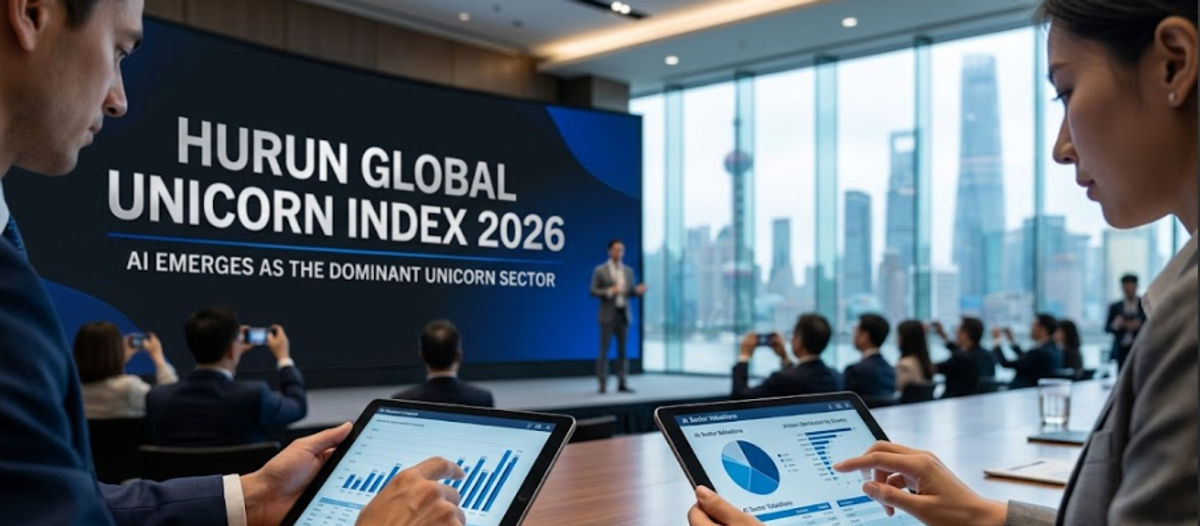
The Hurun Research Institute released the 2026 Hurun Global Unicorn Index on June 25, and the AI industry rankings inside it point to something more significant than a simple company count. This year's list reached a record 1,603 privately held companies - all founded after 2000, all valued above $1 billion. The US leads with 806. China holds second place with 381. And inside China's tally, two companies from Ningbo earned their spots on the list.
If you've been watching how Chinese AI companies are reshaping global competition, this annual ranking is one of the sharper data sets you can reference. The numbers don't editorialize. They just show you where the growth is landing.
Rong Semiconductor Corporation and Keyuan Petrochemicals: Ningbo's Entries Explained
Rong Semiconductor Corporation came in at 541st globally, with a valuation of 16 billion yuan - roughly $2.35 billion. That's a multi-year appearance, not a debut. Staying on the Hurun list is actually harder than getting on it. Companies get acquired, go public and graduate off the list, or simply stop growing fast enough to maintain their valuation bracket. The fact that Rong Semiconductor has appeared for several consecutive years means it's holding ground.
Keyuan Petrochemicals landed at 1,209th, valued at 7.5 billion yuan. Its second consecutive recognition confirms this isn't a fluke. Two years in a row puts it in a different category from first-time entries, which are easier to dismiss as one-off momentum.
These two companies represent something worth noting about Ningbo's industrial mix. Rong Semiconductor fits directly into the conversation around the automotive AI chip race - where Chinese semiconductor firms are gaining global relevance partly because of how contested that sector has become. Keyuan Petrochemicals, though, is petrochemicals. Completely different territory. And that difference matters, because it shows Ningbo's unicorn representation isn't just riding one trend.
That's a healthier sign than it might look at first glance.
How AI Took Over the Hurun Global Unicorn Index 2026 Rankings
Here's the number that defines this year's report. The Hurun Global Unicorn Index 2026 AI industry rankings show that artificial intelligence companies now account for more than one-third of the total combined valuation of all listed unicorns.
Not one-third of company count. One-third of value.
That's concentration, and it's significant. The AI industry startups generating those valuations span large language models, enterprise software, autonomous systems, and increasingly, hardware-integrated applications. For anyone following AI sector coverage beyond the obvious names, the trend runs deeper than software. Physical AI business solutions - AI embedded in manufacturing, logistics, and physical infrastructure - are building into a subcategory that conventional tech valuation reports tend to miss. The Hurun numbers hint at that shift.
So when people say AI is the dominant unicorn sector, they're not wrong. But they're underselling how dominant it actually is by valuation weight.
US vs. China: What the Distribution Actually Tells You
The gap is wide. 806 US unicorns to 381 Chinese ones - more than two to one. But the US vs China global unicorn company distribution statistics reveal something structural, not just numerical.
American unicorns spread across consumer tech, fintech, enterprise SaaS, healthcare, and more. Chinese unicorns cluster tightly: semiconductors, AI, life sciences, new energy. The China innovation blueprint outlined at Summer Davos made that alignment explicit - strategic emerging industries are the national priority, and the unicorn data matches that direction almost exactly.
Honestly, that alignment has trade-offs. Government-aligned sectors get preferential access to capital and regulatory protection. But they also carry policy risk that pure market-driven startups don't. If you're reading these numbers as organic startup growth alone, you're missing some context.
That said, the growth is real. The companies are real. And the trajectory is real enough that a record number of them qualified this year.
Ningbo's Position in a Broader Trend
Ningbo doesn't carry the tech-hub brand recognition of Beijing or Shenzhen. It's not the first city you'd name if someone asked you to describe China's startup geography. But its expanding unicorn count reflects something worth tracking.
In recent years, Ningbo companies in AI chips, medical devices, new-energy vehicles, and semiconductors have completed successful public listings - effectively graduating off the unicorn list by going public. Those exits clear space for the next generation of privately held tech companies valued over 1 billion dollars to emerge. The pipeline looks real from the outside, and the Hurun list backs that up.
The Xiongan startup funding story offers a useful parallel here. Cities that combine industrial infrastructure with available capital tend to produce genuine startup ecosystems over time - not just government-designated ones. Ningbo has that combination. And the pattern coming out of MWC Shanghai AI economy conversations reinforces the broader point: China's AI and semiconductor momentum isn't confined to first-tier cities anymore.
Ningbo keeps proving that.
What the 2026 Hurun Rankings Actually Mean
The Hurun Global Unicorn Index 2026 AI industry rankings are, at their core, a map of where private capital and high-growth businesses are concentrating globally right now. AI sits at the center. China holds second place, with its count clustered tightly around strategic sectors. And cities like Ningbo - industrial, serious, not particularly flashy - are quietly adding weight to the global unicorn rankings one consistent entry at a time.
Rong Semiconductor Corporation and Keyuan Petrochemicals won't make international headlines on their own. But their presence on the list - consecutive, growing in context, representing different industries within one city - signals something real about whether the Ningbo high-tech innovative startup ecosystem has legs beyond press releases.
It does.