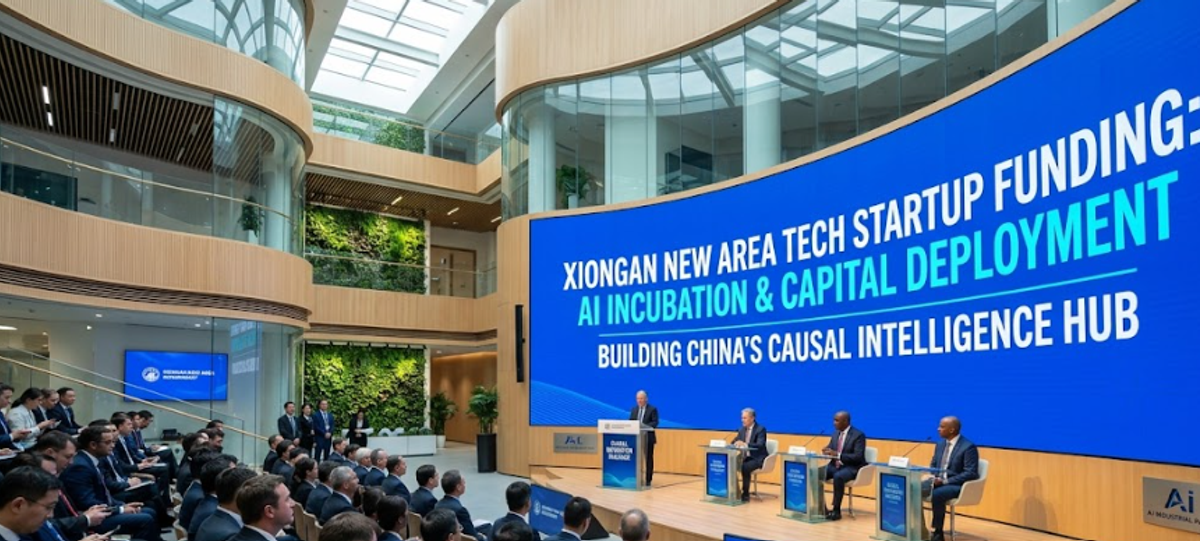
If you're an early-stage tech founder and you've spent time pitching investors with nothing but research results and a roadmap, you already know how that usually ends. Most investors want traction first. Xiongan New Area high-tech startup funding 2026 is working from a different premise - back companies before the market has made up its mind, give them the environment to prove it out, and let the ecosystem do the rest.
That's not a slogan. Stable AI received a 20 million yuan investment at a 300 million yuan valuation when, in vice-president Yu Fei's own words, the company had "only preliminary theories and some research findings." No revenue. No customers. Just early-stage research and a credible thesis.
And that's just one company.
What Makes Xiongan New Area High Tech Startup Funding 2026 Different
Most government-backed tech zones offer tax breaks and reduced rent. Xiongan does those things - but the Xiongan Artificial Intelligence Industrial Park goes further. The park opened in June 2025 and has since attracted around 70 companies, with roughly 80 percent relocating from Beijing. That Beijing-to-Hebei migration isn't happening by accident.
Funding support ranges from 5 million to 100 million yuan for qualified enterprises. The range is intentional. It covers seed-stage companies with early prototypes at the low end, and more mature firms looking to scale at the top. Regular matchmaking events connect startups with investment institutions and financing partners. Competition winners receive a two-year rent exemption for office space, which for a founder burning through runway in year one can be genuinely decisive.
Park manager Cui Hang describes the setup as "precise matching" between enterprises and scenario providers - meaning companies looking to deploy AI get connected directly to businesses that need AI solutions. Supply and demand coordination inside a single compound.
This approach mirrors what's happening globally with AI supply chain integration trends - but here it's built deliberately from the ground up, with government backing and a clear industrial thesis behind every placement decision.
Stable AI, Huaqing Zhiyan, and How the Ecosystem Actually Works
Stable AI focuses on causal intelligence and large data models. Next door sits Huaqing Zhiyan Technology, which specializes in large language models. These two companies didn't end up as neighbors by chance. The park actively places complementary firms in proximity - different enough to avoid competing directly, close enough to collaborate on clients and shared projects.
"These companies are not simply neighbors," Yu Fei said. "They are potential partners and customers."
Huaqing Zhiyan's founder and chairman Li Qiang established the company's headquarters in Xiongan in early 2025. He was honest about the tradeoff: many of Xiongan's industries are still forming. But he bet that long-term growth potential outweighed early friction. Within a single quarter - which, for a company building serious AI infrastructure, is genuinely fast - Huaqing Zhiyan completed talent recruitment, office allocation, and capital deployment in the new area.
The company's focus is on deep integration of AI large models with industrial scenarios: manufacturing, logistics, sector-specific deployments. Not software-as-a-service. Harder to build, longer to prove, but far more defensible once established. Xiongan's ecosystem and access to physical AI solutions for business environments give companies like this the industrial proximity they actually need to develop those partnerships.
Xiongan startup funding 2026 is part of a larger national story too. China's AI sector explosive growth has accelerated demand for purpose-built innovation hubs, and Xiongan is one of the most structured examples of this playbook operating in practice.
Talent Subsidies: The Monthly Numbers That Actually Matter
Here's where the Xiongan talent support program gets specific.
Doctoral degree holders receive 3,000 yuan per month for five consecutive years. Master's degree holders get 2,000 yuan per month. Bachelor's degree holders receive 1,000 yuan per month.
Zhang Zequn knows what those numbers mean day-to-day. He's 27, a doctoral student, and leads R&D at AnYing Technology - the company behind what it describes as the world's first portable non-invasive cerebral hemorrhage detection analyzer. When he says the monthly subsidy "is enough to pay for housing and food, with money left over," he's not rounding up.
An 80-square-meter apartment in Xiongan runs between 1,600 and 1,700 yuan per month. The doctoral subsidy alone is 3,000 yuan. That math works - which, compared to Beijing's rental market, is almost startling.
AnYing's work sits at the intersection of hardware and medical diagnostics. That's exactly the kind of emerging science and technology that needs patient capital and low overhead to develop properly. You can't rush hardware development by burning money faster. You need time, and Xiongan's cost structure buys that time in a way that most cities simply don't.
The Xiongan talent support program bachelor and master degree stipends extend well below the doctoral level too, meaning startups can hire across the full technical spectrum without the salary premiums that Beijing's cost of living demands.
The 15-Minute Living Circle and Why Founders Keep Mentioning It
Zhang's daily commute: just over one kilometer on foot. Parks lining both sides of the road.
The 15-minute living circle is an urban planning concept built into Xiongan from the start. Groceries, pharmacies, green space, restaurants, transit - all within a short walk or bike ride. It sounds like a lifestyle detail. But for founders trying to attract junior researchers and engineers who genuinely can work anywhere, quality of life is a retention argument.
Clean air, walkable neighborhoods, affordable housing - Xiongan has invested in all of these deliberately. And as universities expand campuses into the area, the talent pipeline grows with the infrastructure. This connects directly to China's 2026 innovation blueprint, which has explicitly tied talent attraction to livability, not just compensation packages.
For AI enterprise migration from Beijing to Xiongan, Cui Hang now includes quality-of-life as a standard part of the pitch to prospective tenants. That wasn't always the case in earlier government-backed tech zones.
What Xiongan New Area High Tech Startup Funding 2026 Doesn't Fix
Worth being honest about the gaps.
The ecosystem is still forming. Li Qiang said it himself - Xiongan's industries are in early stages. If you need established enterprise clients on day one, you'll still be doing most of that outreach yourself. The matchmaking events help, but they don't replace a sales pipeline.
The two-year rent exemption isn't automatic. It goes to competition winners. Don't build your financial model around it unless you've actually applied, qualified, and won.
Government project access is real - Yu Fei described it as meaningful for testing and deploying technologies - but government timelines don't always run at startup speed. That mismatch is real and worth factoring in from the start.
For companies working on critical infrastructure security or regulated technology sectors, the policy environment in Xiongan is actually an advantage. You're building inside a system that's actively shaping the rules around global AI governance in 2026, not responding to them after the fact. That positioning matters for companies building long-term in regulated verticals.
If your company builds at the infrastructure level - large models, data services, industrial hardware - the fit here is strong. Consumer apps, less so.
The Bigger Picture
For founders and investors tracking the latest AI developments and evaluating where serious AI infrastructure investment is actually landing, Xiongan now belongs on that map. The combination of early-stage capital, government-backed projects, talent subsidies that cover real living costs, and a built-in ecosystem of complementary partners is rare anywhere in the world - and the numbers from the park's first year suggest it's working.
Whether you're considering a full AI enterprise migration from Beijing to Xiongan or just researching government-backed startup grants in China more broadly, the park's structure is worth understanding in detail. For founders building hardware, biomedical devices, or industrial AI, the overlap between Xiongan's ecosystem and sectors like clean energy startups and deep-tech ventures is growing quickly.
China's commitment to compute infrastructure runs parallel to this whole push. The development of the world's top supercomputer architecture signals that the hardware layer supporting Xiongan's AI ambitions isn't being left to chance.
Xiongan New Area high-tech startup funding 2026 isn't speculative at this point. At 70 companies and growing - with Stable AI, Huaqing Zhiyan Technology, and AnYing Technology already operating and expanding - it's a bet that's already paying out for the founders who moved first.