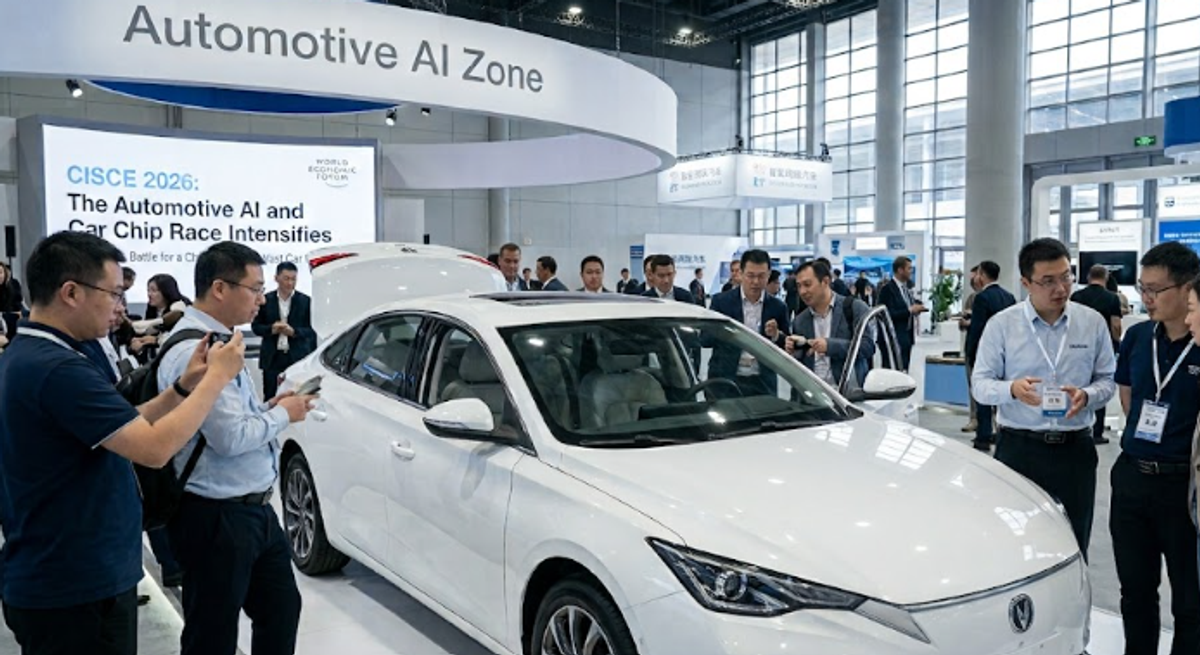
If you've been watching automotive tech, this week's China International Supply Chain Expo just gave you a lot to think about. The CISCE 2026 automotive AI and car chip race moved from background conversation to center stage. Intel, Qualcomm, and Nvidia all showed up in Beijing with real hardware, real partners, and real products - not concepts behind glass.
This wasn't a generic trade expo. For the first time, CISCE added a dedicated AI zone covering the complete pipeline: raw compute infrastructure, data layers, edge AI hardware, and live applications in connected vehicles. 676 companies from 85 countries attended. And US firms topped the foreign exhibitor list for the fourth consecutive year.
That combination is worth sitting with for a moment.
Intel's "Third Domain" - The AI Module That Doesn't Need a New Car
The most talked-about hardware at Intel's booth wasn't a chip in a display case. It was a regular-looking Chang'an Automobile, fitted with a compact AI computing module that most visitors almost walked past.
The Chang'an Auto AI computing module runs on Intel's Core Ultra processor and adds a layer - what Intel's team calls a "third domain" - sitting alongside the infotainment and autonomous driving systems your car already has. The Intel Core Ultra vehicle third domain packs around 100 TOPS of edge computing power. Real-time safety alerts, voice interaction, AI processing done locally. No cloud connection required. Which, if you regularly drive through areas with spotty coverage, matters more than it sounds.
The installation is two cables. Power and internet. Done. This plug-and-play automotive AI upgrade is specifically designed so older vehicles don't need replacement - they just need the module. Intel has already secured more than 130 edge AI design engagements as of mid-2026, which tells you this isn't just an expo demo destined for a shelf.
For anyone tracking physical AI solutions moving from prototype into deployed products in 2026, this is what that actually looks like in practice.
And here's some context that doesn't always make it into the automotive tech coverage: the hardware advances visible in recent supercomputer architecture breakthroughs are trickling down into vehicle-level chips faster than most observers expected. The 100 TOPS figure that sounds impressive today was a data center spec not long ago.
Qualcomm and Nvidia Brought Scale
Qualcomm didn't bring renders or slide decks. They rolled an ArcFox electric vehicle onto the floor - live, running - equipped with the Snapdragon Ride Flex SoC. The Qualcomm Snapdragon Ride Flex SoC in Chinese electric vehicles has been discussed in spec sheets for months. Seeing the Snapdragon Ride Flex SoC Arcfox pairing in an actual car on the expo floor changes the register of that conversation entirely.
Nvidia went even bigger. 39 live demos. Over 110 partners represented at a single booth. Nvidia's smart vehicle partnerships at CISCE 2026 aren't about locking in one automaker - they're about embedding into China's entire EV ecosystem simultaneously. If you want to understand where nvidia China smart vehicles are heading, that partner count tells you more than any press release.
This level of commitment from all three companies reflects the broader AI sector growth reshaping Chinese tech markets throughout 2026. It's not accidental timing.
The US-China Supply Chain Layer Nobody's Ignoring
You can't cover the CISCE 2026 cisce 2026 car chips story without addressing the geopolitical context. Yes, US-China semiconductor tensions exist. But what this expo shows is that commercial relationships haven't stopped moving - in either direction.
James Zimmerman, chair of the American Chamber of Commerce in China, put it plainly: "The Chinese and US economies are integrated and interdependent." He framed the expo's central theme - openness, connectivity, synergy - as a model for what US and China semiconductor supply chain connectivity in 2026 should look like going forward. That framing is intentional. It's aimed at buyers, suppliers, and investors trying to figure out whether supply chains hold.
The six zones at this year's CISCE cover digital technology, advanced manufacturing, smart vehicles, clean energy, and more. The fact that AI sits directly alongside clean energy isn't accidental - it reflects converging investment themes driving discussions around AI and green energy in global infrastructure right now.
This also ties into a larger policy picture. The push toward innovation-led economic resilience in China has directly influenced which sectors get prioritized at an expo this size - and automotive AI is clearly near the top of that list.
What This Means If You're Buying, Building, or Supplying
The CISCE 2026 automotive AI and car chip race has some concrete implications worth naming.
First: Intel's plug-and-play car AI upgrade model could reshape fleet economics significantly. If you manage a vehicle pool - logistics, delivery, ride-hailing - you don't have to wait for the next model year. The module retrofits existing vehicles. That's a faster ROI cycle than most fleet operators were expecting 12 months ago.
Second: the edge computing power 100 TOPS-class hardware on display here is quickly becoming a baseline, not a ceiling. Volume drives price. And the B2B automotive tech trends in 2026 all point toward rapid commoditization of features that were experimental just two years back.
Third: automotive AI solutions are no longer aspirational. They're shipping. Honestly, the same edge deployment logic that's reshaping AI in retail - local processing, reduced latency, no cloud dependency - is now being applied to vehicles at scale. The dedicated AI zone at the China International Supply Chain Expo made that shift unmistakably clear.
Whether you're sourcing components, evaluating automotive AI suppliers, or just tracking where next-gen intelligent driving chips go next - CISCE 2026 gave you a detailed preview. The competition for design wins in Chinese automakers' upcoming vehicle generations is already underway.
High-tech startup funding continues flowing into this space, which means more new entrants are coming. The big three won't be the only players worth watching. Keep an eye on emerging startups entering the automotive AI layer, follow the latest AI news as expo partnerships formalize into production contracts, and check the science and technology coverage from this event for the technical depth that press releases tend to leave out.
The next 18 months will tell you who actually won the car chip race at CISCE 2026.